Varroa mites: testing, thresholds, EPA-registered treatments and regional timing
Varroa mites in the US: how they kill colonies, the alcohol wash, HBHC thresholds, every EPA-registered treatment, amitraz resistance and timing by region.
Varroa mite treatment works when you do three things in order: test your colonies with an alcohol or soap wash, treat with an EPA-registered product as soon as the count reaches the action threshold (2 mites per 100 bees in summer and fall, 1 in spring and winter), and time the big treatment for late summer so the colony raises healthy winter bees. Varroa destructor is in virtually every US apiary, it carries the viruses that kill colonies, and it is the main reason US beekeepers lose so many hives. This guide follows the Honey Bee Health Coalition’s Tools for Varroa Management (ninth edition, June 2026), the EPA list of registered products and land-grant extension advice, with timing by region.
What are varroa mites and how do they reproduce?
From Asia to Wisconsin and Florida
Varroa destructor is a parasite of the Asian honey bee, Apis cerana. The USDA Bee Research Laboratory in Beltsville, Maryland, received the first report of the mite on the western honey bee, Apis mellifera, in 1962, in a sample from Hong Kong. It then spread, mostly through the movement of bees and queens, to every continent; Australia, long the exception, detected it in New South Wales in 2022. In the US it was first found in 1987, in Wisconsin and Florida, in colonies belonging to the same beekeeper, according to University of California Agriculture and Natural Resources. It spread across the mainland within a few years.
Hawaii is a partial exception. The Hawaii Department of Agriculture detected varroa on Oahu in April 2007 and on Hawaii Island in August 2008, and its surveys had not found it on Maui, Kauai or Molokai.
Biology at a glance
The University of Florida’s varroa profile (Ellis and Zettel Nalen) gives these figures:
- Adult female: oval, flat, reddish-brown to dark brown, about 1.0 to 1.77 mm long and 1.5 to 1.99 mm wide (about 1/16 inch): easy to see on a bee’s thorax or on a white board.
- Adult male: smaller and yellowish, found only inside brood cells.
- Lifespan: about 27 days when brood is present; in a broodless winter, the dispersal (phoretic) phase on adult bees can last five to six months.
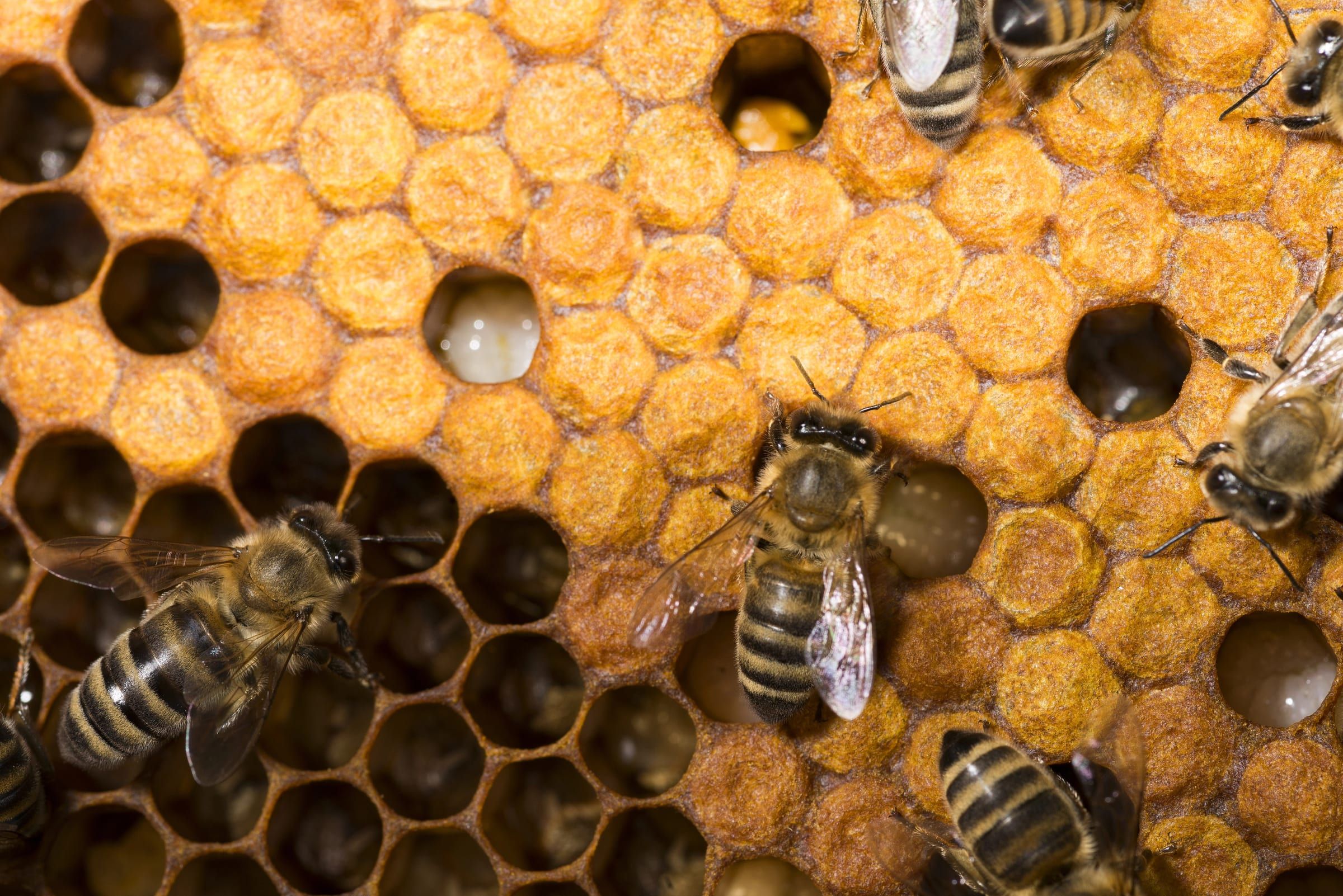
The female enters a larva’s cell just before it is capped. Her first egg, laid shortly after capping, is unfertilized and becomes a male; then she lays a fertilized egg roughly every 25 to 30 hours, each becoming a female. Each takes six to seven days to mature, and the young mites mate inside the cell before the bee emerges.
Why drones make the problem worse
Drone pupae stay capped longer than workers, so more daughters reach adulthood there. Allowing for mortality and failed mating, the University of Florida puts the average output at about one offspring per worker cell and two per drone cell. Mites also prefer drone brood. The Honey Bee Health Coalition notes that an uncontrolled mite population can double every month. Growth is faster when there is a lot of drone brood or when mites come in from collapsing colonies nearby.
Why do varroa mites kill colonies?
The feeding itself shortens a bee’s life, but the viruses the mite injects do most of the harm. Deformed wing virus is the best known: infected bees emerge with crumpled wings, cannot fly and die within days. The University of Florida profile notes that once the mite arrived in the US, it became clear colonies would not survive unless beekeepers intervened with chemical treatment.
The US loss numbers
The national survey run by Auburn University with the Apiary Inspectors of America recorded a record 55.6% annual loss in 2024-25, then 39.9% in 2025-26, from more than 2,300 beekeepers managing 219,000 colonies. In 2025-26, backyard beekeepers with fewer than 50 colonies lost more than operations with over 500, but the 2024-25 crash hit commercial beekeepers hard: in January 2025, the USDA Agricultural Research Service (ARS) reported that commercial beekeepers had lost more than 60% of their colonies since the previous summer, about 1.7 million colonies, an estimated $600 million. When the ARS Bee Research Laboratory analyzed samples taken in February 2025 in California and other western states before almond pollination, it found high levels of deformed wing virus A and B and acute bee paralysis virus, and signs of amitraz resistance in virtually all the varroa collected.
The late-summer timing trap
In late summer and early fall, the bee population is shrinking while the mite population peaks. That is exactly when the colony rears the fat, long-lived winter bees. The Honey Bee Health Coalition stresses treating early in this population-decrease phase, because a late treatment against high mite numbers may not protect the colony from viruses. Bees infected as pupae die young, and the cluster dwindles over the winter despite full frames of honey. Our page on the honey bee life cycle explains how winter bees differ from summer foragers.
Signs that mites are already out of control
Bees with deformed wings, a spotty brood pattern, sunken or chewed cappings, mites visible on adult bees without searching and a colony that crashes in September or October. By then, the threshold was passed weeks ago. Our guide to honey bee diseases helps separate parasitic mite syndrome from American foulbrood and other brood diseases.
How do you test for varroa mites?
The Honey Bee Health Coalition recommends a wash as the standard method. The University of Minnesota Bee Lab recommends testing monthly, and always before and after a treatment to see whether it worked.
The alcohol or soap wash
- Pick one to three frames of open brood from the brood nest, and confirm the queen is not on them.
- Shake the bees into a tub and scoop about 300 bees, roughly 1/2 cup.
- Put them in a jar with 70% isopropyl or ethyl alcohol, or with low-sudsing dish soap in water (the Minnesota Bee Lab uses 1 tablespoon of soap in 1/2 gallon of water).
- Swirl or shake for at least a minute (the Minnesota Bee Lab allows 30 seconds with soapy water), strain the bees out with a mesh, and count the mites. Repeat the swirl with fresh liquid to catch stragglers.
- Mites ÷ bees × 100 = percent infestation. With 300 bees, divide the mite count by 3.
The wash kills the sample, but 300 bees is a tiny fraction of a summer colony, and the Coalition rates it more reliable than the sugar shake.
The powdered sugar shake
Same 300 bees in a jar with a mesh lid, about 2 tablespoons of powdered sugar, shake for about a minute, wait 3 to 5 minutes, shake the mites onto a light plate, and repeat. The bees survive. The Coalition calls it more error-prone, and the Minnesota Bee Lab advises against it in humid weather or during a strong nectar flow.
Other methods: use only as a cross-check
The Coalition ranks sticky boards, carbon dioxide testers, ether rolls, drone brood inspection and visual checks as secondary. Sticky boards show trends but are a whole-colony measure that ants can raid, CO2 may undercount during a flow, and visual inspection is the least reliable of all.
What is the varroa threshold for treatment?
The Honey Bee Health Coalition’s 2026 thresholds, in mites per 100 adult bees:
| Colony phase | Typical timing | No immediate control needed | Treat promptly |
|---|---|---|---|
| Dormant | winter (shorter or absent in the Deep South) | under 1% | 1% or more |
| Population increase | spring buildup | under 1% | 1% or more |
| Peak population | summer flow | under 2% | 2% or more |
| Population decrease | late summer and fall | under 2% | 2% or more |
In a 300-bee wash, 1% is 3 mites and 2% is 6 mites. The Coalition says thresholds vary by region and suggests checking with your extension office or state apiarist. The University of Florida’s management calendar, for example, uses 3%. The Minnesota Bee Lab treats above 2% and considers below 1% the best odds for survival. Keep each count and treatment, with its EPA registration number, in our free hive treatment records.
Which varroa mite treatments are EPA-registered?
Any product that claims to kill mites is a pesticide under the Federal Insecticide, Fungicide, and Rodenticide Act (FIFRA) and must be registered by the EPA. The EPA’s list, last updated in September 2026, includes these active ingredients. The efficacy figures are those reported by the manufacturers and compiled by the Coalition, which has not checked them independently.
| Product | Active ingredient | Form | Temperature range | Supers on? | Reported efficacy |
|---|---|---|---|---|---|
| Apivar | amitraz | strips, 42 to 56 days | none | no; remove 2 weeks before supering | up to 95% |
| Apivar 2.0 | amitraz | strips, 6 to 10 weeks | none | super right after removal | not stated |
| Amiflex | amitraz | gel on wood strip | avoid when bees are not foraging | no | 56% with brood, 98 to 100% without |
| Apistan | tau-fluvalinate | strips | above 50°F (10°C) | no | 95 to 99% only without resistance |
| CheckMite+ | coumaphos | strips | none | no; wait 2 weeks | 85 to 99% only without resistance |
| Apiguard | thymol | gel trays, 2 doses 2 weeks apart | 60 to 105°F (15 to 40°C) | no | 74 to 95% |
| ApiLife Var | thymol, eucalyptus oil, menthol | tablets, 3 treatments of 7 to 10 days | 64 to 95°F (18 to 35°C) | no | 70 to 90% |
| Formic Pro | formic acid 42.25% | gel strips, 14 days or 10 + 10 | 50 to 85°F (10 to 29.5°C) | yes | 83 to 97% |
| Api-Bioxal, EZ-OX | oxalic acid dihydrate | dribble, vapor or spray | risky to open below 40°F (4°C) | yes | 82 to 99% without brood |
| Api-Bioxal RTU | oxalic acid | ready-to-use dribble, up to 4 times | none | yes | 70 to 99% |
| VarroxSan | oxalic acid dihydrate | slow-release strips, 42 to 56 days | none listed; best above 60°F (15°C) | yes | 92 to 98% |
| HopGuard 3 | hop beta acids | cardboard strips, 2 weeks, up to 4 times a year | 55 to 100°F (13 to 38°C) | yes | 75 to 95% |
| OrganiShield | sucrose octanoate esters | spray | 55°F (13°C) or above | no restriction | none reported |
| Norroa | vadescana (dsRNA) | in-hive pouch, twice a year at most, open brood needed | none | avoid | holds mites steady when under 3% |
Two recent additions stand out. Vadescana, sold as Norroa, is the first RNA-interference varroa product: a double-stranded RNA that silences a gene the mite needs. EPA proposed the registration in May 2025 and registered it in September 2025, finding it highly specific to its target gene in varroa and expecting no risks to bees when used as labeled. The label requires open brood in the colony at application. The Coalition presents it as a maintenance tool for colonies already under 3%, not a knockdown. EPA also lists an L-glutamic acid strip registered in 2025, which, according to the Coalition, was still looking for a route to market.
The EPA list also includes Mite Away Quick Strips, an older 46.7% formic acid strip: follow its own label. Thymovar and 65% liquid formic acid, which appear in the Coalition guide, are Canadian registrations, not US ones.
Prices
Most products are sold over the counter by bee supply companies. As a guide, Mann Lake listed a 12-pack of Apivar strips at $42.95 in fall 2026, enough for six colonies at 2 strips each.
What the law allows
EPA’s advisory on varroa products, published in January 2024, is clear on three points:
- The label is the law. Using a registered pesticide in a manner inconsistent with its labeling is unlawful under FIFRA.
- Homemade or unregistered products containing amitraz, oxalic acid, formic acid or thymol are not exempt as minimum-risk pesticides. FIFRA has no “own personal use” exception, although a hobbyist who keeps bees and eats the honey may fall under personal use. Selling honey, bees, nucs or pollination services takes you outside it, and so does treating someone else’s hives.
- Honey with residues not covered by a tolerance or exemption can be adulterated under the Federal Food, Drug, and Cosmetic Act. Oxalic acid, formic acid and thymol are exempt from tolerances for in-hive use, but homemade or unregistered products may contain other ingredients that are not, and selling honey with those residues is a violation.
States can be stricter than EPA. Some require state registration of pesticide products, so a product on the EPA list may not be legal in every state: ask your state pesticide regulatory agency.
How do you apply the main varroa treatments?
The label on the package overrides any guide, including this one. Wear chemical-resistant gloves, long sleeves and eye protection, treat every colony in the apiary at the same time, and never leave strips in longer than the label says.
Apivar (amitraz strips)
- 1 strip per 5 frames of bees, so 2 strips for a single deep with a full cluster and 4 for a strong double. Hang them in the brood nest or near the cluster, at least 2 frames apart.
- Leave in for 42 to 56 days, then remove. Do not treat more than twice a year, and never reuse strips.
- Remove 2 weeks before supering. Apivar 2.0 runs 6 to 10 weeks (10 when brood is present) and allows supering right after removal.
- Release is slow, so do not expect an immediate drop. Test after treatment to check for resistance.
Formic Pro (formic acid)
The only product that reaches mites under the cappings, and it can go on with honey supers.
- Option 1: two strips for 14 days. Option 2: one strip for 10 days, then a second strip for 10 days.
- Daytime temperatures 50 to 85°F (10 to 29.5°C). The cluster should cover at least 6 frames.
- Lay strips across the top bars of the brood box, keep the bottom entrance fully open and use a solid or closed screened bottom board. Do not remove the paper wrap.
- Expect bearding and a short brood interruption, and check that the colony is still queenright afterward. A heat wave in the first days increases queen loss.
Thymol (Apiguard, ApiLife Var)
Thymol evaporates, so it needs warmth: Apiguard from 60 to 105°F (15 to 40°C), ApiLife Var from 64 to 95°F (18 to 35°C). Apiguard is two 50 g trays two weeks apart, set on the top bars with a spacer rim. In the Northeast and Midwest this means August, not October. In the South and California, avoid the hottest weeks to prevent absconding and brood loss.
Oxalic acid: dribble and vapor
Oxalic acid only kills mites on adult bees, so it shines when the colony has no capped brood. From the Api-Bioxal label (June 2025), which the Coalition applies to EZ-OX as well:
- Dribble: 35 g (about 2.3 tablespoons) in 1 liter (about 1 quart) of 1:1 sugar syrup; 5 mL (about 1 teaspoon) per occupied space between frames in each brood box, maximum 1.7 fl oz (50 mL) per colony whether the bees are in a nuc or in single or multiple brood boxes.
- Vapor: 0.14 oz (4 g) per brood box with a vaporizer, following the vaporizer instructions. Vapor is dangerous to the applicator: the label requires a NIOSH-approved elastomeric half-mask respirator with acid gas cartridges and N, R or P filters, goggles or a face shield, chemical-resistant gloves and long sleeves. Stand upwind.
- Api-Bioxal RTU is premixed: 5 mL per occupied seam, which can be repeated up to 4 times, 7 to 10 days apart, when brood is present.
- VarroxSan releases oxalic acid slowly from strips over 42 to 56 days: up to 4 strips per brood chamber, roughly 1 per 2.5 frames of bees, folded over a frame in the cluster.
HopGuard 3 (hop beta acids)
One strip per 5 frames of bees, no more than 2 strips per brood chamber, for 2 weeks; up to 4 treatments a year, 55 to 100°F (13 to 38°C). The strips must be wet to work, kill some bees and brood where they touch, and are sticky to handle. Supers can stay on, but harvest honey only from supers, not treated brood boxes.
When to treat for varroa in your region
The US spans climates from Minnesota to Florida, so there is no single varroa calendar. Use these regional frameworks with your own wash results, and compare them with our beekeeping calendar.
Northeast and Upper Midwest
Colonies go broodless or nearly so for part of winter. The University of Minnesota Bee Lab plan, written for northern colonies:
- Spring: treat new packages with oxalic acid 5 to 7 days after installation, while they have no capped brood. Treat overwintered colonies with Formic Pro, or with VarroxSan or Norroa if counts are low, and finish before supers go on.
- Summer: if counts pass 2%, use Formic Pro with the supers on.
- Before mid-August: treat with Formic Pro, Apiguard or ApiLife Var to protect the winter bees, removing supers if the product requires it.
- Late fall: oxalic acid dribble or vapor when the colony is broodless and the bees are loosely clustered, around 40 to 50°F (4 to 10°C).
South and Southeast
In Florida and along the Gulf Coast, colonies often raise brood almost all year and may never give you a clean broodless window. The University of Florida calendar recommends monitoring in most months and considering treatment at 3%. Oxalic acid alone loses much of its power here: combine it with a brood break, such as caging the queen or making splits, or rely on formic acid, amitraz or VarroxSan, which cover a brood cycle. In the South, Africanized genetics are a further reason to requeen with known, gentle, mite-tolerant stock.
California and migratory operations
California’s almond bloom in February draws commercial colonies from across the country, trucked in from summer and fall locations in many states. The 2025 ARS findings came from samples taken right before that bloom. For migratory beekeepers, the late-summer and fall mite knockdown before colonies are trucked west is the treatment that decides winter survival, and amitraz resistance means that wash results after treatment matter more than ever.
Pacific Northwest and other mild, wet areas
Long, mild falls can keep brood going late and limit thymol, which needs warmth. Plan the main treatment in August, while temperatures still suit formic acid or thymol, and use the first cold, broodless spell for oxalic acid. Ask your state extension apiculturist for local timing.
Are varroa mites resistant to treatments?
The Coalition’s guide lists documented resistance to three synthetic families: tau-fluvalinate (Apistan), described as widespread; coumaphos (CheckMite+), widely reported; and amitraz (Apivar, Amiflex), now documented. No resistance is known for thymol, formic acid, oxalic acid or hop beta acids.
The amitraz result from ARS in 2025 is the warning sign. If your Apivar treatment no longer brings counts below 1% to 2%, stop relying on it. The Coalition recommends:
- Rotate active ingredients from season to season and within the year.
- Test before and after each treatment; a resistance test such as the Pettis test, done with a mite sample and the product, helps confirm doubts.
- Never leave strips in beyond label time; low leftover doses select for resistant mites.
A Penn State study published in the Journal of Insect Science (2024), based on more than 15 years of Pennsylvania beekeeper surveys, found that beekeepers who treated had significantly better winter survival than those who did not, and those who combined several types of treatment did better than those who relied on one. It found no significant difference between “soft” treatments (naturally derived) and “hard” ones (synthetic).
Non-chemical varroa control: brood breaks, drone trapping and resistant stock
Brood breaks and splits
Caging the queen, or splitting a colony so that one half raises a new queen, stops brood production. After about three weeks, every mite is on an adult bee, where one oxalic acid treatment can reach it. Our queen rearing guide covers raising the replacement queens that splits need.
Drone brood trapping
Put a drone comb or a foundationless frame in the brood nest in spring. Once the drone brood is capped, and before it emerges 24 days after the egg is laid, remove the frame and freeze it, then return it to the colony to clean out. The Coalition ranks drone brood as a poor sampling method, but as a trap it removes a share of the mites during buildup.
Mite-resistant stock
Two stocks evaluated by the USDA ARS laboratory in Baton Rouge are now sold by US queen breeders:
- Varroa Sensitive Hygiene (VSH) bees, bred at Baton Rouge, uncap and remove mite-infested pupae. VSH breeding material went to industry from 2001.
- Russian bees, from Russia’s Primorsky region, a stock with known varroa resistance.
In a three-year field test in Alabama (2004 to 2006) reported by Danka and Harris (2008), 12% of VSH colonies, 24% of Russian colonies and 40% of Italian colonies reached the varroa treatment threshold at some sampling, with no significant difference in honey yield. Resistant stock means treating less often, not never. Our page on honey bee breeds compares Italian, Carniolan, Russian and other stocks.
What do state laws say about varroa?
There is no federal registration of beehives, and no single US rule for varroa. Federal law governs the products (EPA, FIFRA) and the honey (FFDCA). Everything else is state law, enforced by your state department of agriculture and its state apiarist. A few examples show how much it varies:
- Pennsylvania: the 1994 Bee Law mandates apiary registration, for $10 covering about two years. State inspectors focus on American foulbrood but look for other threats.
- Texas: registration is voluntary for general beekeeping ($35, valid to August 31 each year, and required for bee removal), but bees brought in from another state need a health certificate and a Texas interstate permit, and sellers of queens, packages and nucs must supply a health certificate or an affidavit. Varroa is not on the Texas Apiary Inspection Service’s list of reportable pests.
- Hawaii: varroa is on Oahu and Hawaii Island, so moving bees or used equipment between islands requires prior inspection and certification by the Hawaii Department of Agriculture, and importing bees or used equipment without certification is prohibited.
Before you buy packages from another state, move hives for pollination or sell nucs, check your own state’s rules: our guide to beekeeping laws by state is a starting point.
Keep a simple log for every colony: test date and result, product, lot number, dates in and out, and follow-up result. It helps you meet label and state requirements, and after two seasons it shows when your apiary crosses the threshold and which rotation keeps it down.
Frequently asked questions
When should I treat my bees for varroa mites?
Treat whenever a mite wash shows 2 or more mites per 100 bees in summer and fall, or 1 or more in spring and winter, the action thresholds in the Honey Bee Health Coalition guide. The most important treatment is in late summer, before the colony raises its winter bees: the University of Minnesota Bee Lab advises treating before mid-August in the Upper Midwest. Test monthly, and in the South keep testing through winter.
How many mites per 100 bees is too many?
The Honey Bee Health Coalition's 2026 guide sets the action threshold at 1% during dormancy and spring buildup and 2% at peak population and during the fall decline. With a standard 300-bee alcohol wash, that is 3 mites or 6 mites. Some extension services, such as the University of Florida, use 3%, so check with your state apiarist or extension office.
Can I treat for varroa with honey supers on?
Only with products whose EPA label allows it. According to the Honey Bee Health Coalition guide, Formic Pro, HopGuard 3, VarroxSan, Api-Bioxal and EZ-OX may be used with supers on, while Apivar, Apistan, CheckMite+, Apiguard, Thymovar and ApiLife Var may not. Apivar must come out two weeks before supering. The label is the law, so read it before every application.
Is it legal to use oxalic acid from the hardware store?
Only registered oxalic acid products, such as Api-Bioxal or EZ-OX, are legal for use in hives. EPA's advisory on varroa products says it has no personal-use exception, although a hobbyist who keeps bees and eats the honey may fall under personal use. Selling honey, bees or pollination services takes you outside it, and honey with unregistered residues counts as adulterated. States may be stricter.
What is the best varroa mite treatment?
There is no single best one. The Honey Bee Health Coalition recommends rotating active ingredients: amitraz, formic acid, oxalic acid, thymol and hop beta acids work in different ways. Choose by season, temperature, whether supers are on and whether brood is present. Penn State researchers found that Pennsylvania beekeepers who used several treatment types had better winter survival than those who used one.
Are varroa mites resistant to Apivar?
Resistance to amitraz, the active ingredient in Apivar and Amiflex, is documented. In 2025 the USDA Agricultural Research Service found signs of amitraz resistance in virtually all varroa collected from commercial colonies that collapsed before almond pollination. Test your colonies before and two to three weeks after treatment, and switch to another mode of action if counts do not drop.
Do I need to register my hives because of varroa?
Varroa itself does not trigger registration, but state laws vary. Pennsylvania requires every apiary to be registered, for a $10 fee covering about two years, while Texas makes registration voluntary but requires health certificates to bring bees into the state. Hawaii restricts moving bees and used equipment between islands. Check your state department of agriculture or state apiarist.
Can a colony survive varroa without treatment?
Rarely, in the US. The University of Florida's varroa profile notes that after the mite arrived, colonies would not survive unless beekeepers treated them, and US losses hit a record 55.6% in 2024-25. Mite-resistant stocks such as VSH and Russian bees reduce how often you need to treat, but in USDA field tests some colonies of every stock still crossed the treatment threshold.
Sources
- Tools for Varroa Management, ninth edition (June 2026), Honey Bee Health Coalition
- EPA-registered pesticide products approved for use against varroa mites in bee hives (updated September 2026), US Environmental Protection Agency
- Advisory on the applicability of FIFRA and FFDCA for substances used to control varroa mites in beehives, US Environmental Protection Agency
- EPA proposes to register new pesticide for varroa mite control (vadescana, May 2025), US Environmental Protection Agency
- USDA researchers find viruses from miticide-resistant parasitic mites are cause of recent honey bee colony collapses (June 2025), USDA Agricultural Research Service
- Varroa destructor, USDA ARS Bee Research Laboratory, Beltsville
- Field comparison of VSH, Russian and Italian honey bees (Danka and Harris, American Bee Journal, January 2008), USDA ARS Honey Bee Breeding, Genetics and Physiology Laboratory
- U.S. beekeeping survey 2025-2026 results (June 2026), Auburn University
- Varroa, Varroa destructor Anderson and Trueman (Ellis and Zettel Nalen, EENY-473), University of Florida IFAS Extension
- Florida beekeeping management calendar (ENY-156), University of Florida IFAS Extension
- Varroa mite testing and management, University of Minnesota Bee Lab
- Combining pest treatments may be key to helping honey bees survive the winter (June 2024), Penn State Center for Pollinator Research
- Mighty mite (Kathy Keatley Garvey, 2008), University of California Agriculture and Natural Resources
- Apiary and pollinator services, Pennsylvania Department of Agriculture
- Regulations, Texas Apiary Inspection Service
- Frequently asked questions about varroa mite, Hawaii Department of Agriculture
- Compliance with beekeeping laws in Hawaii, University of Hawaii CTAHR
- Api-Bioxal label, EPA Reg. No. 73291-2 (accepted June 2025), US Environmental Protection Agency
- Norroa (vadescana) label, EPA Reg. No. 94614-4 (registered September 2025), US Environmental Protection Agency
- Apivar 12-pack (price), Mann Lake