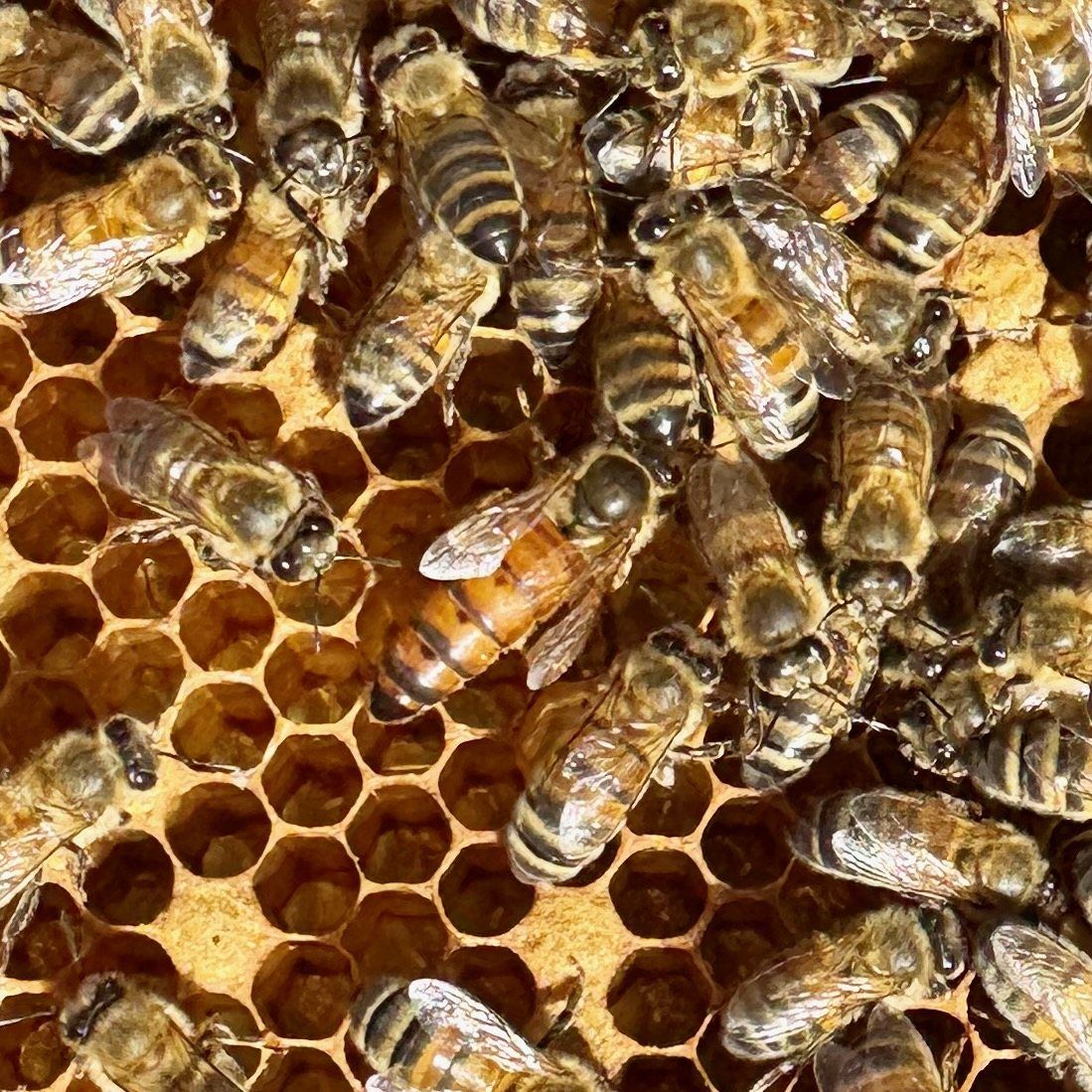
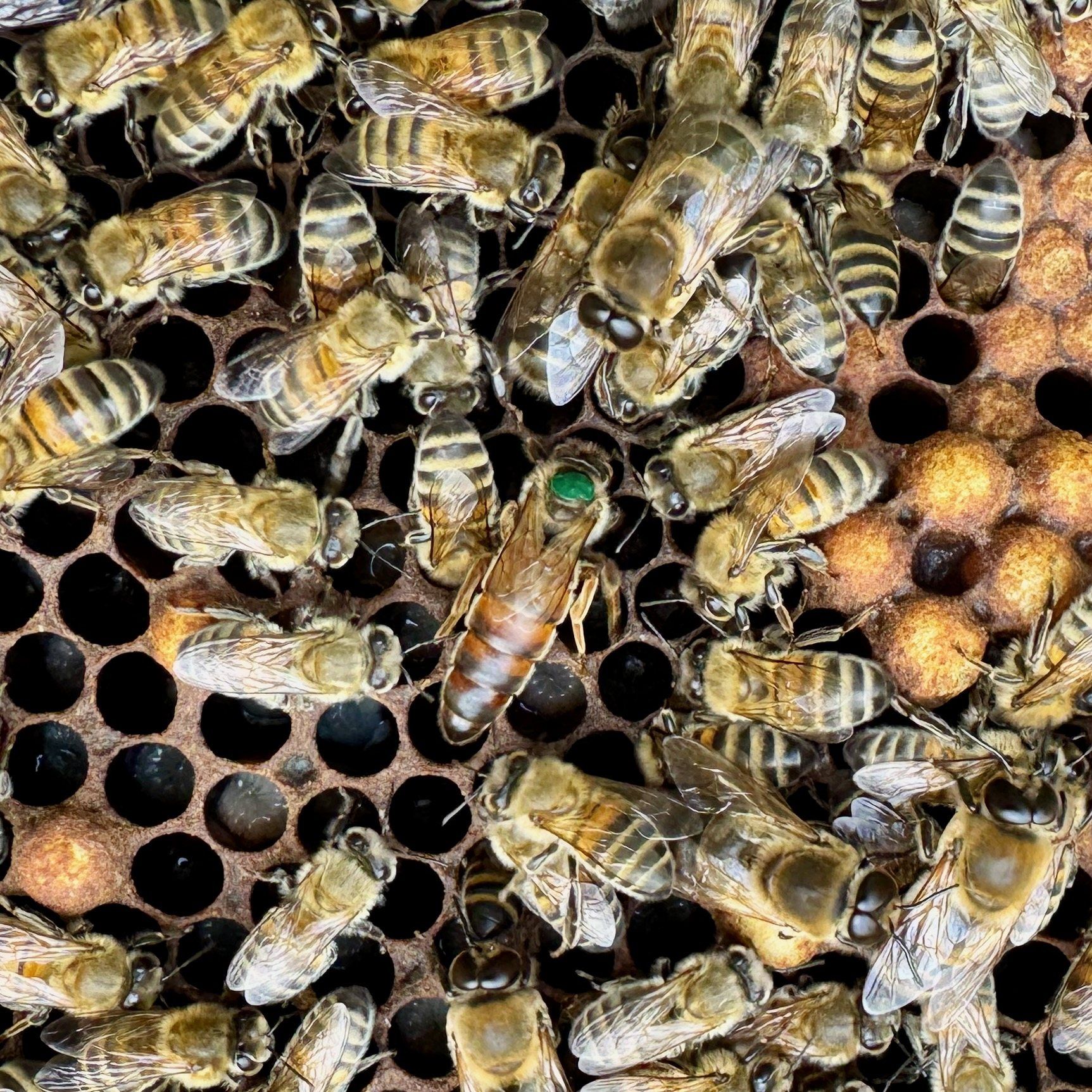
Honey bee life cycle: egg, larva, pupa, development days for queens, workers and drones, and how long bees live
The honey bee life cycle day by day: egg, larva, pupa, 16, 21 or 24 days by caste, summer and winter lifespans, and what it means in a Langstroth hive.
The honey bee life cycle runs through four stages: egg, larva, pupa and adult. A queen takes about 16 days from egg to adult, a worker 21 days and a drone 24 days. Once she emerges, a worker raised in summer lives roughly five to seven weeks, while a worker raised in fall can live for months and carry the colony through winter.
Those three numbers, 16, 21 and 24, are worth memorizing before your first inspection. They tell you how long a queenless hive needs to recover, when a split will start making bees again, why mite control in late summer matters more than in November, and why a colony with a full deep of honey can still collapse in February.
The four stages of the honey bee life cycle
Honey bees (Apis mellifera) go through complete metamorphosis, the same pattern as butterflies, beetles and flies. The larva is a white, legless grub with no eyes and one job: eating. The rebuild into a winged insect happens later, sealed away under a wax capping.
Egg (days 1 to 3)
The queen lays a single egg at the bottom of each cell, glued in place by one end. It is about 1/16 inch (1 to 1.5 mm) long, according to the University of Florida, white and slightly curved. Penn State’s Field Guide to Honey Bees and Their Maladies explains that a freshly laid egg stands straight up, then leans over the next three days until it lies flat on the cell bottom just before hatching. Tilt the frame so sunlight falls into the cells and you can read roughly how recently the queen walked across it.
Whatever the caste, the egg hatches in about three days. Utah State University Extension uses the same figure, and it is why “eggs seen” in your inspection notes means a laying queen was present within the last three days.
Larva (days 4 to about 9)
The larva hatches on day 4 into a film of food laid down by nurse bees. It grows fast, molting several times as it outgrows its skin, and soon curls into a fat white “C” filling the cell bottom. North Central SARE’s life cycle sheet notes that the larval period is a little shorter for queens and a little longer for drones than for workers.
When the larva fills its cell, workers seal it with a porous wax capping: around day 8 after the egg is laid for a queen, day 9 for a worker and day 10 for a drone, according to SARE. Utah State’s brood guide gives the same day 9 for worker cells. From then on it is capped brood, as opposed to open brood, meaning eggs and uncapped larvae.
Pupa (the capped stage)
Under the capping, the larva stretches out, spins a silk cocoon and becomes a prepupa, then a pupa. Larval tissues are largely broken down and rebuilt into head, compound eyes, antennae, mouthparts, six legs and four wings. Steroid hormones called ecdysteroids drive the molts, and a Brazilian team (Mello and colleagues, Frontiers in Genetics, 2014) notes that in honey bees their level in the hemolymph peaks during the pupal stage, while adult structures form.
The pupa begins pure white and darkens in a fixed order. Penn State’s field guide describes the eyes coloring first, from white to pink, then purple and finally brown, and only then the body. Researchers, including Mello’s group, use that sequence (white, pink, dark pink and brown eyes, then light, intermediate and dark body) to age pupae precisely. If you uncap a worker cell and see purple eyes, that bee is a few days from emerging.
Adult (emergence)
At the end of the capped stage, the adult chews around the capping and climbs out. She will not grow again: a bee is full size the day she emerges. Freshly emerged workers look gray, fuzzy and a bit wobbly, and they are easy to spot on a brood frame.
Development timeline for queens, workers and drones
Stage lengths are those of the University of Florida’s IFAS Extension (Mortensen, Schmehl and Ellis); capping days come from North Central SARE’s life cycle sheet. Capping days count from the day the egg was laid. The capped stage includes cocoon spinning and the prepupa.
| Caste | Egg | Larva | Capped on about | Capped stage | Egg to adult |
|---|---|---|---|---|---|
| Queen | 3 days | about 5.5 days | day 8 | about 8 days | 15 to 16 days |
| Worker | 3 days | about 6 days | day 9 | about 12 days | 21 days |
| Drone | 3 days | about 6.5 days | day 10 | about 14.5 days | 24 days |
Treat these as averages. Brood nest temperature, genetics and nutrition move them by a day or so. A queen sometimes emerges on day 15; drones can run past 24 days. Chilled brood slows down, which is one reason Utah State advises inspecting brood on calm days above 55°F (13°C).
Worker development day by day
Workers are most of the brood you will look at, so their schedule is the one to know:
- Days 1 to 3: egg, upright at first, lying flat by day 3.
- Day 4: the larva hatches into a pool of food.
- Days 4 to 6: rich nurse secretions first, then a diet that includes honey and pollen.
- Days 7 to 9: the larva fills the cell and is capped at about day 9.
- Days 10 to 12: cocoon, prepupa, molt to pupa.
- Days 12 to 20: pupa; eyes, then body, darken.
- Day 21: the adult chews out.
A deep frame of capped worker brood, then, is a frame of bees that will all emerge within about 12 days. A frame of eggs will not add a single adult for nearly three weeks.
Why the queen is fastest and the drone slowest
The queen emerges five days ahead of a worker despite being much larger. She is fed lavishly on royal jelly for her whole larval life. The drone has the longest development, mostly because of his roughly two-week capped stage. That long capped stage is exactly what varroa mites exploit.
What makes a larva a queen, a worker or a drone?
Fertilization sets the sex
The queen controls whether sperm stored in her spermatheca reaches each egg as she lays it. A fertilized egg becomes a female, worker or queen; an unfertilized egg becomes a male. She measures cell width with her front legs and lays unfertilized eggs in the wider drone cells. On a Langstroth frame you will find drone comb mostly along the bottom bars and corners, and in any gap the bees can fill with their own comb. Drone cappings are domed, like the end of a pencil eraser, while worker cappings are nearly flat.
Diet sets the caste
Whether a female larva becomes a queen or a worker depends on her cell and her food. A queen larva is raised in a large, vertical, peanut-shaped queen cell and fed royal jelly the whole way. A worker larva gets nurse secretions at first and then a diet that includes honey and pollen.
A University of Illinois study in Science Advances (2015) found that this is not just about quantity. p-Coumaric acid, present in pollen and honey but not in royal jelly, switches a large share of the genome, including genes tied to ovary development, and steers the larva toward becoming a worker.
That flexibility is how a colony replaces a lost queen. Workers convert a few cells holding very young female larvae into emergency queen cells and flood them with royal jelly. The larvae need to be young; older ones already on the worker track make poor queens. That is why the standard fix for a queenless hive with no eggs is a frame of eggs and young larvae from another colony. For the full division of roles, see our guide to the honey bee colony.
Brood temperature: why a few degrees change the adult
Brood only develops properly in a tight temperature band. The University of Florida’s extension guide to colony social organization puts the brood area at about 93°F (34°C). Jürgen Tautz’s team at the University of Würzburg found the air around brood combs always within about 91 to 97°F (33 to 36°C), though never at one constant value. Workers hold it there by clustering on the comb and shivering their flight muscles for heat, and by fanning and bringing in water to cool.
In a 2003 PNAS study, Tautz’s group raised pupae at 90, 94 and 97°F (32, 34.5 and 36°C), all temperatures found in natural hives. Almost all emerged (98 to 100%), but the adults differed. Bees raised at 90°F (32°C) performed only about 20% as many dance circuits as the others and disappeared from the colony sooner, while those raised at 97°F (36°C) scored best on tests of olfactory learning.
Heat is a growing issue in much of the country, not just cold. A 2023 paper in Frontiers in Ecology and Evolution notes that long exposure below about 90°F (32°C) raises the risk of deformed wings, legs and abdomens, and that pupal survival falls to zero at around 100°F (38°C). Bees in the Southwest and Central Valley spend summer days hauling water and fanning to keep the brood nest under that ceiling, so shade in the afternoon and a reliable water source within a short flight of the hive are part of brood care there.
For beekeepers in the Northeast and Upper Midwest, the same numbers argue for short inspections in April and for avoiding pulling brood frames out on a cold, windy day.
How long do honey bees live?
| Caste | Adult lifespan | Notes |
|---|---|---|
| Summer worker | about 5 to 7 weeks | worn out by brood rearing and foraging |
| Winter worker | months, sometimes past 280 days | raised from late summer into fall |
| Drone | about 20 to 40 days | dies at mating or is evicted in fall |
| Queen | several years | often 1 to 2 years in managed hives |
The summer worker figure is SARE’s, which gives about five to seven weeks in summer and up to five or six months in winter. The drone figure, for unmated drones, comes from Juliana Rangel and Adrian Fisher’s 2019 review in Apidologie. Brian Johnson’s 2010 review cites winter bees still foraging at more than 280 days old. SARE notes that a queen can live several years but often only one to two in managed hives, where beekeepers replace her once her laying falls off. Many commercial beekeepers requeen every year or two, partly because a young queen is less inclined to swarm and partly to keep defensive genetics in check.
Brood rearing is what wears summer bees out as much as flying. Producing brood food is physiologically expensive, and a colony with steady pollen coming in raises longer-lived young bees than one in a pollen dearth.
Worker jobs by age
A worker’s job changes as she ages, following the development of her glands. Biologists call it age polyethism. Johnson’s review lays out the main phases: a few days of maturing and cell cleaning, a nurse phase of about a week from roughly day 4 to day 12, and a “middle-aged” phase from about day 12 to day 21.
| Approximate age | Main task | What is happening in her body |
|---|---|---|
| 1 to 3 days | cleaning cells | too immature to fly or sting |
| about 4 to 12 days | nursing brood, tending the queen | brood food glands active |
| about 12 to 21 days | building comb, receiving nectar, fanning, guarding | wax glands active |
| from about 3 weeks | foraging for nectar, pollen, water and propolis | brood food glands shrink |
The schedule is flexible. Johnson shows that if a colony runs short of young bees, about 20% of foragers can regain the ability to feed brood, and if foragers are lost, younger bees start foraging early. Juvenile hormone speeds the move to foraging; vitellogenin, a storage protein abundant in nurses, holds it back. The two run in opposite directions, and Johnson presents their mutual suppression as a hypothesis rather than a settled mechanism. Foraging is the last and riskiest phase, usually lasting only a couple of weeks.
Winter bees and how the timing shifts by region
Bees raised from late summer into fall, as the queen’s laying slows and forage tapers off, are built differently from summer bees. Winter bees, often called fat bees, are a distinct physiological state, which Johnson characterizes as low juvenile hormone, an active fat body, high vitellogenin and stronger immunity: a nurse-like profile held for months.
These bees cluster around the queen, generate heat by shivering their flight muscles and burn stored honey. The 2023 Frontiers paper reports that at about 36°F (2.5°C) outside, the cluster core can stay above 95°F (35°C), warm enough for brood, while the outer mantle stays above about 63°F (17°C). In late winter these same bees restart brood rearing and feed the first spring generations, then die off.
When winter bees appear, and how sharply, depends on where you keep bees:
- Northeast and Upper Midwest: Cornell’s overwintering advice has colony populations peaking in July and bottoming out in December, with mite numbers rising in August as bee numbers start to decline and peaking between August and September, just as the long-lived winter bees are being reared. Cornell recommends at least 80 lb (36 kg) of honey for a two-deep colony going into winter and 50 lb (23 kg) for a nuc.
- Mid-Atlantic: MAAREC’s Basic Bee Biology for Beekeepers describes a temperate colony that starts raising drones in spring once food is reliable and stops before fall; most colonies eliminate their drones each fall, and adult drone numbers can fall very fast in September and October. Queenless colonies tend to hold on to their drones longer. MAAREC puts the average peak at about 60,000 adult bees in June.
- Florida and the Gulf Coast: the University of Florida’s management calendar has colony populations growing from March, swarm control from March to May and the main flow over by July. With short, mild winters, colonies in central and south Florida often keep some brood through the cool months, so the summer bee and winter bee distinction blurs, and that brood lets varroa keep breeding.
- California: colonies headed for almond pollination are fed and pushed to build in January and February so they are strong for bloom, which compresses the cycle months ahead of a natural schedule.
Why late summer decides the winter
A bee parasitized by varroa as a pupa does not build the reserves she needs to overwinter and dies early. This is where many US colony losses begin. The national survey led by Auburn University, with Oregon State University and the Apiary Inspectors of America, recorded a record 55.6% annual loss in 2024-25, then 39.9% in 2025-26; Auburn’s bee center points to parasites and poor forage. The Honey Bee Health Coalition calls varroa the most damaging honey bee pest and a major factor in colony losses worldwide. Its guide calls for prompt control at 1 mite per 100 bees during the dormant and population increase phases and at 2 per 100 at peak population and during the late summer and fall decline. If you treat after the winter bees have already been raised in a heavily infested colony, the damage is done. Our guide to varroa mites covers alcohol washes and EPA-registered treatments.
Queens and drones: maturity, mating and lifespan
From virgin queen to laying queen
A virgin queen emerges on about day 16, seeks out and kills rival queens, and makes orientation flights before her mating flights, which SARE puts a few days after emergence, typically within the first week. The University of Florida notes that all mating happens in the first two weeks of a queen’s life. She mates in flight with drones from other colonies.
Michael Simone-Finstrom and David Tarpy’s 2018 USDA-ARS study followed 80 queens: 65% started laying after a single successful mating flight, and the other 35% tried to fly again the next day. They mated with 8 to 25 drones, 13.5 on average. Rangel and Fisher cite an average of 12 to 14 drones, with some queens mating with more than 50. Citing earlier work, they note that a fully mated queen typically stores 5 to 7 million sperm, enough for life; she never mates again.
Laying begins a few days after the last mating flight, usually within about two weeks of emergence. Add 21 days of worker development, and the first daughters of a new queen appear about a month, often a little more, after she emerged. At the spring peak, MAAREC says a queen may lay about 1,500 eggs a day, nearly her own body weight. Our queen bee guide covers marking, introduction and requeening.
Drones
A drone emerges on about day 24 with no stinger, no pollen baskets and huge eyes that meet on top of his head. He is not ready to mate right away. Rangel and Fisher report that unmated drones usually live 20 to 40 days, with orientation flights from about five to eight days after emergence and sexual maturity reached, depending on the study, between 6 and 16 days, or 16 to 18 days in more recent work. Drones gather in congregation areas 30 to 200 m (about 100 to 650 ft) across and 10 to 40 m (about 33 to 130 ft) up, where up to 11,000 drones from as many as 240 colonies may assemble. A drone that mates dies immediately.
That open mating matters most in the southern tier of states where Africanized honey bees are established. A virgin queen there may mate with Africanized drones, and her daughters inherit their defensiveness. The USDA’s Carl Hayden Bee Research Center in Tucson notes that Africanized colonies may swarm as often as every six weeks in swarm season. Buying marked, mated queens from reputable breeders and requeening hot colonies is standard advice.
Using the life cycle in your bee yard
- Queenless hive: an emergency queen raised from a one-day-old larva emerges about 12 days later, needs one to two weeks to mate and start laying, and her first workers take 21 more days. Expect about six weeks from queen loss to the first new workers, with the population falling the whole time. Do not tear down capped queen cells in a hive that has lost its queen, and wait about three weeks before looking for eggs.
- Splits and nucs: a walk-away split raising its own queen produces no new bees for roughly a month after that queen emerges, and nearly seven weeks from the day you split. A split given a mated queen, or a purchased nuc with a laying queen, skips most of that gap, which is why package bees and nucs with mated queens build up faster.
- Package bees: a 3 lb (1.4 kg) package is a box of adult workers with a caged queen and no brood. Even if the queen starts laying within a few days of release, nothing emerges for three weeks, and the package workers keep dying the whole time. Expect the population to drop for the first month before it turns around, and feed steadily so the bees can draw comb for the queen to fill. A nuc, which arrives with drawn comb, brood in every stage and a laying queen, has no such gap.
- Swarm season: queen cells with eggs or young larvae mean swarm preparations; a cell is capped on about day 8, and a prime swarm often leaves around then. In much of the North that means checking every 7 to 10 days through late spring; in Florida, the UF calendar has swarm control from March. Our swarming guide has the details.
- Spotty brood with domed cappings: drone brood scattered in worker cells means unfertilized eggs, from a failing or unmated queen or from laying workers. Several eggs per cell, often stuck to the side walls, point to laying workers. The University of Georgia’s honey bee program notes that laying workers rarely accept a new queen, which is why prompt requeening of a queenless hive matters; once laying workers are established, many beekeepers combine the colony with a queenright one instead.
- Disease checks: sunken, darkened or perforated cappings can signal American foulbrood or other brood disease. Utah State’s brood guide flags many sunken, dark or damaged caps as a warning sign. Many states require apiary registration, and state apiarists or inspectors will examine suspect brood; your state department of agriculture can tell you the rules where you live. Our page on beekeeping laws by state has an overview.
Varroa and the brood cycle
Varroa mites reproduce only in capped brood. A mated female mite slips into a cell just before it is capped, hides in the brood food under the larva, then lays her eggs once the cell is sealed. Her offspring feed on the developing pupa and mate inside the cell, and the mated daughters walk out with the emerging bee.
The drone’s longer capped stage gives the mite more time to raise mature daughters, and mites strongly prefer drone cells. Swiss researchers at Agroscope measured that preference at about 8.3 to 8.6 times in favor of drone brood. That preference is the basis of drone brood trapping:
- In spring, place a drone comb frame (the green plastic drone foundation sold by most bee suppliers works) at the edge of the brood nest in a deep.
- Let the queen lay it up and the mites move in before capping, around day 10.
- Remove the frame once it is capped and before the drones emerge at day 24, then freeze it for at least a couple of days before returning it for the bees to clean out.
- Repeat while the colony is still raising drones.
The life cycle also explains why brood breaks work. Mites inside capped cells are shielded from most treatments that act on mites riding on adult bees. A colony with no capped brood, after a swarm, a split raising its own queen, or a queen caged for a few weeks, has every mite exposed on adult bees. Counting forward from the timetable above, a hive whose queen is caged on the comb, so the colony cannot raise emergency cells, is free of worker brood about 21 days later, and free of drone brood about 24 days later. That window is when a treatment aimed at mites on adult bees, such as an EPA-registered oxalic acid product used according to its label, does the most good: the Honey Bee Health Coalition notes oxalic acid is less effective when capped brood is present. The Coalition also treats an induced brood break as one tool, not a stand-alone strategy, and warns that caging queens during the late summer and fall population decline can hurt colony survival.
Agroscope’s work also explains why trapping is never enough on its own: in spring a colony raises about ten times more worker brood than drone brood, and mites breed there too. Combine it with monitoring by alcohol wash or sugar roll and with treatment when counts reach the Honey Bee Health Coalition thresholds. For the month-by-month picture of when these timings come into play in your region, see our beekeeping calendar, and for anatomy and the senses, the bee biology section.
Frequently asked questions
How long do honey bees live?
A worker raised in spring or summer lives about five to seven weeks. Workers raised in late summer and fall become winter bees and live for months, some past 280 days. Drones usually live 20 to 40 days. A queen can live several years, but in managed hives she often lasts only one or two, and many commercial beekeepers requeen every year or two.
What are the stages of the honey bee life cycle?
There are four: egg, larva, pupa and adult. The queen lays an egg in a cell, nurse bees feed the larva for about six days, workers cap the cell with wax, the pupa transforms out of sight, and the adult chews its way out. During an inspection you can see eggs and larvae; pupae stay hidden under the cappings.
How long does it take a honey bee egg to become an adult?
About 15 to 16 days for a queen, 21 days for a worker and 24 days for a drone. Every caste spends three days as an egg, and the big difference is the capped stage, which lasts about eight days for a queen, 12 for a worker and 14.5 for a drone. Chilled brood develops more slowly, so a cold snap can add a day or so.
What is the difference between summer bees and winter bees?
Summer bees nurse, build and forage hard and wear out in about five to seven weeks. Winter bees, sometimes called fat bees, are raised from late summer into fall, rear little brood and barely forage. They keep large reserves of vitellogenin, a storage protein, and low juvenile hormone, which lets them cluster through winter and raise the first spring brood.
Can a worker bee turn into a queen?
No adult worker can. But any very young female larva can still become a queen if workers build a queen cell around her and feed her royal jelly throughout development. That is how a queenless colony makes emergency cells. It needs eggs or larvae under about three days old from fertilized eggs, which is why a frame of eggs can rescue a queenless hive.
Why do bees kick drones out in the fall?
Drones exist only to mate. They do not forage, make wax or feed brood, and they eat stores the colony needs for winter. When mating season ends and nectar dries up, workers stop feeding them and drag them out; in the Mid-Atlantic, MAAREC notes drone numbers fall fast in September and October. Queenless colonies tend to keep drones longer. In the Deep South, drones may reappear very early in the year.
When do worker bees start foraging?
Usually at about three weeks old, after cleaning cells, nursing brood, building comb, handling nectar and guarding. The schedule bends to the colony's needs. Lose a lot of foragers and younger bees go out early; lose the young bees and some foragers return to nursing. Once foraging, a summer bee usually has only a couple of weeks left to live.
Do Africanized bees have a different life cycle?
The stages and castes are the same: egg, larva, pupa and adult, with queens, workers and drones. What differs is colony behavior. Africanized colonies are much more defensive and swarm far more often; the USDA bee lab in Tucson says they may swarm as often as every six weeks in swarm season. In southern states where they are established, requeen hot colonies with marked queens.
Sources
- The life cycle of honey bees, North Central SARE, USDA National Institute of Food and Agriculture
- European Honey Bee, Apis mellifera Linnaeus and subspecies (EENY-568/IN1005), Ashley N. Mortensen, Daniel R. Schmehl and Jamie Ellis, University of Florida IFAS Extension
- A Field Guide to Honey Bees and Their Maladies (2011), Maryann Frazier, Dewey Caron and Dennis vanEngelsdorp, Pennsylvania State University, MAAREC
- What is bee brood? (September 2026), Utah State University Extension
- Developmental regulation of ecdysone receptor (EcR) and EcR-controlled gene expression during pharate-adult development of honeybees (Frontiers in Genetics, 2014), Tathyana R. P. Mello, Klaus Hartfelder, Zilá L. P. Simões et al., University of São Paulo
- Behavioral performance in adult honey bees is influenced by the temperature experienced during their pupal development (PNAS, 2003), Jürgen Tautz et al., Proceedings of the National Academy of Sciences, via PubMed Central
- The organizational impact of chronic heat: diffuse brood comb and decreased carbohydrate stores in honey bee colonies (Frontiers in Ecology and Evolution, 2023), Frontiers in Ecology and Evolution
- The Social Organization of Honey Bees (ENY-166), Ashley N. Mortensen, Bryan Smith and James D. Ellis, University of Florida IFAS Extension
- Study identifies chemical in diet that determines a honey bee's caste (Science Advances, 2015), University of Illinois News Bureau
- Division of labor in honeybees: form, function, and proximate mechanisms (Behavioral Ecology and Sociobiology, 2010), Brian R. Johnson, Springer, via PubMed Central
- Seasonality of Brood and Adult Populations (Basic Bee Biology for Beekeepers), Mid-Atlantic Apiculture Research and Extension Consortium (MAAREC), via Bee Health eXtension
- Overwintering, Cornell University, College of Agriculture and Life Sciences, Pollinator Network
- Florida Beekeeping Management Calendar (ENY156/IN848), University of Florida, IFAS Extension
- Factors affecting the reproductive health of honey bee (Apis mellifera) drones: a review (Apidologie, 2019), Juliana Rangel and Adrian Fisher II, Springer
- Honey Bee Queens Do Not Count Mates to Assess their Mating Success (Journal of Insect Behavior, 2018), Michael Simone-Finstrom and David R. Tarpy, USDA-ARS
- Honey bee disorders: non-infectious diseases and pests, University of Georgia, Honey Bee Program
- Africanized honey bees overview, USDA-ARS Carl Hayden Bee Research Center
- Tools for Varroa Management: A Guide to Effective Varroa Sampling and Control (9th edition, 2026), Honey Bee Health Coalition
- U.S. honey bee colony losses ease after record year (June 2026), Auburn University, College of Agriculture
- Le retrait du couvain de mâles operculé : une mesure efficace pour diminuer l'infestation de varroa dans les colonies (1998), Swiss Bee Research Center, Agroscope