Raising queen bees: grafting, cell builders, the day-by-day schedule, mating nucs and mite-resistant stock
How to raise queen bees in the US: larva age for grafting, cell builders, a day-by-day schedule, mating nucs, regional timing, Africanized areas, state rules.
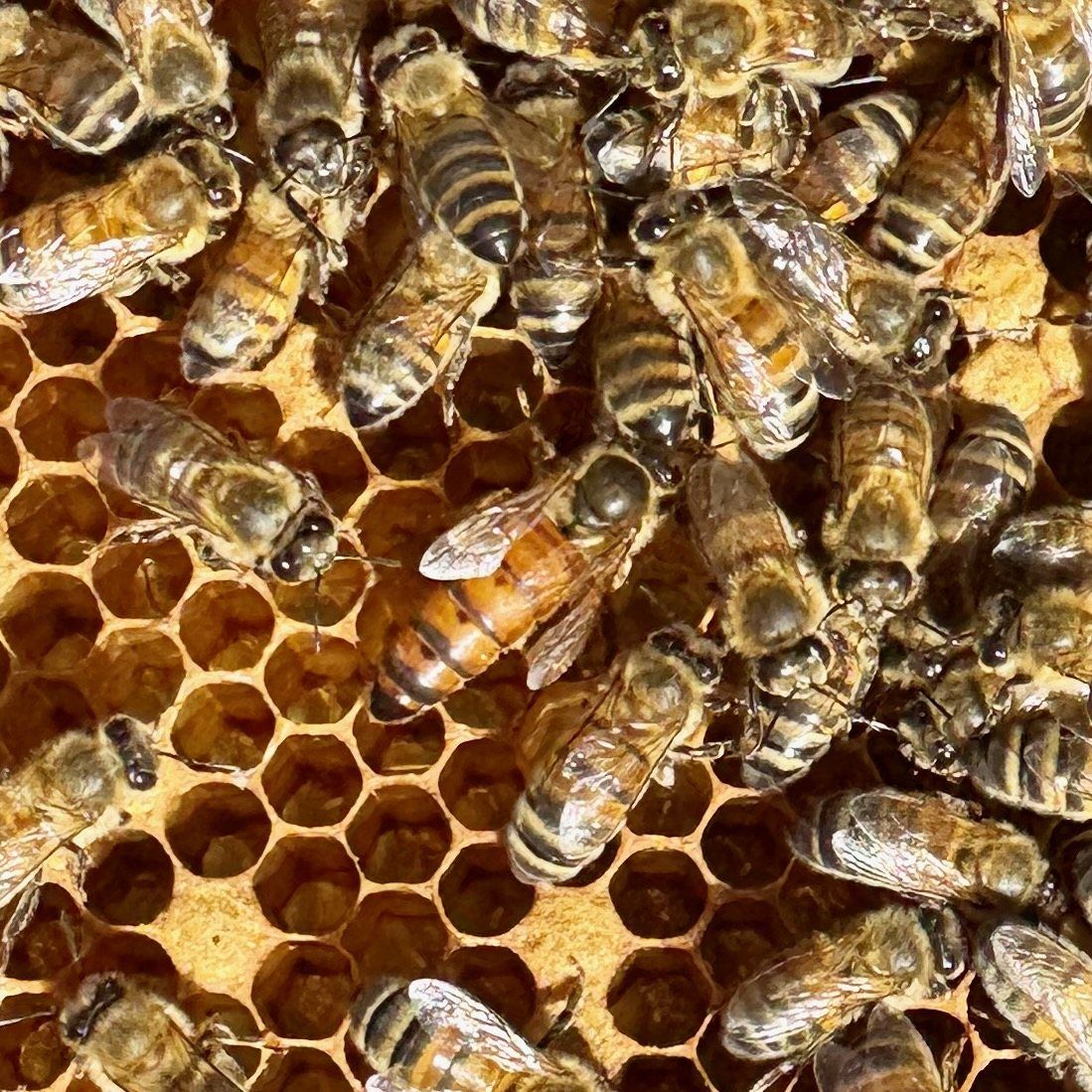
Raising queen bees means getting a strong colony to build a batch of queen cells from very young larvae of a colony you picked, then getting those virgin queens mated in small mating nucs. Three numbers drive the whole job: larvae 12 to 18 hours old at grafting, ripe cells moved to mating nucs 10 days after grafting, and about two more weeks before you look for eggs. Cell builders, drone colonies and selection records all exist to get those steps right and to breed from the right mothers.
It is also how you get queens when you need them. Commercial queens are scarce early in spring, US law allows imports from only two countries, and the best defense against varroa and Africanized genetics is good stock you can multiply yourself.
Why raise your own queen bees?
A colony replaces its own queen well enough, through swarming, supersedure or emergency cells after a loss. What it will not do is choose. Emergency cells are often raised from larvae that are already too old, and the old queen’s faults, whether hot temper, swarminess or poor wintering, pass on at random.
Raising queens on purpose gives you:
- Choice of mother. You graft from your gentlest, most productive, most mite-resistant colony, based on records.
- Control of larval age, the main lever on queen quality.
- Numbers. One cell builder can finish one or two batches of 24 cells a week, according to Wilkinson and Brown.
- Timing. You know to the day when queens will emerge, which makes splits, requeening and nuc sales predictable.
- Local adaptation. A queen raised from colonies that survived your winter and your mite load is a better bet than one shipped from a different climate.
There is a supply argument too. USDA APHIS allows adult queens and packages into the continental US only from Canada and New Zealand. Imports from Australia are prohibited, and whole colonies cannot be imported from any country. Most US beekeepers therefore depend on domestic queen producers, whose supply is tightest in early spring, exactly when overwintering losses create demand. For queen biology, her spermatheca, pheromones and lifespan, see our page on the queen bee.
When can you raise queens? A regional calendar
You need three things at once: strong colonies full of young nurse bees, mature drones flying in numbers, and steady nectar and pollen. When that happens depends entirely on where you are.
| Region | Typical queen rearing window | Notes |
|---|---|---|
| California (Central Valley, Northern California) | March to June | colonies build on almond bloom in February; hot, dry summers end the season early |
| Deep South and Gulf Coast (Florida, Georgia, Louisiana, Texas) | March to May, sometimes a fall batch | early drones; Africanized genetics in parts of the region |
| Southeast and mid-Atlantic | April to June | tulip poplar and clover flows |
| Northeast and upper Midwest | late May to July | short season; clover and basswood flows; requeen in July for winter |
| Pacific Northwest | May to July | cool, wet springs can delay mating flights |
| Hawaii | much of the year | producers shipping queens need State Apiary Program certification where the destination requires it |
These windows are a guide, not a rule. Start when your colonies have capped drone brood and are bringing in nectar. A late cold snap in the Midwest or a dearth in a Southern summer stops mating flights and starves cell builders, whatever the calendar says. In a dearth, feed your cell builder constantly.
What equipment do you need?
| Item | Use | Essential? |
|---|---|---|
| Cell bar frame (a deep Langstroth frame with 2 or 3 bars) | holds 12 to 24 queen cups, about 2 in (5 cm) of space below each bar | yes, for grafting |
| Queen cups (plastic or wax) | artificial queen cells | yes, for grafting |
| Grafting tool (Chinese tool, metal tool or fine wet paintbrush) | lifts the larva into the cup | yes, for grafting |
| Head magnifier and bright cool light | to see larvae about 1/16 in (1 to 2 mm) long | strongly recommended |
| Queen excluder | keeps the queen below the cell box | yes |
| Swarm box or starter box | holds grafts for the first 24 hours | method dependent |
| Cell protectors | protect ripe cells in mating nucs | useful |
| Incubator and emergence cages | hold ripe cells if nucs are not ready | useful once you raise dozens |
| Mating nucs (mini nucs, 2-frame or 5-frame nucs) | one per queen | yes |
| Marking tube and paint pen | identify mated queens | yes |
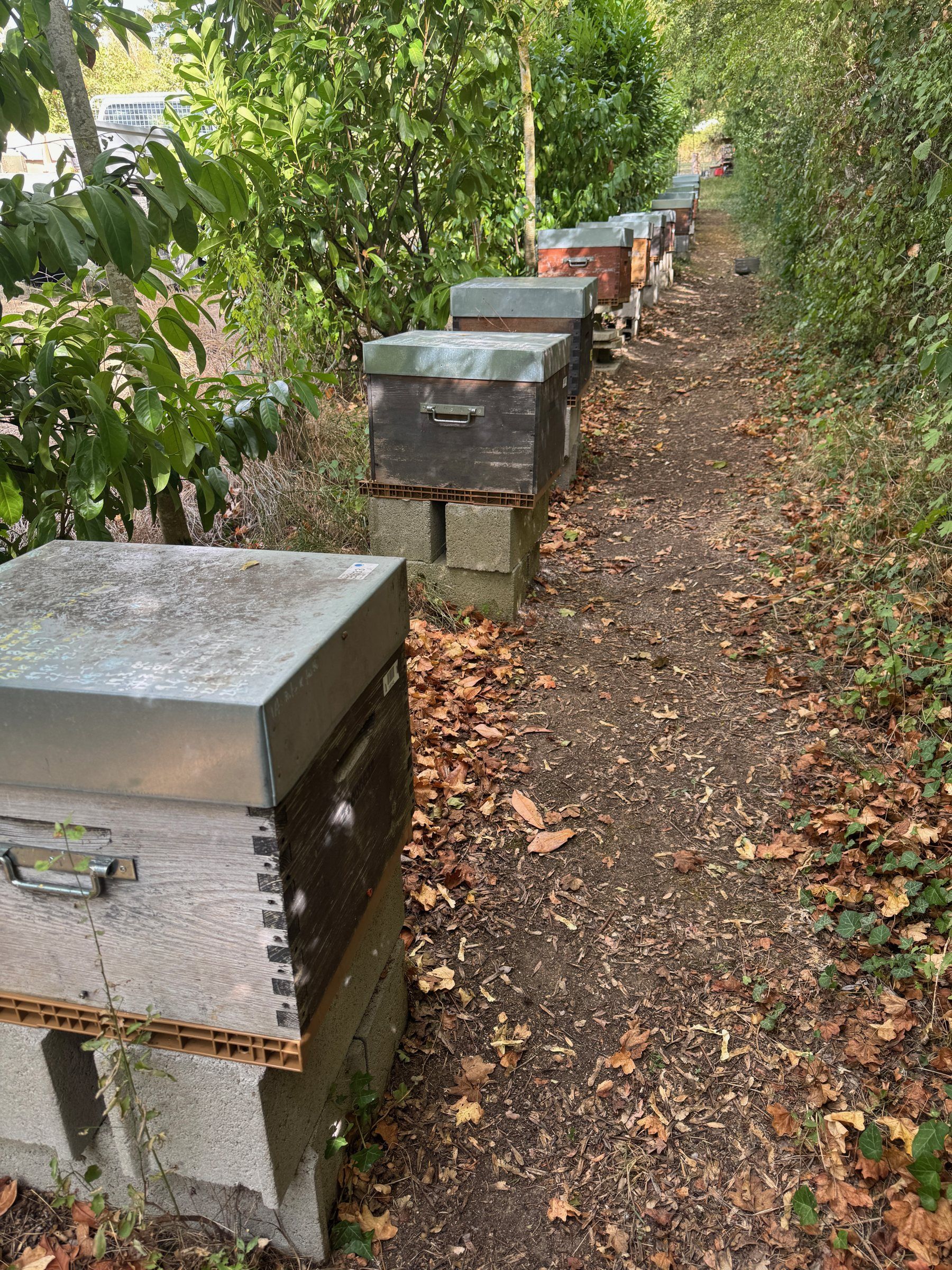
Most US beekeepers raise queens in standard 10-frame or 8-frame Langstroth equipment. A cell builder is usually a strong double deep, or deeps with mediums above. Mating nucs can be 5-frame deep nucs, deeps divided into 2-frame compartments, or mini nucs that use a few cups of bees.
Prime the cups before grafting. Wilkinson and Brown put the empty cell bar frame into the cell builder 8 to 24 hours beforehand so the bees can polish the cups, warm them and add a small rim of wax.
How do you choose breeder and drone colonies?
A queen gets half her genes from her mother and half from the drones she mates with, and her daughters are half-sisters through a dozen or more fathers. Selection has two sides: the colony you graft from and the colonies that supply drones.
The breeder colony
Choose on at least one full season of records, comparing colonies in the same yard, in the same year, with queens of the same age. A simple score sheet:
| Trait | How to judge it | Example scoring |
|---|---|---|
| Temper | stings, followers, smoke needed | 4: work without gloves; 1: defensive |
| Calmness on the comb | bees stay put or run | 4: still; 1: run and drip off |
| Swarming | swarm cells despite room | 4: none; 1: swarmed with room |
| Honey crop | lb per colony, against the yard average | relative |
| Spring buildup and wintering | frames of brood on a fixed date, survival | relative |
| Hygiene | freeze-killed brood test | % removed |
| Varroa | alcohol wash, mites per 100 bees, on a fixed date | relative |
Never graft from a colony showing signs of American foulbrood or other serious brood disease.
Which stock?
Italian and Carniolan bees dominate the US queen market, but several American programs have bred for mite resistance:
- VSH (varroa sensitive hygiene). Bred at the USDA-ARS laboratory in Baton Rouge, Louisiana. Workers detect and remove pupae in cells where varroa mites are reproducing. Breeding material went to industry from 2001 through a cooperative agreement with Glenn Apiaries. In a three-year Alabama trial reported by Danka and colleagues in 2008, 12% of VSH colonies reached a treatment threshold at any sampling time, against 24% of Russian and 40% of Italian colonies. Pol-line bees are a VSH-derived line.
- Russian bees. USDA-ARS brought 100 queens into the US in 1997 from the Primorsky territory of far eastern Russia, where honey bees had long been exposed to varroa, and released the stock to beekeepers in 2000.
- Purdue mite-biters. Purdue University began a mite resistance breeding program in 1997, first on grooming and, since 2007, on mite biting. The share of fallen mites with chewed legs rose from about 3% to nearly 50%. Breeder queens are distributed through the Indiana Queen Breeders Association and the Heartland Honey Bee Breeders Cooperative.
- Others. The Honey Bee Health Coalition’s 2026 guide also lists Minnesota Hygienic, Hilo bees, Carniolan and Buckfast stock, but warns that there is “no standardization or labelling for ‘varroa-resistant’ stock”. Ask the producer how the line was tested.
Our page on honey bee breeds compares these stocks in more detail, and our breeding section covers insemination and genetics.
Drone colonies
Rangel and Fisher’s 2019 review in Apidologie puts drone sexual maturity anywhere from 6 to 8 days to 16 days after emergence, with sperm counts peaking around 20 days. A drone takes 24 days from egg to adult. In practice, put drone comb into your drone colonies about six weeks before your virgins will fly, which is about three weeks before your first graft.
Keep mites down in drone colonies. The same review links varroa to poorer drone survival, and coumaphos, fluvalinate and amitraz to lower sperm counts or viability. Use an EPA-registered varroa product according to its label, and treat outside the drone-rearing window where you can. The Honey Bee Health Coalition advises prompt control at 1 or more mites per 100 bees in the dormant and population increase phases, and at 2 or more per 100 in the peak and population decrease phases. Note its warning about drone brood removal: it is a useful mite control, but it “reduces drones available for mating”. Do not use it in your drone colonies. Our guide to varroa mites covers treatment options.
Grafting: what larva age and how?
The core rule: graft larvae 12 to 18 hours after hatching, as Wilkinson and Brown do. At that age the larva has the longest possible time on a queen diet and is still big enough to lift. Larvae much past two days old have started developing as workers and give smaller queens with fewer ovarioles and a smaller spermatheca.
To get larvae of known age, add an empty drawn comb to the breeder colony, or confine the queen overnight on an empty comb in an excluder cage, four days before you graft.
Wet or dry?
Dry grafting works well with practice. Priming cups with a little diluted royal jelly helps if acceptance is your weak point. Delaplane and Harbo, at the University of Georgia, found in 1988 that primed cups were accepted at 92% (44 of 48) against 77% (37 of 48) for dry cups, with no difference in queen weight (267 mg against 268 mg).
Double grafting, replacing the accepted larva after a day with a fresh young one, gave no gain in queen weight in the same study. The authors called it “not worthwhile”. Spend that time finding younger larvae.
The technique
- Take a frame of young larvae from the breeder colony and brush the bees off rather than shaking them.
- Work out of direct sun and wind, ideally in a warm room, with a damp towel over the frame. Low humidity in the West dries larvae fast.
- Slide the tool under the larva from the outside of its C, without rolling it, and lift it with its brood food.
- Lay it in the center of the cup and draw the tool back.
- Return the frame to the starter or cell builder quickly.
How do you set up a cell builder?
The cell builder takes the grafted larvae, feeds them royal jelly and draws them out into queen cells. It needs an excess of young nurse bees, lots of pollen and nectar or syrup, and either no queen or a queen kept well away from the cells.
Queenless starter, queenright finisher
The common American setup splits the work in two. Shake a large mass of young bees, taken from frames of open brood and without the queen, into a ventilated swarm box with a frame of pollen and a frame of honey or a feeder, and leave it in the shade for a few hours. Give it the grafts for about 24 hours, then move the accepted cells into a strong queenright colony, above an excluder, to finish. The UMass Raising Queens guide uses a queenless “cell raiser” set up the day before grafting.
A queenright cell builder
Wilkinson and Brown described a single queenright colony that starts and finishes cells, published in the American Bee Journal in 2002:
- At least 20 full deep combs of bees, 8 to 12 combs of brood and 2 to 3 of pollen, in two brood boxes.
- The queen and most open brood below an excluder; capped brood above.
- The cell bar frame in the top box between a frame of pollen and a frame of young larvae.
- Without a reliable flow, 1 to 2 quarts (1 to 2 L) of heavy syrup a week, about 60% sugar by weight.
- Six or seven days after grafting, shake the bees off every brood frame in the top box and destroy any emergency cells.
- One or two brood frames rotated each week.
Across 152 batches the overall acceptance rate was 81%. Queen pupae from the queenright builder weighed 0.254 g against 0.249 g from queenless colonies, not a significant difference. A queenright builder can match a queenless one if it is packed with nurse bees and fed without a break. Twenty fat cells beat sixty thin ones.
Queen rearing schedule: from egg to laying queen
A queen develops in 16 days: 3 days as an egg, about 5.5 days as a larva and 7.5 days as a pupa, with the cell capped on day 8, according to USDA SARE. The schedule below follows the UMass Raising Queens guide, with day 0 the day the egg is laid. The guide rounds grafting to day 3 and emergence to day 15; with larvae 12 to 18 hours old at grafting, expect emergence about 12 days after the graft.
| Day from egg | Day from graft | Stage | What you do |
|---|---|---|---|
| about -18 | about -21 | drones | drone comb into drone colonies |
| -1 to 0 | -4 to -3 | eggs | empty comb in breeder colony, or queen confined |
| 2 | -1 | preparation | set up the starter or cell raiser; prime cups |
| 3 | 0 | graft | larvae 12 to 18 hours after hatching |
| 5 | 2 | acceptance | check: accepted larvae float on royal jelly; regraft if needed |
| 8 | 5 | capping | cells sealed |
| 9 to 12 | 6 to 9 | pupa | do not jar, chill or turn the cells |
| 12 | 9 | nucs | stock mating nucs with bees |
| 13 | 10 | ripe cells | cells into mating nucs |
| 15 | 12 | emergence | virgin queens emerge |
| 20 | 17 | mating flights | leave nucs closed in flying weather |
| 26 | 23 | first eggs | check for eggs |
| 33 | 30 | brood | judge the brood pattern |
Wilkinson and Brown remove cells 11 days after grafting, about a day before emergence; the UMass guide moves them on day 10. Treat day 10 as the target and day 11 as the limit: the first virgin out will tear down her sisters. A hot cell builder or slightly older larvae can bring emergence forward. Our queen rearing calendar dates every step from your grafting day and exports it to your phone or computer calendar.
Between capping and day 10 a bump, a turn on its side or a chill can kill or deform the pupa. Move cells before capping or once ripe, warm and tip down. An incubator at brood nest temperature, about 93 to 95 °F (34 to 35 °C), holds capped cells if nucs are not ready.
Raising queens without grafting
The walk-away split
The UMass guide calls the walk-away split an entry point to queen rearing: divide a colony so that one half keeps the old queen and the other, with eggs and young larvae, rears a new one. It costs nothing but control, because the bees choose the larvae.
48-hour cells
Some beekeepers move grafted cells into mating nucs two days after grafting, once accepted, and let the nucs finish them. The UMass guide describes this abbreviated method as easier, with less cell raiser management, but notes that it gives less control over larval rearing and limits production. It is still little studied.
Other methods compared
| Method | Principle | Strengths | Limits |
|---|---|---|---|
| Grafting | larvae moved by hand into cups | cheap, big batches, precise larval age | needs practice and good eyes |
| Cupkit systems (Jenter, Nicot type) | queen lays into removable cell bases | known age, larva never touched | pricier kit, queen confined 1 to 2 days |
| Miller method | strip of young brood with a cut edge | no special tools | few cells, approximate age |
| Walk-away split | colony raises its own cells | no equipment | bees choose larvae, sometimes too old |
Mating nucs and drones
Mating nucs
Fill each nuc with young bees a few hours before the ripe cell goes in, tip down, and give it food. Then leave it alone. Mini mating nucs save bees but are prone to robbing, overheating in Southern and Western summers and absconding. Five-frame deep nucs are forgiving and can be sold as nucs once the queen is laying.
How many flights, how many drones?
Simone-Finstrom and Tarpy, of USDA-ARS and North Carolina State University, followed 80 queens allowed a single mating flight, in a study published in 2018. They made 2.4 flights on average, orientation flights included, with confirmed mating flights of 12 to 47 minutes, and mated with 13.5 drones on average, between 8 and 25. A fully mated queen typically stores 5 to 7 million sperm.
Drones gather in drone congregation areas 30 to 200 m (about 100 to 650 ft) across and 10 to 40 m (about 30 to 130 ft) up, drawing drones from up to 240 colonies within about 3 miles (5 km), according to Rangel and Fisher. You cannot control which drones your queens meet; you can only stack the odds by keeping plenty of selected drone colonies near your mating yard. The only way to be certain of the father is instrumental insemination.
What Florida requires of queen producers
Florida’s Honey Bee Queen Compliance Agreement (FDACS-08419, Revised 1/18), incorporated by reference into state rule 5B-54.0105, shows how seriously drone saturation is taken where Africanized bees are present. In the current form, a queen producer who signs it must establish at least 60 European drone source colony equivalents, each equal to 250 square inches (about 1,600 cm²) of drone comb, for each 1,000 or fewer mating nuclei. 75% of them must be within a 1/4 mile (0.4 km) radius of the mating yard and the rest within 1 mile (1.6 km). Breeder queens and drone source colonies must be headed by European queens, drone colonies must be requeened every year with European production queens, and records of queen, drone and drone semen sales must be kept for state inspectors.
Mating in Africanized areas
Africanized honey bees are established across much of the southern US. Texas A&M’s Master Beekeeper material notes that Africanized colonies produce drones earlier and in greater proportion than European colonies, and that they “saturate DCAs”. An open-mated queen in those areas may come back a hybrid. Its advice for hobbyists: buy only marked, mated queens, and requeen as soon as you find an unmarked one, because she was raised by the colony and may be Africanized. UF/IFAS Extension notes that in Florida queens must be bought from a producer who has been inspected and certified.
If you raise queens in the South, keep your mating yard surrounded by your own European drone colonies, raise queens early in the season, check temper in every new colony, and do not sell queens unless you meet your state’s requirements.
How do you test and select queens?
The freeze-killed brood test
Hygienic behavior is the workers’ ability to detect, uncap and remove dead or diseased brood. It is linked to resistance to chalkbrood, American foulbrood and, to a degree, varroa, and it responds to selection. Penn State Extension’s protocol:
- Test a populous colony whose workers are all daughters of the queen being evaluated.
- Choose capped worker brood at the pink or purple-eyed pupa stage.
- Push two 2-inch (5 cm) metal rings into the comb, about 100 cells each.
- Pour about 35 mL of liquid nitrogen into each ring, let it boil off, then add about 40 mL more.
- Let it thaw, remove the rings and return the frame to the brood nest.
- Exactly 24 hours later, count cells still occupied.
- The colony qualifies as hygienic if it removes at least 95% of the frozen brood in 24 hours in two separate tests, 10 or fewer cells left out of 200.
Wear cryogenic gloves and safety glasses and cover your skin: liquid nitrogen burns.
Simpler options
Freezing a section of capped brood in a home freezer for 24 hours, then reinserting it, avoids liquid nitrogen, though results take longer. A pin-killed test, piercing about 100 cappings with an insect pin, is cheap but less consistent. Compare only colonies tested the same way. For mite resistance itself, regular alcohol washes on a fixed date across all colonies give the most practical comparison.
Marking, introducing and buying queens: what the law says
Marking
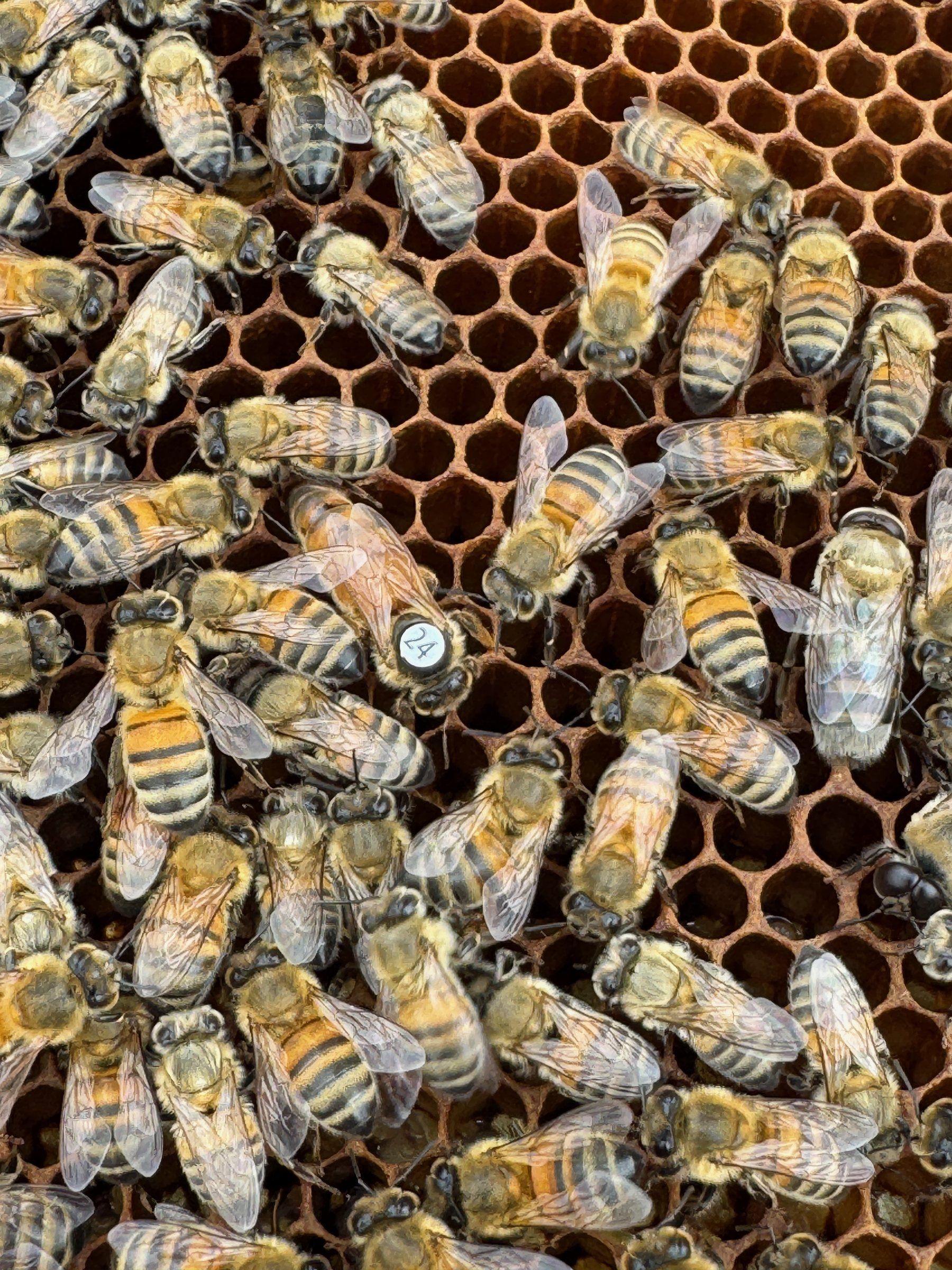
Mark the thorax of a mated queen once she is laying, never the abdomen. The international code follows the last digit of the year:
| Last digit | Color | Years |
|---|---|---|
| 1 or 6 | white | 2026, 2031 |
| 2 or 7 | yellow | 2027, 2032 |
| 3 or 8 | red | 2028, 2033 |
| 4 or 9 | green | 2029, 2034 |
| 5 or 0 | blue | 2030, 2035 |
Judge a new queen on several weeks of brood, not on the first eggs. If many queens in one batch lay poorly, suspect the drones or the weather during mating flights.
Introducing
Introduce a laying queen in a cage with a candy plug to a colony that has been queenless for about a day, after removing every queen cell, and check for eggs a week later. Virgins are much harder to introduce; use a ripe cell or a mated queen instead. The Honey Bee Health Coalition warns that late-season requeening “is often unsuccessful”, so requeen by midsummer in the North.
Buying queens
A mated production queen from a US supplier costs around $45 to $50 with marking at October 2026 prices. Lappe’s Bee Supply in Iowa, for example, lists a Carniolan queen at $44.95, with marking $4 extra, shipped by next-day air from April through August and free shipping on three or more. Instrumentally inseminated breeder queens from VSH, Pol-line, Russian or mite-biter programs cost much more, but one good breeder queen can mother hundreds of daughters.
State and federal rules
There is no single national law on raising or selling queens. Rules are set by each state department of agriculture and its state apiarist, so check yours before you sell. A few examples:
- Texas. Anyone selling queens, nucs or packages must provide a Texas Apiary Inspection Service health certificate, valid one year from inspection, or a signed, notarized affidavit with every sale. Bees entering Texas from another state need a health certificate and a $200 interstate permit.
- Florida. Queens must come from inspected and certified producers, according to UF/IFAS Extension, and queen producers sign the compliance agreement described above.
- Hawaii. Importing live or dead bees into the state is illegal, although honey bee semen can be brought in for breeding. Queen producers shipping to destinations that require certification must be inspected by the State Apiary Program, with at least 40 colonies and 20 per yard, and certificates last 90 days.
- Federal. Under 7 CFR part 322, queens and packages may enter the continental US only from Canada and New Zealand, and honey bee germplasm only from Australia, Bermuda, Canada, France, Great Britain, New Zealand and Sweden.
Many states also require registration of apiaries or permits to move colonies across state lines. Our guide to beekeeping laws by state points you to the right office. For most hobby beekeepers, a sound plan is to buy one or two queens from a mite-resistant program, keep records for a season, then graft from the best colony you have.
Frequently asked questions
How old should larvae be when you graft them?
As young as you can lift. Wilkinson and Brown, writing in the American Bee Journal, graft larvae 12 to 18 hours after hatching, about three and a half days after the egg was laid. At that age the larva is a tiny C in a pool of brood food. Larvae much older than two days have started developing as workers and give smaller queens with fewer ovarioles.
How long does it take to raise a queen bee?
A queen takes 16 days from egg to adult. In the UMass Raising Queens schedule you graft on day 3, cells are capped on day 8, moved to mating nucs on day 13 and emerge on day 15. Mating flights start around day 20 and you check for eggs around day 26, so plan on roughly four weeks from graft to a laying queen.
When should I start raising queens?
When colonies are strong, drones are flying and there is a nectar flow, not by a fixed date. In California and the Deep South that can be March. In the Northeast, upper Midwest and Pacific Northwest it is usually late May through July. Start your drone colonies about three weeks before your first graft so mature drones are flying when your virgins are.
How much does a queen bee cost?
A mated production queen shipped from a US supplier costs around $45 to $50 with marking at October 2026 prices. Lappe's Bee Supply in Iowa, for example, lists a Carniolan queen at $44.95, plus $4 for marking, shipped April through August by next-day air, with free shipping on three or more. Virgin queens and ripe cells cost less, while instrumentally inseminated breeder queens cost much more.
Can I raise queens if I live in an Africanized bee area?
Yes, but plan around the drones. Africanized colonies produce more drones and can saturate drone congregation areas, so open-mated queens may be hybrids. In Florida, queens must be bought from inspected and certified producers, and queen producers under the state compliance agreement must keep at least 60 European drone colony equivalents per 1,000 mating nuclei nearby. Many hobbyists in the South buy marked, mated queens and requeen any colony with an unmarked queen.
Can I import queen bees into the US?
Only from Canada and New Zealand, according to USDA APHIS. Adult queens and packages may enter the continental US from those two countries, not from Australia, and whole colonies cannot be imported from anywhere. Honey bee semen can come from a short list of countries for breeding. Hawaii is separate: live bees cannot be brought into the state at all.
What is a walk-away split?
It is the simplest way to raise a queen: split a colony and leave one half without a queen but with eggs and young larvae, and the bees raise their own emergency cells. The UMass Raising Queens guide calls it a simple entry point to queen rearing that gives little control over rearing conditions. It needs no equipment, but the bees, not you, choose the larvae.
What color should I mark a 2026 queen?
White. The international color code uses the last digit of the year: white for 1 and 6, yellow for 2 and 7, red for 3 and 8, green for 4 and 9 and blue for 5 and 0. A queen raised in 2026 is white, a 2027 queen yellow. Mark only the thorax, after she is laying, and let the paint dry before releasing her.
Sources
- Raising Queens: A How-To Guide to Sustainable Queen Rearing (2021), Hannah Whitehead et al., University of Massachusetts Amherst, Northeast SARE (USDA)
- The life cycle of honey bees, SARE, USDA
- Rearing queen honeybees in a queenright colony (American Bee Journal, April 2002), David Wilkinson and Mike A. Brown, National Bee Unit
- A re-examination of double grafting (American Bee Journal, 1988), Keith S. Delaplane and John R. Harbo, University of Georgia Honey Bee Program
- Honey bee queens do not count mates to assess their mating success (Journal of Insect Behavior, 2018), Michael Simone-Finstrom and David R. Tarpy, USDA-ARS
- Factors affecting the reproductive health of honey bee drones: a review (Apidologie, 2019), Juliana Rangel and Adrian Fisher II, Texas A&M University, Springer
- Status of bees with the trait of varroa sensitive hygiene (VSH) for varroa resistance (American Bee Journal, January 2008), Robert G. Danka et al., USDA-ARS Honey Bee Breeding, Genetics and Physiology Laboratory, Baton Rouge
- Release of USDA-ARS Russian honey bees, USDA-ARS Honey Bee Breeding, Genetics and Physiology Laboratory, Baton Rouge
- Our breeding program (mite-biter bees), Purdue University, Department of Entomology
- Tools for Varroa Management, 9th edition (2026), Honey Bee Health Coalition
- Honey bee breeding program design: testing for hygienic behavior, Penn State Extension
- Honey bees and other bees: import requirements, USDA APHIS
- The basics of queen management in beekeeping operations (ENY2128, 2025), Francesca L. Michelini, Devan Rawn and Cameron Jack, UF/IFAS Extension
- Honey Bee Queen Compliance Agreement (FDACS-08419, Rev. 01/18), Ref-09152, Florida Department of Agriculture and Consumer Services
- Fla. Admin. Code R. 5B-54.0105, Location of managed honey bee colonies, Legal Information Institute, Cornell Law School
- Africanized honey bees (Master Beekeeper Program), Texas A&M AgriLife
- Regulations, Texas Apiary Inspection Service, Texas A&M AgriLife
- Compliance with beekeeping laws in Hawaii, University of Hawaii at Manoa, CTAHR
- Carniolan queen bee (price checked October 2026), Lappe's Bee Supply