Yellow-legged hornet in the US: where it is, how to identify it and how to protect your hives
Yellow-legged hornet in the US: where it has been found in Georgia and the Carolinas, how to identify and report it, and how beekeepers can protect their hives.
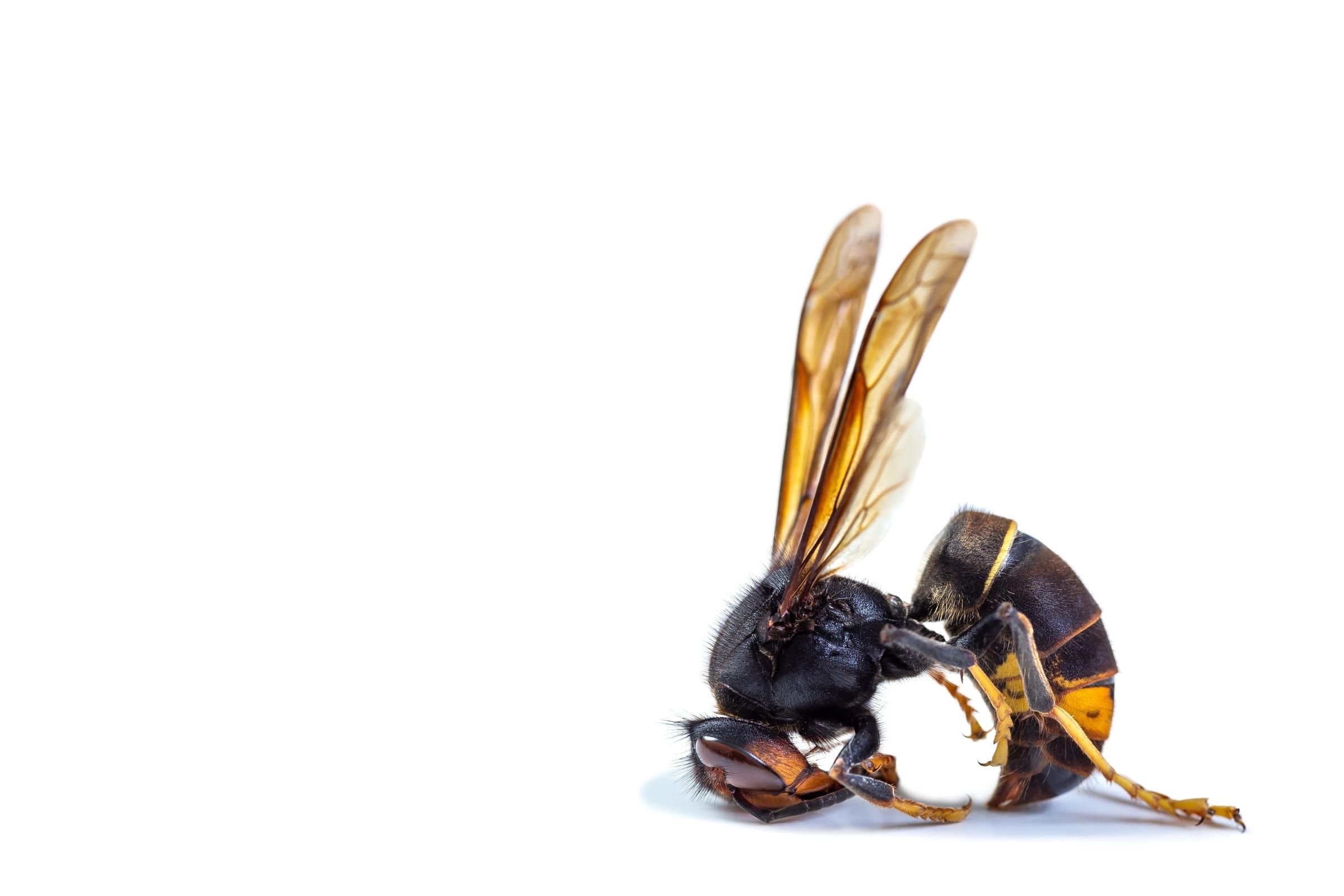
The yellow-legged hornet (Vespa velutina), sometimes called the Asian hornet, is an invasive social wasp that preys on honey bees at the hive entrance. In the United States it was first confirmed near Savannah, Georgia, in August 2023, and USDA APHIS now lists detections in Georgia, South Carolina and North Carolina. It is about 3/4 to 1 inch (19 to 25 mm) long, mostly dark, with one strong yellow-orange band on the fourth abdominal segment and legs that are yellow at the tips. If you think you have seen one, photograph it from a safe distance, note the location and report it to your state department of agriculture. Do not try to remove a nest: state and federal responders do that. Outside the Southeast the hornet has not been found, but beekeepers everywhere should learn to recognize it.
What is the yellow-legged hornet, and is it the murder hornet?
The yellow-legged hornet is a true hornet, genus Vespa, native to Asia. A single introduction into southwestern France around 2004 grew into the population that now covers much of Western Europe, which is why European sources call it the Asian hornet. It is not the “murder hornet”. That name was given to the northern giant hornet (Vespa mandarinia), a much larger species first detected in late 2019 near Blaine, Washington. The Washington State Department of Agriculture and its partners destroyed four nests in 2020 and 2021, and USDA APHIS announced in 2024 that the northern giant hornet had been eradicated from the United States. The two species are often confused in news coverage, but the yellow-legged hornet is the one US beekeepers now need to watch.
The US population did not come from Europe. In 2024, APHIS reported that DNA testing by its National Identification Services had likely ruled out ancestry from the invasive European populations, and University of Georgia researchers said in August 2026 that the genetics indicate the Georgia hornets came directly from the native range in Asia, although the exact origin is hard to pinpoint.
How do you identify a yellow-legged hornet?
The features that matter
Combining the descriptions from APHIS, the University of Georgia, North Carolina and the California Department of Food and Agriculture (CDFA):
- Size: about 3/4 to 1 inch (19 to 25 mm). Workers are smaller than a European hornet.
- Head: mostly black from above, with yellow or orange on the face.
- Thorax: black or dark brown, with no yellow markings on top.
- Abdomen: dark at the base, with alternating dark and yellow-orange bands and a strong yellow-orange band on the fourth segment.
- Legs: brown or black near the body and yellow at the tips. North Carolina calls the yellow lower legs the most distinctive feature.
- Waist: narrow and clearly pinched. CDFA uses this to rule out horntail wood wasps, whose abdomen is cylindrical with no narrow waist.
Yellow-legged hornet vs European hornet
The European hornet (Vespa crabro) is the only true hornet established in North America before 2023. Penn State Extension says it was first detected here in the 1840s and is now widespread in the eastern states. It is the insect most often mistaken for the yellow-legged hornet.
| Feature | Yellow-legged hornet (Vespa velutina) | European hornet (Vespa crabro) |
|---|---|---|
| Overall color | Dark, mostly black or dark brown | Reddish-brown and yellow, much brighter |
| Abdomen | Dark with a strong yellow-orange band on segment 4 | Mostly yellow with dark markings |
| Legs | Yellow tips | Reddish-brown |
| Size | 3/4 to 1 in (19 to 25 mm) | Workers to about 1 in (25 mm), queens to 1.3 in (35 mm) |
| Activity | Daytime hunter | Also flies at night, often to porch lights |
| Typical nest | Paper nest, small and sheltered in spring, high in trees or on buildings later | In hollow trees, sometimes wall voids |
| Status | Invasive, reportable in states with a response program | Introduced long ago, widespread; no reporting needed |
Other look-alikes
APHIS lists the insects most often reported by mistake: bald-faced hornet, elm sawfly, European hornet, great golden digger wasp, hoverflies, northern giant hornet, western cicada killer, paper wasps and yellowjackets. Clemson adds cicada killers and yellowjacket queens to the common mistakes in South Carolina. Two deserve a closer look:
- Bald-faced hornet (Dolichovespula maculata): despite its name, an aerial yellowjacket, not a true hornet. It is black with ivory-white markings on the face, thorax and abdomen, and builds oval, gray paper nests in shrubs, trees and sometimes under eaves, according to Penn State.
- Eastern cicada killer (Sphecius speciosus): a large solitary wasp that digs burrows in sandy soil in midsummer and does not build a paper nest.
Many of these wasps are beneficial predators or pollinators. Georgia stresses that domestic look-alikes do not threaten honey bees and that many are valuable pollinators, so do not kill them on suspicion.
Where has the yellow-legged hornet been found in the US?
Georgia: the main population
A beekeeper near Savannah reported an unusual hornet on August 9, 2023. State and federal officials confirmed the identification that month: according to UGA, it was the first live specimen of the species detected in the open United States. The Georgia Department of Agriculture (GDA), working with APHIS and UGA, has published the response figures in its Yellow-Legged Ledger ever since.
| Year | Nests found and destroyed in Georgia (GDA) |
|---|---|
| 2023 (from August) | 5 secondary nests |
| 2024 | 47 (4 embryo, 3 primary, 40 secondary) |
| 2025 | 62 (4 embryo, 5 primary, 53 secondary) |
| 2026 (to July 29) | 54 (33 embryo, 12 primary, 9 secondary) |
| Total, Aug. 2023 to July 29, 2026 | 168 nests, with 3,338 traps deployed |
The 2026 figures show a shift toward embryo nests: finding a queen’s first small nest in spring removes the colony before it produces new queens in the fall. Most activity has stayed around Chatham County and the neighboring coastal counties; APHIS reported in 2024 that most of Georgia’s roughly 1,000 survey traps that year were in Chatham County.
South Carolina: Lowcountry and York County
South Carolina officials captured their first hornet about three months after the Savannah detection, APHIS reported. Clemson University’s Department of Plant Industry (DPI), the state’s regulatory agency for plant pests, found several queens and one embryo nest in Beaufort County in spring 2024, then 16 nests in Beaufort County that year. Traps in Beaufort and Jasper counties caught 4,219 hornets in 2024. On December 8, 2025, a beekeeper’s report of a hornet hunting honey bees led DPI to a nest in York County, on the North Carolina line south of Charlotte: the first detection in South Carolina outside the Lowcountry.
North Carolina: first finding in 2026
On July 27, 2026, the North Carolina Department of Agriculture and Consumer Services (NCDA&CS) confirmed the first established presence of the yellow-legged hornet in the state, in Matthews. A Union County homeowner had noticed adult hornets at her hummingbird feeder; follow-up surveys found more near the Union and Mecklenburg county line, and more than 200 survey traps were set around the site. By August 2026 the state listed detections in Union and Guilford counties. The same NCDA&CS page lists, for Georgia, Chatham, Bryan, Effingham and Liberty counties and, for South Carolina, Beaufort, Colleton, Charleston, Dorchester, Jasper and York.
The rest of the country
APHIS lists no other state with detections. The California Department of Food and Agriculture wrote in December 2025 that the hornet had not been detected in California. If you keep bees in the Northeast, the Midwest, the Pacific Northwest or California, the hornet is not in your area as far as official records show, but the spread so far, along the Southeast coast and then inland to the Charlotte area, shows how far a queen can travel. UGA notes that the species left its native range through inadvertent human traffic, so freight and moved equipment are the likely routes for any long jump.
What is the life cycle of the yellow-legged hornet?
Each colony is founded by one mated queen and lasts a single season. APHIS, GDA and Clemson describe the same stages; the dates below fit coastal Georgia and the Carolinas, where mild winters stretch the season.
| Period (Southeast) | What the hornet does | What beekeepers can do |
|---|---|---|
| Winter (December to February) | Mated queens overwinter alone in sheltered spots. Old nests die. | Plan monitoring; check sheds and empty equipment for old nests. |
| Early spring (March to April) | Queens emerge, feed on flowers and start an embryo nest about the size of a tennis ball, often on a porch or in another sheltered spot. | Set queen monitoring traps (North Carolina suggests March). Report every small paper nest. |
| Late spring (May to June) | The first workers emerge. The colony expands into a larger primary nest. | Watch flowers and water sources near apiaries; worker trapping can start in May. |
| Summer (July to August) | Many colonies relocate to a secondary nest, often high in trees, which APHIS says can grow as large as a beach ball and hold up to 6,000 workers. Hawking at hives starts. | Fit entrance muzzles; watch hive fronts and report hornets the same day. |
| Fall (September to November) | Colonies produce males and new queens, and attacks on honey bee hives are at their worst. | Keep colonies strong and fed; report so nests are found before queens disperse. |
| Late fall to early winter | New queens mate and disperse to overwinter. | Clemson says nests should ideally be destroyed by late summer or early fall, and destruction continues into early winter. |
The GDA’s July 2026 advice is to keep monitoring hives year-round, and that hawking tends to peak before noon and again after 5 p.m. Hornets may forage up to about 0.6 mile (1,000 m) from the nest, according to UGA, which sets the search radius when an apiary is attacked.
For the bee side of this calendar in your region, see our beekeeping calendar.
How does the yellow-legged hornet harm honey bee colonies?
Hawking at the entrance
The hornet hunts by hovering in front of the hive, facing the entrance, and seizing returning foragers in mid-air. It takes the bee to a perch, discards the head, wings and abdomen and chews the thorax into a protein ball for its larvae. UGA describes western honey bees as essentially defenseless against it: unlike Asian honey bees, they have not evolved group defenses against this predator. As UGA’s bee program director Jamie Ellis put it in 2026, “Apiaries are like consistently available buffets for the hornets.”
Foraging paralysis
The bees taken are not the main damage. In a study published in the Journal of Pest Science in 2019, Fabrice Requier and colleagues combined field observations in France with colony modeling. They showed that hornets cause foragers to fail to return home and, more importantly, trigger a foraging paralysis: the colony largely stops flying while hornets patrol. In their simulations, that paralysis was a major driver of winter colony collapse, because a colony that stops bringing in pollen and nectar in late summer raises a weak population of winter bees. North Carolina’s state apiarist, Don Hopkins, warned in July 2026 that the hornets can cause reduced foraging and colony failure, meaning less honey and less crop pollination.
Hornets do not only eat honey bees. UGA researchers sequencing DNA from larval fecal pellets found butterflies, flies, beetles and native wasps in the diet as well, plus scavenged meat, trash and roadkill.
Pressure on already stressed colonies
A colony carrying a heavy load of varroa mites or fighting another honey bee disease has fewer bees to spare. In the Southeast, late-summer varroa control coincides with the start of hornet predation, so getting mite levels down in July and August is one of the best indirect defenses you have.
Pollination and migratory beekeeping
There is no published estimate yet of US colony losses caused by yellow-legged hornets, and the affected area is small compared with the country’s beekeeping. The concern is what happens if the hornet spreads into regions that send colonies to California almond orchards or other crops. Every colony and every piece of equipment that moves out of a detection area is a possible ride for a queen. If you keep bees in coastal Georgia, the South Carolina Lowcountry, York County or the Charlotte area and move hives or equipment, inspect them for hornets and small paper nests before loading, and check with your state apiarist about any movement guidance.
What should you do if you see a yellow-legged hornet or find a nest?
Report it to the right agency
Agencies need a photo, the exact location and your contact details. North Carolina asks for a size reference such as a quarter or a pen in the frame.
| State | How to report |
|---|---|
| Georgia | GDA online form; email [email protected]; phone 404-656-3600 |
| South Carolina | Clemson DPI yellow-legged hornet reporting tool; phone 864-646-2140 |
| North Carolina | NCDA&CS Yellow-Legged Hornet Reporting Tool (ncagr.gov/YLH) |
| Any other state | Your State Plant Regulatory Official or the USDA State Plant Health Director, usually reached through the state department of agriculture |
Many states run their apiary programs inside the department of agriculture, and your state apiarist or your land-grant university’s extension service can also route a report. As Ellis puts it: “When in doubt, point it out.”
Leave the nest alone
APHIS is explicit: “Only State or Federal responders should remove or treat yellow-legged hornet nests.” Keep a safe distance, do not disturb the nest and record its exact position. Late-season secondary nests are usually high in trees, where leaves hide them until fall.
The one nuance is the spring embryo nest, about tennis-ball size. Georgia recommends contacting a pest management professional and notifying the GDA Plant Protection Division before acting, and stresses that anyone removing such a nest must kill the queen. Clemson asks South Carolina residents not to remove embryo nests themselves but to report them so a response team can do it.
How responders find and destroy nests
Responders work back from the hornets to the nest. UGA describes the basic method: set up a feeding station with protein bait such as chicken or tuna, watch hornets as they leave, follow the flight line and repeat until the nest is found. Clemson’s DPI adds hornet lining, thermal imaging and radio tracking. Once a nest is found, the area is taped off, the property owner is contacted, and trained staff destroy and remove it after consent or an administrative warrant.
Should beekeepers trap yellow-legged hornets?
What traps can and cannot do
Trapping in the US has two jobs: detection, to show where hornets are, and early-season removal of queens. Ellis’s summary: “Every queen that you capture in spring is a queen that will not get to make a nest.” But UGA’s bee program also notes that commercial traps have shown high bycatch and low yellow-legged hornet catch, and that no effective lure has been developed yet. UGA’s Lewis Bartlett is studying baits that hornets would carry back to the nest: “If we can’t eradicate them, we need to know what baits they’ll take.”
Practical guidance from the states
- Timing: North Carolina suggests setting traps in March for queens and/or May for workers, checking them every one to two weeks, and keeping them up until the first frost.
- Bait: Clemson’s preferred bait is a mixture of grape juice and dark brown sugar, which it calls “Georgia Juice”. UGA mentions homemade baits based on beer, white wine or berry syrup.
- Design: use a trap that lets small insects escape and that you can check easily. Release non-target insects alive.
- Reporting: in South Carolina’s citizen trapping program, every report must include a photo. In all three states, report each suspect hornet through the state tool.
- Agency traps: Clemson asks residents to leave DPI traps alone, since staff monitor them.
Outside the Southeast, a trap is a detection tool only. A few well-placed, regularly checked traps near apiaries close to ports and freight hubs are more useful than dozens left unchecked.
How can you protect your hives from yellow-legged hornets?
Entrance muzzles
A muzzle, or modified entrance, is a mesh cage fitted over the hive entrance. Bees walk or fly through the mesh, but hornets can no longer hover right at the entrance, so the predation zone is pushed further out, as UGA describes it. The best evidence comes from France: in the 2020 study by Requier, Rome, Villemant and Henry in the Journal of Pest Science, 22 pairs of colonies were compared, one with a muzzle and one without. The muzzle did not reduce the number of foragers that failed to return, but it drastically reduced foraging paralysis. In the authors’ simulations, it raised the survival probability of colonies under heavy hornet pressure by up to 51%.
On a 10-frame or 8-frame Langstroth hive, the muzzle covers the bottom-board entrance, usually behind an entrance reducer. Make sure dead bees can still be cleared and that ventilation is adequate in a Southern summer, when hives often need the full entrance open. Fit it at the first sign of hawking and leave it on until hornet activity ends in late fall.
Electric harps
An electric harp is a frame of charged vertical wires set in front of hives: bees pass through the gaps, while hovering hornets touch the wires and drop into a tray. A pilot study presented at the Neobiota 2026 conference by Burbui and colleagues (University of Pisa, INBO and Ghent University) found that harps reduced hornet numbers in front of hives. But the hornets that stayed hunted longer and were just as successful, which the authors read as compensation. Harps need power and maintenance and remain experimental; few US apiaries currently face enough pressure to justify one.
Swatting and other hobbyist measures
UGA notes that, for hobbyists, swatting hornets one at a time with a badminton racket may be the most practical control. Report what you kill, with a photo, so the agency can trace the nest.
Colony management
- Reduce entrances in late summer where heat allows: a smaller entrance is easier for guard bees to defend and also limits robbing during the summer dearth.
- Keep colonies strong: combine weak colonies before fall rather than leaving them exposed.
- Control varroa on schedule so winter bees are healthy even if foraging slows.
- Check stores: a colony that stops foraging in September and October misses the fall flow. Heft your hives and, if needed, feed your bees syrup before winter.
- Pick an open site where you can see hive fronts easily; our guide on where to put a beehive covers the trade-offs.
- Report early: a hornet reported in July leads to a nest destroyed before it releases queens.
Are yellow-legged hornets dangerous to people?
A yellow-legged hornet foraging on flowers or hunting at a hive is not a particular danger to passers-by. Like other social wasps, it defends its nest, and disturbing one, for example while trimming a tree or pressure-washing eaves, can bring many stings. Clemson’s York County extension office points out that the hornet often nests on homes and other structures, which raises the chance of accidental contact early in the season.
First aid for bee, wasp and hornet stings, following CDC NIOSH advice:
- Wash the sting site with soap and water and apply ice to reduce swelling.
- Have someone stay with the person to watch for an allergic reaction, and do not scratch the sting.
- Call 911 immediately if the person has trouble breathing, swelling of the face, lips or throat, dizziness or collapses: CDC describes anaphylaxis as life-threatening and needing immediate emergency care.
- People with a history of severe reactions should carry their prescribed epinephrine auto-injector and wear a medical ID.
Beekeepers should know that a standard bee suit is not enough near a hornet nest. UGA recommends double-walled mesh suits with a gap of about 3/16 inch (5 mm), high-top boots and thick gloves for anyone working close to hornets. Leave nest work to responders.
Who regulates the yellow-legged hornet in the US?
There is no single federal “hornet law”. The response rests on federal plant protection authority and on state law, which differs from state to state.
| Agency | Role |
|---|---|
| USDA APHIS, Plant Protection and Quarantine | Works with states to detect, control and prevent spread; funds rapid response, provides traps, surveys, mapping and identification; in 2024 it provided rapid-response funding to Georgia and South Carolina |
| USDA National Identification Services | Confirms identifications and runs DNA testing |
| Georgia Department of Agriculture, Plant Protection Division | Leads trapping, tracking and nest eradication in Georgia; publishes the Yellow-Legged Ledger |
| Clemson University Department of Plant Industry | South Carolina’s plant pest regulatory agency; traps, tracks and destroys nests with owner consent or administrative warrant |
| NCDA&CS Plant Industry Division | Surveys and responds in North Carolina with APHIS; home to the state apiarist |
| Land-grant universities (UGA, Clemson, NC State) | Research, identification support, extension outreach |
| Your state department of agriculture | First contact everywhere else; check its apiary pages for registration and any reporting rules |
Two points follow for beekeepers. First, reporting rules and responder powers are set by each state, so do not assume Georgia’s procedures apply where you live; check your own state department of agriculture. Second, many states require or encourage apiary registration, and a registered apiary is easier for inspectors to alert when a hornet is found nearby. Our guide to beekeeping laws by state explains how registration works.
Frequently asked questions
Where has the yellow-legged hornet been found in the US?
USDA APHIS lists detections in Georgia, South Carolina and North Carolina. Georgia's population, around Savannah and the coastal counties, is the largest, with 168 nests destroyed from August 2023 to late July 2026. South Carolina has found nests in the Lowcountry and one in York County. North Carolina confirmed its first hornets in Union County in July 2026. California reported no detection as of December 2025.
Is the yellow-legged hornet the same as the murder hornet?
No. The so-called murder hornet is the northern giant hornet, Vespa mandarinia, a much larger species found near Blaine, Washington, in 2019. Four nests were destroyed in 2020 and 2021 and USDA declared it eradicated from the United States in 2024. The yellow-legged hornet, Vespa velutina, is smaller, about 3/4 to 1 inch long, and is now the main invasive hornet concern for US beekeepers.
How do I report a yellow-legged hornet?
Photograph it from a safe distance, with a coin or pen for scale if possible, and note the exact location. In Georgia, use the Department of Agriculture's online form, email [email protected] or call 404-656-3600. In South Carolina use the Clemson Department of Plant Industry tool or call 864-646-2140, and in North Carolina the NCDA&CS online tool. Elsewhere, contact your state department of agriculture.
Should I remove a yellow-legged hornet nest myself?
No. APHIS states that only state or federal responders should remove or treat yellow-legged hornet nests. Keep your distance, do not disturb it, record its location and report it. Responders use tracking, thermal imaging and protective gear designed for hornets. Georgia asks anyone facing a small spring embryo nest to notify its Plant Protection Division first, because the queen must be killed, and South Carolina asks residents not to remove one at all.
How can I tell a yellow-legged hornet from a European hornet?
The yellow-legged hornet is dark: a black or dark brown thorax, a dark abdomen with one strong yellow-orange band on the fourth segment and legs that are yellow at the tips. The European hornet, established in the eastern US since the 1840s, is larger, up to 1.3 inches for queens, with a reddish-brown and yellow pattern, brown legs and a habit of flying to porch lights at night.
Are yellow-legged hornets dangerous to people?
A hornet hunting at flowers or hives is rarely a threat to people; the risk comes from disturbing a nest, which they defend and where they can sting repeatedly. Most stings cause local pain and swelling that fade within hours. Call 911 at once if someone has trouble breathing, swelling of the face or throat, dizziness or collapse after a sting. People with known sting allergies should carry their prescribed epinephrine auto-injector.
What should beekeepers in Georgia and the Carolinas do now?
Watch hive fronts for hornets hovering at entrances, especially before noon and after 5 p.m., and report them the same day. Keep monitoring year-round, since queens and embryo nests appear in spring. Fit entrance muzzles on hives under pressure, keep colonies strong and treated for varroa, and consider joining your state's citizen trapping or reporting program.
Can I trap yellow-legged hornets in my backyard?
In states with detections, agencies welcome monitoring traps that are checked and reported. North Carolina suggests setting traps in March for queens and in May for workers, checking them every one to two weeks until the first frost. South Carolina recommends a grape juice and dark brown sugar bait. Commercial traps have shown high bycatch and low hornet catch, so release non-target insects and report every suspect hornet.
Sources
- Yellow-legged hornet, USDA Animal and Plant Health Inspection Service (APHIS)
- Plant Protection Today: USDA supports states' yellow-legged hornet hunters and pollinator health, USDA APHIS
- APHIS in action: victory over the world's largest hornet species, USDA APHIS
- Yellow-legged hornet, Georgia Department of Agriculture
- Yellow-Legged Ledger, issue 48 (July 15 to July 29, 2026), Georgia Department of Agriculture, Plant Protection Division
- April 2025 yellow-legged hornet update: citizen trapping program, Clemson University Department of Plant Industry, Regulatory Services
- May 2025 yellow-legged hornet update: queens and embryo nests, Clemson University Department of Plant Industry, Regulatory Services
- Yellow-legged hornet, University of Georgia Bee Program, College of Agricultural and Environmental Sciences
- Help control the yellow-legged hornet (August 3, 2026), UGA CAES Field Report
- February 2025 update on the yellow-legged hornet in SC, Clemson University Department of Plant Industry, Regulatory Services
- York County Extension supports yellow-legged hornet eradication program, Clemson Cooperative Extension, Upstate District
- Plant Industry: yellow-legged hornet, North Carolina Department of Agriculture and Consumer Services
- NCDA&CS confirms first finding of yellow-legged hornet in state, asks beekeepers to watch for predator hornet (July 27, 2026), North Carolina Department of Agriculture and Consumer Services
- Yellow-legged hornet, Vespa velutina: pest fact sheet (December 2025), California Department of Food and Agriculture, Plant Pest Diagnostics
- European hornet, Penn State Extension
- Baldfaced hornet, Penn State Extension
- Predation of the invasive Asian hornet affects foraging activity and survival probability of honey bees in Western Europe (F. Requier et al., 2019), Journal of Pest Science, vol. 92
- A biodiversity-friendly method to mitigate the invasive Asian hornet's impact on European honey bees (F. Requier et al., 2020), Journal of Pest Science, vol. 93, via Pestinfo
- Nearly fatal ambush: how electric harps could alter Vespa velutina predatory behaviour on Apis mellifera colonies (G. Burbui et al., 2026), ARPHA Conference Abstracts, Neobiota 2026
- Insects and scorpions at work, CDC, National Institute for Occupational Safety and Health (NIOSH)