Honey bee breeds in the US: Italian, Carniolan, Russian, VSH and Africanized bees compared
Types of honey bees in the US compared: Italian, Carniolan, Russian, Buckfast, mite-resistant VSH, Pol-line and mite-biter stock, Africanized bees and imports.
The main types of honey bees kept in the US are Italian and Carniolan bees, both European subspecies of the western honey bee, Apis mellifera, plus Russian bees and several American lines bred for resistance to varroa mites, such as VSH, Pol-line and Purdue mite-biters. In the South and Southwest, Africanized honey bees also live in the wild and can hybridize with managed colonies. For most new beekeepers, a gentle Italian or Carniolan stock, or a mite-resistant line from a reputable producer, bought from a supplier your local bee club trusts, is the right start.
This guide explains where American honey bees came from, how each stock behaves, which suits your region, what Africanized bees mean for beekeepers, and what federal and state rules say about buying and moving queens.
How many honey bee breeds are there?
One species, around 27 subspecies
Every honey bee in an American hive belongs to one species, Apis mellifera, the western honey bee. Biologists recognize about 27 subspecies, each shaped by the climate of its native range in Africa, Europe and western Asia. Beekeepers call them races or breeds. A 2021 study led by Kathleen Dogantzis at York University in Toronto, published in Science Advances, sequenced 251 genomes from 18 subspecies and concluded that the species most likely arose in western Asia and spread “thrice out of Asia” into Africa and Europe.
In the 2014 genome survey by Wallberg and colleagues in Nature Genetics, based on 140 genomes from 14 populations, the native subspecies clustered into four major groups already described from earlier work:
- M: western and northern Europe, including the dark European or “German” bee, A. m. mellifera.
- C: eastern and southern Europe, including the Italian (A. m. ligustica) and the Carniolan (A. m. carnica).
- A: Africa, including A. m. scutellata, the ancestor of Africanized bees in the Americas.
- O: the Middle East and western Asia, including the Caucasian bee (A. m. caucasica).
Subspecies, stock, line
- A subspecies (race) is a natural population, such as A. m. ligustica.
- A stock or line is a population kept by breeders through selection and controlled mating, such as Russian, VSH or Pol-line bees.
- A hybrid is a deliberate cross between lines.
Almost all US honey bees are mixtures with mostly C lineage ancestry. When a catalog says “Italian” or “Carniolan”, it describes a breeder’s line selected from that type, not a pure subspecies. Our page on honey bee genetics explains how queens and drones pass on traits.
Where did American honey bees come from?
Honey bees are not native to the Americas. North America has thousands of native bee species, but none of them is a honey bee. As Purdue researcher Maddie Carpenter explained on Oregon State University Extension’s PolliNation podcast in 2021, the first recorded importation came in 1622, when the Virginia Company sent hives from England to Jamestown, Virginia. Those first bees were dark European bees from Britain. The first successful import of Italian bees reached New York in 1859, and imports from 1866 onward built the core of American Italian stock: most US stocks still derive from them.
The Honeybee Act of 1922 then restricted the importation of honey bees from countries where the tracheal mite was known to exist, according to the USDA-ARS Bee Research Laboratory in Beltsville. Carpenter’s genetic work found that today’s US bees carry a large share of Italian and Carniolan ancestry, with a remnant of the old British black bee.
Today, imports are tightly limited. USDA APHIS, under the bee regulations at 7 CFR part 322, allows adult queens and package bees into the continental US only from Canada and New Zealand. Queens and packages from Australia are prohibited, whole colonies in hive bodies cannot be imported from any country, and used beekeeping equipment cannot be imported for beekeeping. Adult bees from other countries are restricted to universities and federal or state agencies with research permits. Hawaii is outside these rules: under state law, live or dead bees cannot be brought into Hawaii at all, although, according to the University of Hawaii, honey bee semen may be imported from the mainland for queen breeding.
The practical consequence is that the US gene pool is largely closed. New genetic material comes mostly from research programs, from Canada and New Zealand, and from breeding material such as semen.
Why a closed gene pool matters
A closed population can lose diversity over time, especially when a large share of queens and packages comes from a limited number of big producers in California and the Southeast. Every package you buy in spring is a sample of that pool. Bee breeders and research programs therefore keep separate lines and exchange breeding material, often as semen for instrumental insemination, rather than as live bees. For a hobbyist, the takeaway is simple: buying queens from several producers, or raising queens from your own best survivors, adds diversity to your apiary and to the drones flying in your area.
Italian bees: the American standard
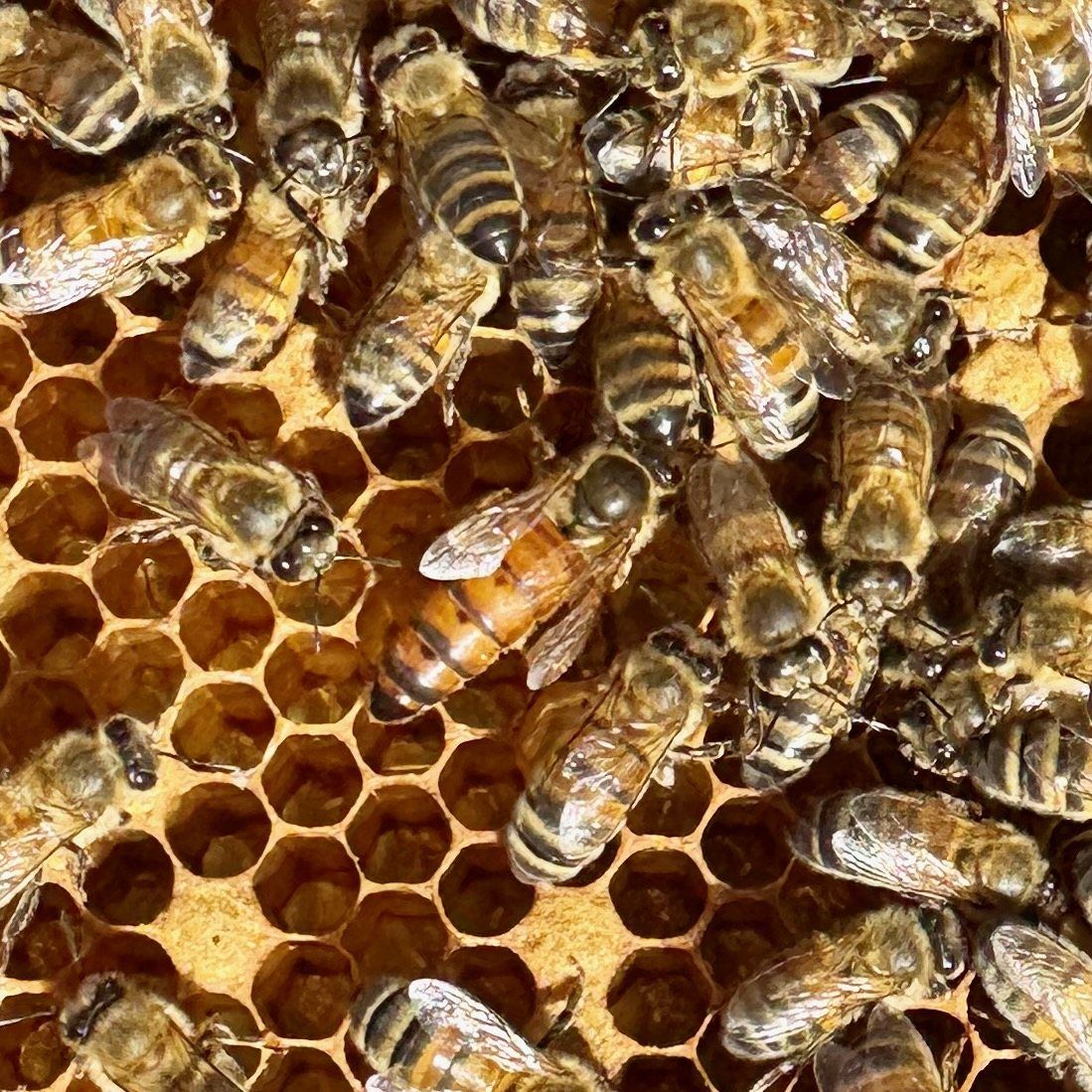
The Italian bee, A. m. ligustica, from the Italian peninsula, is the most common bee in US beekeeping and the default in most package bees. Its traits, as described by breeders and extension services:
- Color: yellow to leather-colored, with bright bands on the abdomen. Queens are easy to spot.
- Temper: generally gentle and calm on the comb.
- Build up: early and strong, with large colonies that suit honey production and pollination contracts.
- Weaknesses: it keeps rearing brood when nectar stops, so it eats through stores in a dearth and in winter; it drifts and robs readily.
Italians do well where seasons are long, in the South, California and the Pacific coast. In the northern states they need heavy winter stores and shelter from wind. “Cordovan” bees, a very yellow color mutation within Italian stock, are a variant, not a separate breed.
Carniolan bees: gentle and thrifty
The Carniolan bee, A. m. carnica, comes from the eastern Alps and northern Balkans, around Slovenia and Austria. US Carniolans are breeders’ lines of this type.
- Color: dark gray-brown, with short gray hairs.
- Temper: very gentle, often workable with little smoke.
- Build up: slow in winter, explosive as soon as pollen comes in, which suits early fruit bloom and dandelion.
- Winter: small clusters that use little honey, which is why they are popular in the Northeast, the Midwest and the Northern Plains.
- Weaknesses: a strong tendency to swarm in spring if space and swarm control fall behind, and a sharp cut in brood rearing during a dearth.
A Carniolan colony can go from four frames of bees to swarming in a few weeks in May. Our guide to swarming covers the control methods.
Italian or Carniolan for a first hive?
Both are good beginner bees, and the choice depends mostly on where you live and how you will manage space:
- Choose Italians if your season is long, your winters are mild and you want a colony that builds steadily without sudden swarming pressure. Plan to feed in a summer dearth and leave enough honey for winter.
- Choose Carniolans if winters are long and cold, or if you will check the hive every 7 to 10 days in spring and add boxes or split before the colony runs out of room.
- Whatever you pick, ask the producer whether the queens were open mated or instrumentally inseminated, where the mating yards are, and whether the line was selected for mite resistance or hygienic behavior.
Because a queen mates with many drones, her daughters raised in your apiary will reflect the drones flying near you. After one or two rounds of natural requeening, most American colonies end up as local mixtures whatever was in the original package.
Russian bees: selected in Primorsky
In 1997, USDA-ARS scientists at the Baton Rouge Honey Bee Breeding, Genetics and Physiology Laboratory imported about 100 queens from the Primorsky territory of far eastern Russia. Honey bees there had lived alongside Varroa for far longer than in Europe or America. After quarantine on an island and years of testing, with resistance to varroa as the main selection criterion and resistance to tracheal mites, honey production and chalkbrood also considered, ARS began releasing Russian stock to queen breeders in 2000.
NC State Extension’s comparison, written by David Tarpy with commercial beekeeper Jeffrey Lee and updated in December 2025, describes Russian bees as:
- more than twice as resistant to varroa mites as other honey bees, and highly resistant to tracheal mites;
- holding back colony growth until pollen is available, and halting brood rearing when it runs short, where Italians keep a large brood nest whatever the conditions;
- keeping active queen cells throughout the brood-rearing season, which beekeepers used to Italians often misread as swarm preparation;
- able to produce about as much honey as standard stocks, if not more;
- sometimes more defensive, especially in the second generation.
Pure Russian stock is kept by certified breeders who maintain its genetic identity. A “Russian hybrid” from a general supplier may carry only part of these traits.
Mite-resistant American stocks: VSH, Pol-line, Minnesota Hygienic and mite-biters
Several US programs have bred bees that slow varroa mite growth. The Honey Bee Health Coalition’s 2026 guide lists them, alongside Carniolan and Buckfast lines, but warns that there is “no standardization or labelling for ‘varroa-resistant’ stock”. Ask how a line was tested before you pay for it.
VSH and Pol-line
Varroa sensitive hygiene (VSH) is the ability of workers to detect and remove pupae in cells where varroa mites are reproducing. It was developed at USDA-ARS in Baton Rouge. In a trial in Alabama from 2004 to 2006, reported by Robert Danka and colleagues in 2008, on average 12% of VSH colonies reached the mite treatment threshold at any sampling time, against 24% of Russian and 40% of Italian colonies. In the authors’ words, “the need for treatment of VSH colonies was half that of Russian colonies and 30% that of Italian colonies”.
Pol-line bees are a VSH-derived line selected within commercial beekeeping operations. In a study published in Scientific Reports and announced by ARS in April 2022, colonies were tracked in commercial operations in Mississippi, California and North and South Dakota:
| Varroa treatment | Pol-line winter survival | Standard colonies |
|---|---|---|
| No fall treatment | 62.5% | 3% |
| Treated in fall and December | 72% | 56% |
Minnesota Hygienic and Purdue mite-biters
- Minnesota Hygienic bees come from a breeding program Marla Spivak started at the University of Minnesota in 1993, selecting for hygienic behavior: workers detect and remove diseased and mite-infested brood. In SARE-funded field trials, hygienic colonies showed good resistance to American foulbrood in 1998 and 1999 and, after a year without treatment, significantly lower varroa levels than commercial stock while producing as much honey.
- Purdue mite-biters, from Purdue University in Indiana, are selected for workers that groom and bite varroa mites off adult bees. Purdue began breeding for mite resistance in 1997, first for grooming and from 2007 for mite biting. The share of fallen mites with chewed legs rose from about 3% to nearly 50%. Breeder queens are distributed through the Indiana Queen Breeders Association and the Heartland Honey Bee Breeders Cooperative.
None of these stocks lets you stop monitoring. Our guide to varroa mites covers alcohol washes, thresholds and EPA-registered treatments.
Buckfast and Caucasian bees in the US
The Buckfast is a hybrid line created at Buckfast Abbey in Devon, England, by Brother Adam (Karl Kehrle, 1898 to 1996). The abbey says the so-called Isle of Wight disease epidemic killed 29 of its 45 colonies; a chronology hosted by the University of Namur records 16 survivors out of 46 in 1916, all headed by Italian or Carniolan stock. That convinced him crossing could give a hardier bee, and he made his first cross in 1917, two years before he took charge of the apiaries. He crossed stocks collected across Europe and the Middle East at an isolated mating apiary on Dartmoor and fixed the result by selection. Buckfast bees are bred for a gentle temper, low swarming and good wintering, but they are kept true only by controlled mating, and they are far less common in the US than Italian or Carniolan stock.
The Caucasian bee, A. m. caucasica, from the mountains between the Black and Caspian Seas, was popular in the US in the early twentieth century. It is very gentle and has a long tongue, but it uses large amounts of propolis, gluing frames together, and builds up slowly. Few producers keep it pure today.
What happened to the dark European bee?
The dark European bee, A. m. mellifera, the bee of the Jamestown hives, was the honey bee of American farms for more than two centuries. Once Italian stock became available after 1859, commercial beekeepers switched to it, and the queen and package trade spread Italian genetics across the country. The dark bee is not sold as a stock in the US today. Its genes survive mainly as the remnant that Carpenter’s research detected in modern American colonies, and in feral colonies that have mixed with managed bees for generations.
Africanized honey bees: what beekeepers in the South need to know
Where they came from
African honey bees, A. m. scutellata, were taken to Brazil in the 1950s to breed a bee better suited to the tropics. According to USDA-ARS, they reached the Brazilian wild in 1957 and spread north through South and Central America. The first swarm identified in the US was found just outside Hidalgo, Texas, on October 19, 1990. By 2004, ARS listed Africanized bees in southern California, Arizona, New Mexico, Nevada and Texas, plus Puerto Rico and the US Virgin Islands. Florida’s first documented arrival was in 2001, near the Port of Tampa, according to UF/IFAS Extension, and they have since spread through the southern half of the state.
How they differ
- Defensiveness: UF/IFAS describes them as considerably more defensive than European bees. A colony may send out several hundred to thousands of bees and chase an intruder for 400 yards (about 365 m) or more. Their venom is not stronger; the danger is the number of stings.
- Reproduction: colonies grow and swarm more often, so wild Africanized colonies can dominate an area.
- Mating: ARS reports that European queens mate disproportionately with African drones, which Africanized colonies produce in large numbers. An open-mated queen in these areas can come back a hybrid.
- Takeover: Africanized swarms invade European colonies and replace the queen, a behavior called nest usurpation, which reached 20 to 30% of colonies in Arizona studies.
- Dominance: queen behavior and defensiveness are among the African traits that are genetically dominant.
What to do in an Africanized area
- Buy marked queens from inspected, certified producers, and requeen any colony with an unmarked queen.
- Requeen any colony that turns highly defensive, as UF/IFAS advises.
- Keep apiaries away from people and animals, with a barrier or flight path upward.
- Follow your state’s rules. In Florida, rule 5B-54.0105 sets where managed colonies may be located, requires apiary locations to be registered with the Florida Department of Agriculture and Consumer Services, and makes colonies on non-agricultural land follow the best management requirements of a beekeeper compliance agreement.
Requeening a defensive colony
Requeening a hot colony is the main tool in Africanized areas, and it is easier in calm, warm weather during a flow:
- Order a marked, mated European queen from a certified producer before you start.
- Move the colony a few yards and put an empty box on the old site, so that many of the most defensive foragers return there and can be dealt with separately.
- Find and remove the old queen, wearing full protection and using plenty of cool smoke.
- Introduce the new queen in her cage with a candy plug, and check for release after several days.
- Look for queen cells about a week later and destroy any you find, because the colony may try to raise a queen from its own brood.
After about six weeks, most workers will be daughters of the new queen and the colony’s temper should reflect hers. If it stays very defensive, or if you are not comfortable working it, ask your state apiarist or a local beekeeper with removal experience for help.
You cannot identify Africanized bees by eye. Laboratory identification uses wing and body measurements or DNA, which your state apiarist can arrange.
Honey bee breeds compared
Typical traits as described by breeders, extension services and USDA-ARS. Every stock varies by producer.
| Trait | Italian | Carniolan | Russian | VSH / Pol-line | Africanized |
|---|---|---|---|---|---|
| Lineage | C | C | mostly C, with other ancestry | selected lines of mixed ancestry | A |
| Color | yellow | dark gray-brown | dark | variable | looks like European bees |
| Temper | gentle | very gentle | variable | usually gentle | highly defensive |
| Spring build up | early, steady | explosive | follows the flow | depends on base stock | fast |
| Swarming | moderate | high | moderate, keeps queen cells | depends on base stock | very high |
| Winter stores needed | high | low | low | depends on base stock | not adapted to cold winters |
| Varroa tolerance | low | low | good | good | moderate |
| Best fit | South, California, long seasons | North, short seasons | North, low-treatment beekeeping | everywhere | not for beekeeping |
Which bees should you buy for your region?
Match the bee to your climate
- Northeast, Midwest and Northern Plains: long, cold winters. Carniolan, Russian and mite-resistant lines, which winter in small clusters, are popular. Italians work if you leave ample stores.
- South and Gulf Coast: long seasons and early springs suit Italians. In Africanized areas of Texas, Florida and the Gulf states, buy marked queens from certified producers and requeen promptly.
- Southwest: Africanized bees are widespread in Arizona, New Mexico, southern Nevada and southern California. Requeening with European stock is the main defense.
- California: the center of US package and queen production and of almond pollination each February. Many commercial operations there run Italian-type stock.
- Pacific Northwest: mild, wet winters and a late spring. Carniolans and mite-resistant lines from northern producers tend to suit it better than southern packages.
Why local adaptation matters
The European GEI experiment, run by the COLOSS research network from 2009 to 2012, set up 621 colonies of 16 origins in 21 apiaries across 11 countries without varroa treatment after an initial oxalic acid dose. According to Fani Hatjina’s summary for the Eva Crane Trust, local colonies survived an average of 553 days, against 470 days for non-local ones. No strain was best everywhere. The study was European, but the lesson travels: queens from a producer in your climate, or from local beekeepers selecting survivors, often do better than bees raised in a very different region.
What it costs
At October 2026 prices, a mated production queen costs around $45 plus shipping. Lappe’s Bee Supply in Iowa, for example, lists a Carniolan queen at $44.95. Breeder queens from VSH, Pol-line or mite-biter programs cost much more but can mother hundreds of daughters. Our guides on how to start beekeeping and queen rearing cover packages, nucs and raising your own.
Packages, nucs or a new queen?
- A package is about 3 lb (1.4 kg) of bees shaken from several colonies, with a caged queen, usually from producers in California or the Southeast. It is the cheapest way to get a given stock, but the colony has to build all its comb.
- A nuc is a small colony on four or five frames with brood and a laying queen, often from a local beekeeper. It starts faster, and you can see how the queen lays and how the bees behave before you take it home.
- A new queen in an existing colony is the cheapest way to change stock. Within about six weeks, the workers will mostly be her daughters.
How to judge a stock in your own apiary
Keep a simple record for each colony: temper, calmness on the comb, spring build up, swarming, honey yield, winter survival and mite counts from regular alcohol washes or sugar rolls. After two seasons, these notes tell you more about a stock in your conditions than any catalog. Breed from, or buy more of, the colonies that score well, and requeen those that do not.
What state rules apply when you buy or move bees?
Beyond the federal import rules, each state sets its own apiary law, and rules differ widely. A few examples:
- Texas: anyone selling queens, nucs or packages must provide a Texas Apiary Inspection Service health certificate, valid one year from inspection, or a signed, notarized affidavit with every sale. Bees entering Texas from another state need a health certificate and a $200 interstate permit.
- Florida: under rule 5B-54.0105, apiary locations must be registered with FDACS, colonies on non-agricultural land need a beekeeper compliance agreement with best management requirements, and queen producers follow a separate honey bee queen compliance agreement.
- Hawaii: live bees cannot be imported into the state.
Rules on registration, inspection and moving colonies also vary in other states. Check with your state department of agriculture or state apiarist before you order bees from another state, and see our guide to beekeeping laws by state. Our page on bee strains gathers the other articles on breeds and breeding.
Frequently asked questions
What is the best honey bee for beginners?
Italian or Carniolan stock from a reputable US producer is the usual starting point, because both are gentle and widely available as packages and nucs. Italians suit long seasons in the South and California; Carniolans winter on less food in the North. Temper and mite tolerance vary more between producers than between breeds, so ask your local bee club which suppliers do well in your area.
Are honey bees native to the United States?
No. The western honey bee, Apis mellifera, evolved in western Asia and spread into Africa and Europe. The first recorded hives reached Jamestown, Virginia, from England in 1622. North America's thousands of native bee species include bumble bees, mason bees and sweat bees, but none of them is a honey bee.
What is the difference between Italian and Carniolan bees?
Italians are yellow, build large colonies early and keep rearing brood through dearths, so they need more stores in winter and can rob. Carniolans are dark gray-brown, cut brood rearing when nectar stops, winter in small clusters and explode in spring, which makes them prone to swarming. Both are gentle. In the North many beekeepers favor Carniolans; in the South and California, Italians.
Are Russian bees good for beginners?
They can be, if you understand their rhythm. Russian bees, imported by USDA-ARS from far eastern Russia in 1997, were selected for resistance to varroa and tracheal mites. They hold back brood rearing until pollen comes in and keep active queen cells through the season, which can surprise a beginner. Buy from a breeder certified through the Russian program rather than a vague Russian hybrid.
Can I import queen bees into the US?
Only from Canada and New Zealand. USDA APHIS allows adult queens and package bees from those two countries into the continental United States, prohibits them from Australia and bans whole colonies from anywhere. Imports from other countries are restricted to universities and government research. Hawaii is separate: live bees cannot be brought into the state at all.
How can I tell if my bees are Africanized?
You cannot tell reliably by looking. Africanized and European workers look almost identical, and laboratory identification uses wing and body measurements or DNA. The practical sign is behavior: many bees pouring out at a small disturbance, chasing far from the hive and staying agitated for hours. In Africanized areas, buy marked queens from certified producers and requeen any colony that turns highly defensive.
Is there a varroa resistant honey bee?
Several US stocks resist varroa better than standard bees, including VSH, Pol-line, Russian and Purdue mite-biter lines. In a USDA-ARS study, untreated Pol-line colonies survived winter at 62.5%, against 3% for standard colonies. None is immune, and the Honey Bee Health Coalition warns that varroa-resistant labels are not standardized. Keep monitoring mites with any stock.
How much does a queen bee cost in the US?
A mated production queen from a US supplier costs around $45 in October 2026, plus shipping: one Iowa supplier lists a Carniolan queen at $44.95. Instrumentally inseminated breeder queens from VSH, Pol-line or other selection programs cost much more. Prices change every season, so compare several producers and ask your local bee club which suppliers do well in your area.
Sources
- A worldwide survey of genome sequence variation provides insight into the evolutionary history of the honeybee Apis mellifera (Nature Genetics, 2014), Wallberg et al., University of Pretoria repository
- Where did western honey bees come from? New research finds the sweet spot (Dogantzis et al., Science Advances, 2021), York University
- What is the North American honey bee? (PolliNation podcast, episode 195, October 2021), Maddie Carpenter and Andony Melathopoulos, Oregon State University Extension
- Honey bees and other bees: import requirements, USDA APHIS
- Release of USDA-ARS Russian honey bees, USDA-ARS Honey Bee Breeding, Genetics and Physiology Laboratory, Baton Rouge
- Comparison of Russian and Italian honey bees (AG-655, December 2025), David Tarpy and Jeffrey Lee, NC State Extension
- Status of bees with the trait of varroa sensitive hygiene (VSH) for varroa resistance (American Bee Journal, January 2008), Robert G. Danka et al., USDA-ARS, Baton Rouge
- ARS-developed varroa-resistant honey bees better winter survivors (April 7, 2022), USDA Agricultural Research Service
- Purdue honey bee breeding program, Purdue University, Department of Entomology
- Tools for Varroa Management, 9th edition (2026), Honey Bee Health Coalition
- A sustainable approach to controlling mite pests of honey bees (project LNC97-117), Marla Spivak, University of Minnesota, SARE
- What's buzzing with Africanized honey bees? (Agricultural Research, March 2004), USDA Agricultural Research Service
- Living with the African honey bee (ENY-170, revised November 2024), J. D. Ellis and M. Bammer, UF/IFAS Extension
- Fla. Admin. Code R. 5B-54.0105, location of managed honey bee colonies, Legal Information Institute, Cornell Law School
- Regulations, Texas Apiary Inspection Service, Texas A&M AgriLife
- Compliance with beekeeping laws in Hawaii, University of Hawaii at Manoa, CTAHR
- Our bees: history of the Buckfast Abbey bee department, Buckfast Abbey
- Importance of adaptation of bee populations on their local environment, Fani Hatjina, Hellenic Agricultural Organization DEMETER, via the Eva Crane Trust
- Carniolan queen bee (price checked October 2026), Lappe's Bee Supply
- Tracheal mite, USDA-ARS Bee Research Laboratory, Beltsville