Honey bee swarming: signs, swarm prevention, splits, catching swarms and Africanized bees
Swarm prevention for US beekeepers: why bees swarm, swarm cell signs, splits, Demaree and checkerboarding, catching swarms, regional seasons and state rules.
Swarm prevention means managing a colony so that it does not reproduce by swarming, when the old queen flies off with half or more of the workers to start a new nest and leaves the rest to raise a new queen. Most US colonies try to swarm in spring, just before and during the main nectar flow. You prevent it by giving room before the hive fills, keeping young queens, equalizing colonies and inspecting every seven to nine days, and, once queen cells with larvae appear, by splitting the colony yourself.
A colony that swarms at the start of the flow rarely makes a honey crop that year, and a swarm that settles in a neighbor’s wall can become a costly removal job. A split made on your schedule gives you a new colony and a new queen instead. In the southern states, swarming has a second dimension: where Africanized honey bees are established, an uncontrolled swarm or a captured wild one can bring Africanized genetics into your apiary.
Why do honey bees swarm?
A honey bee colony is a superorganism, described in our guide to the honey bee colony. It reproduces not by laying more eggs but by dividing, and swarming is how it divides.
The main triggers
University of Florida Extension stresses a nuance: colonies swarm because they are crowded, not simply because they are strong. Several pressures build up together:
- Brood nest congestion. In spring, the queen lays at full speed and two 10-frame deeps fill quickly with brood, bees and nectar. When the queen runs out of empty cells, swarm preparations start. An 8-frame hive fills sooner.
- Backfilling. During a flow, bees store nectar in cells as brood emerges. The brood nest shrinks, the queen has less room still, and the colony is “honey bound.”
- Queen pheromone that no longer reaches everyone. In a packed colony, the queen’s mandibular pheromone, which suppresses queen rearing, spreads poorly. Colonies with young queens are less inclined to swarm, which is why UF recommends requeening every year.
- Season. European colonies tend to swarm in early spring, just before and during the principal flow, once drones are flying.
- Genetics. Some lines swarm more than others. Selecting against swarming is part of queen rearing. Africanized colonies, according to the USDA’s Carl Hayden Bee Research Center in Tucson, may swarm as often as every six weeks during swarm season, compared with about once a year for European colonies, and can throw several swarms each time.
Swarm cells, supersedure cells and emergency cells
Not every queen cell means a swarm is coming.
| Type of cell | When you see it | Where | How many | What to do |
|---|---|---|---|---|
| Swarm cells | crowded colony, spring flow | along the bottom bars and edges of brood frames | often many | act at this inspection |
| Supersedure cells | old or failing queen being replaced | on the face of the comb | one to a few | usually let the bees proceed |
| Emergency cells | queen lost or killed | on the face, built over worker cells | variable | look for eggs; do not destroy them |
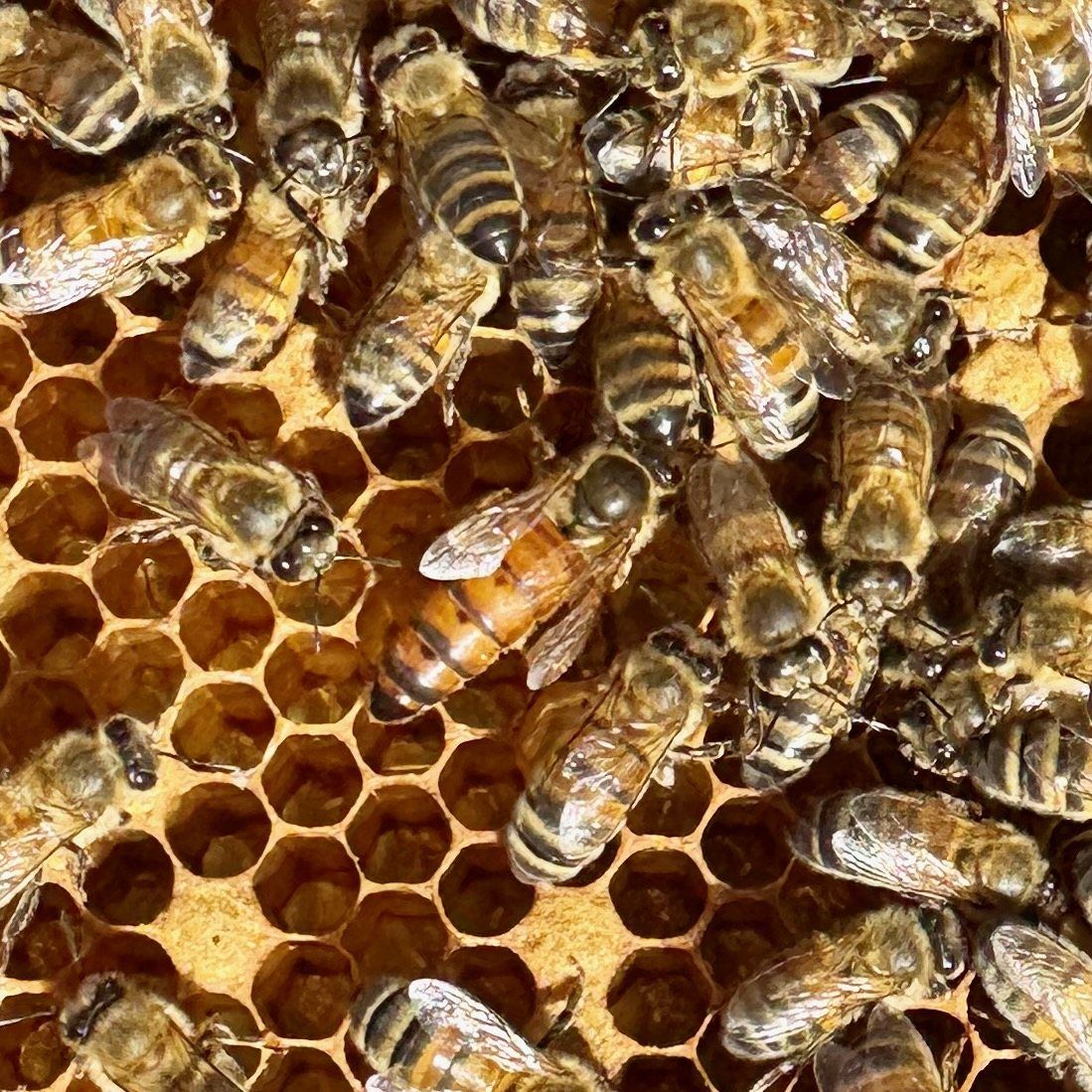
Empty queen cups mean little. A cup holding an egg, or a larva floating in royal jelly, is the sign that preparations have begun. Our page on the queen bee explains how to find and assess the queen.
What are the signs a hive is about to swarm?
Inside the hive
- Queen cells with eggs or larvae, often hidden along the bottom bars. Tip each brood frame up to look underneath.
- A brood nest packed wall to wall, with nectar backfilled into the brood area.
- Fewer eggs. Workers slim the queen down before a swarm so she can fly, and her laying drops.
- The queen has moved up into the top deep, leaving the bottom box empty of brood.
Signs outside, such as bees bearding on the front of the hive, are unreliable: bearding is common on hot, humid evenings. Only an inspection tells you.
The countdown
A queen develops in 16 days from egg to emergence: her cell is capped about 8 days after the egg is laid, and the virgin emerges about 8 days later. The prime swarm usually leaves around the time the first cell is capped, on a warm, calm day.
| What you find | Approximate time left | What you can still do |
|---|---|---|
| eggs in queen cups | about a week | split or Demaree; checkerboarding is too late |
| larvae in royal jelly | a few days | split now, or Demaree |
| capped queen cells | the swarm may leave today, or may have left | check the population; split, keeping the queen cells |
That is why UF recommends inspections every seven to nine days from about four weeks before the main flow: a colony with no started cells at one inspection is unlikely to swarm before the next.
What happens when a colony swarms?
Who leaves and who stays
UF Extension reports that 50 to 70% of the workers leave with the old queen, while the parent colony keeps 30 to 50% of the bees, all the brood and several developing queens. In a study reviewed by Clarence Collison in Bee Culture, Rangel and Seeley (2012) measured an average of 75%.
Fell and colleagues (1977) weighed 126 swarms in Ithaca, New York: 3.4 lb (1.53 kg) on average, about 11,800 bees, roughly the size of a 3-lb package. In southeastern Louisiana, USDA-ARS entomologist José Villa (2004) weighed 95 swarms at an average of 3.1 lb (1.42 kg), from 0.4 to 9.5 lb (0.17 to 4.3 kg). Before leaving, the bees fill up on honey and warm their flight muscles to at least 95 °F (35 °C), according to Seeley and colleagues (2003).
The cluster and the house hunt
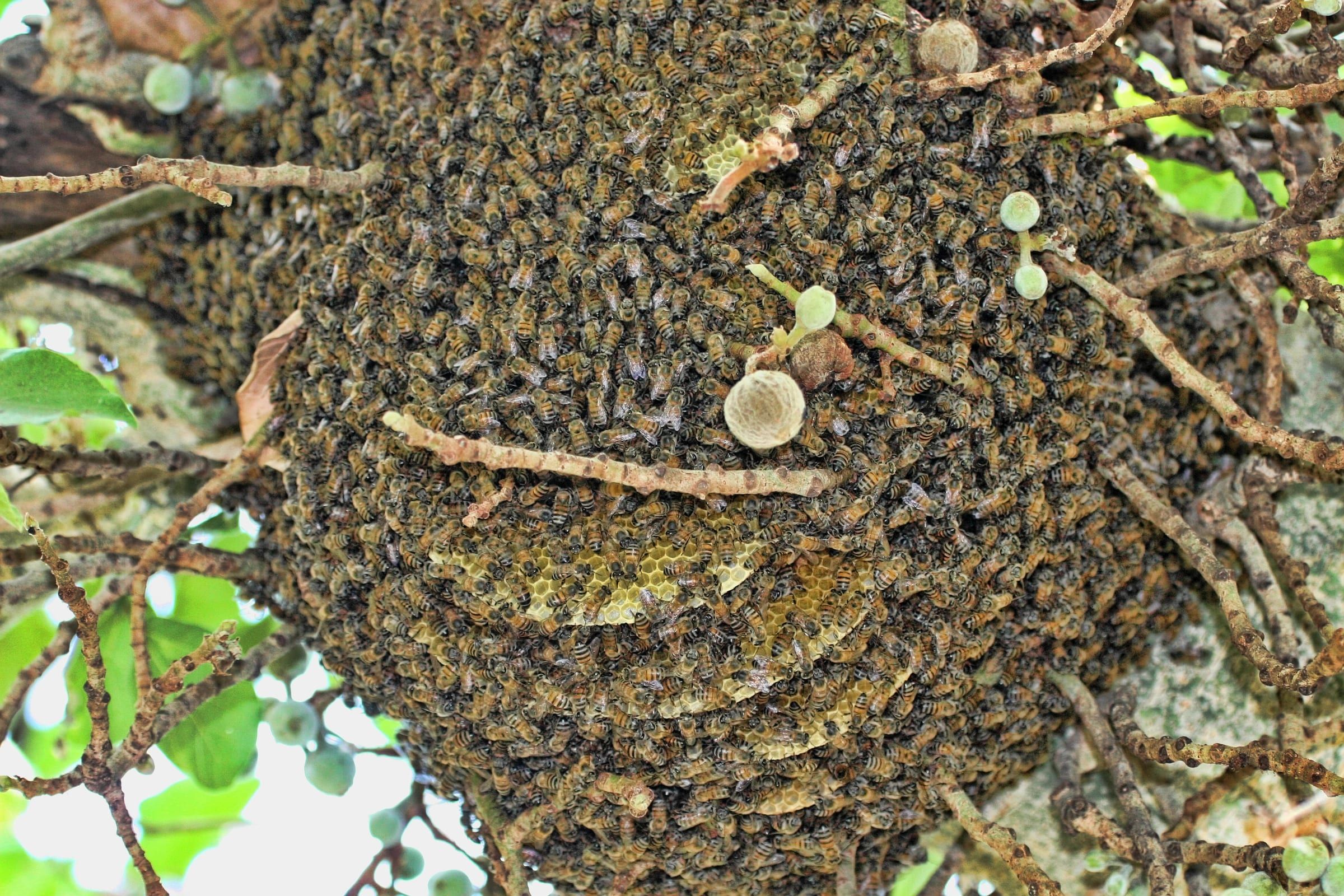
The swarm first settles nearby, often on a branch or a fence: the University of California notes that clusters usually form within 100 to 200 yards of the original hive. About 5% of the bees are scouts (Beekman and colleagues, 2006), which inspect cavities up to several miles away and advertise them with dances on the cluster. Once a quorum of 10 to 15 or more scouts gathers at one site, the swarm prepares to leave (Seeley and Visscher, 2003). UF says the choice can take minutes or up to four days; Villa measured about 20 daylight hours of scouting on average.
Villa followed swarms moving from 650 ft (200 m) to 6 miles (10 km), 2.1 miles (3.36 km) on average. In the same study, swarms chose 8-gallon (31-liter) boxes 37 times against 16 times for 3.4-gallon (13-liter) boxes. MAAREC’s Basic Bee Biology for Beekeepers puts the preferred cavity at about 10.6 gallons (40 liters), within a range of 5 to 26 gallons (20 to 100 liters), with a small entrance near the bottom, about 9 ft (3 m) up and facing south. A single 10-frame deep holds roughly 40 liters, which makes it a ready-made swarm trap.
Afterswarms
When the first virgin queen emerges in the parent colony, she may kill her rivals or leave with part of the remaining bees in an afterswarm, or secondary swarm. Afterswarms are smaller and can follow one another, leaving the parent colony too weak to make a crop, or queenless if the last virgin is lost on her mating flight. A virgin queen mates with about 15 drones over several flights, according to UF.
How do you prevent swarming?
UF advises watching for swarm signs from early spring, two to four weeks before the main flow, and starting prevention about four weeks before it.
The main measures
| Measure | How it works | Limits |
|---|---|---|
| Inspections every 7 to 9 days | find queen cells before they are capped | essential through the swarm season |
| Reversing deeps | put the crowded upper deep on the bottom so the queen has room to move up | only works before cells are started, and only if brood is not split across both boxes |
| Space in time | supers on before the brood boxes are full; drawn comb in the brood nest | necessary, not sufficient once cells exist |
| Equalizing | move frames of brood and bees from strong colonies to weak ones | only between healthy colonies, as brood diseases travel with the frames |
| Young queens | UF recommends requeening yearly with European queens from a reputable source | ideally 4 to 6 weeks before the main flow, or in late summer |
| Clipping the queen | cut about half of one forewing, as UF describes | a safety net: the swarm returns without her, then may leave with a virgin |
| Cutting queen cells | destroy cells every 7 to 9 days | never enough alone; one missed cell is enough |
Checkerboarding
Checkerboarding, refined and named by the late Walt Wright, works on the honey above the brood nest rather than the brood itself. According to Rusty Burlew (Honey Bee Suite), it is done in early spring, before the bees start swarm preparations, on a day of at least 60 °F (16 °C). In the two supers directly above the brood nest, alternate frames of capped honey with empty drawn comb, so that both boxes read full, empty, full, empty. The idea is that the colony sees room overhead and keeps expanding instead of preparing to swarm. Once swarm cells appear, it is too late.
How to split a hive to prevent swarming
A split, or artificial swarm, turns the swarming urge into increase. UF suggests taking 2 to 4 frames of bees and brood from strong colonies to make a nuc. The parent colony loses its congestion, and the nuc raises or receives a queen.
The walkaway split
- Set up a nuc or a single deep next to the hive.
- Move 2 to 4 frames of brood with their bees, including at least one frame of eggs or queen cells, plus a frame of honey and pollen.
- Shake in the bees from one or two more frames, because older bees will fly back to the parent hive.
- Make sure the old queen is in the hive you intend her to be in.
- Give the queenless side a mated queen, a queen cell, or let it raise one from eggs. Raising one takes roughly four weeks before a new queen is laying.
- Feed light syrup if there is no flow, and leave the queen-raising side alone while the virgin mates.
The Michigan “easiest split”
In her 2026 swarm management handout, Meghan Milbrath (Michigan State University) describes a split for when colonies show backfilling and brood to the edges of the frames: mark every other frame in the hive, move the marked frames to a new set of boxes, and center the unmarked frames in the original, filling the gaps with drawn comb. After four days, eggs show which box has the queen; give the other a mated queen or a queen cell, or let it raise its own.
Splits and varroa
A split also creates a brood break. The Honey Bee Health Coalition lists splits among the practices that slow mite growth during population increase, but warns that a brood break is not a stand-alone strategy: combine it with a well-timed miticide. Our guide to varroa mites covers monitoring and treatment.
The Demaree and Taranov methods
Demaree
George Demaree published his method in the American Bee Journal in 1884, according to the Eastern Apicultural Society. It separates the queen from her brood while keeping the whole colony together for the flow. EAS notes that it works best in a strong flow and needs as much extra equipment as the hive already has.
- Lift the hive off its bottom board and set a new deep of drawn comb on it. Take out two center frames.
- Find the queen and put her, with two frames of capped brood, in the center of the new deep. Remove any swarm cells.
- Add a queen excluder and one or more empty supers.
- Put the original brood box on top, brood pushed to the center and the two spare drawn frames on the outsides.
- After 7 to 8 days, destroy any queen cells in the top box. After that, the brood is too old to produce new queens.
Burlew warns that the method is heavy, risks injuring the queen, and is dangerous in a severe cold snap, when there may not be enough bees to cover both brood boxes. A colony may need a second Demaree later in the season.
Taranov
Devised by the Russian G. F. Taranov in 1947, this method separates swarm-ready young bees from foragers without finding the queen. Burlew describes a ramp at about 45° running from the ground up to the entrance but stopping about 4 in (10 cm) short of it, with a strip of burlap or carpet attached 2 to 3 in (5 to 8 cm) below its top edge.
- Use it when the colony is about to swarm, as queen cells are being capped. Midday suits it, when many foragers are out.
- Spread a sheet over the ramp and the ground around it, then shake every frame onto it. Brush, do not shake, frames with ripe queen cells.
- Return the frames and close the hive.
- Over 1 to 2 hours, foragers fly across the gap into the hive, while the young bees and the old queen cluster under the ramp.
- Hive that cluster like a swarm, far enough away that it does not return to the parent colony, which raises a new queen.
Which method should you use?
| What you find | Method | Why |
|---|---|---|
| crowded, no queen cells, early spring | reversing, checkerboarding, more space | simple prevention |
| eggs or young larvae in cells, flow coming | Demaree | keeps the whole force for the honey crop |
| capped cells | walkaway split or Taranov | the swarm is imminent: separate the queen from the cells |
| queen cannot be found | Taranov or the “easiest split” | no need to find the queen |
| you want more colonies | walkaway split | a new colony and a brood break against mites |
How to catch a bee swarm
Equipment
A nuc box or a 10-frame deep with drawn comb or foundation, a bed sheet, a spray bottle of water, pruning shears, a bee brush, a smoker, a stable ladder, and your veil and suit. Most swarms are gentle, but a sting at the top of a ladder is how accidents happen.
Taking the swarm
- Get permission from the property owner, and check the site: power lines, traffic, height.
- Hold the box under the cluster and give the branch one sharp shake, or cut a small branch and lower it in.
- Watch the entrance. Bees fanning with their abdomens raised mean the queen is inside. Bees flying back to the branch mean she is not: repeat.
- Wait until dusk, when the stragglers have gone in, then close and move the box. UC notes that beekeepers usually remove the box after dark.
- Set the swarm in its permanent spot. If it came from your own apiary, put it far enough away that it does not drift back.
Swarm traps
A swarm trap is a box of about 40 liters, such as a single deep, with an old brood comb inside and a small entrance, mounted about 9 ft (3 m) up and facing south, following the MAAREC criteria. Many beekeepers add a commercial swarm lure or a few drops of lemongrass oil, which mimics the bees’ Nasonov scent. Check traps every week in swarm season.
After hiving
- Feed light 1:1 syrup if there is no flow, because the swarm must build all its comb. Check after a week or two for eggs; an afterswarm has a virgin queen that still has to mate.
- Treat for mites early. The Apiarist reports research by Wilde and colleagues showing that 25 ± 9% of a colony’s mites left with a natural swarm and 36 ± 11% with a Taranov swarm. In the first days, before the first brood is capped, all the mites are on the adult bees. The Honey Bee Health Coalition says mite levels should be managed even in newly established colonies such as swarms. EPA’s list of registered varroa products includes oxalic acid products such as Api-Bioxal, Api-Bioxal RTU, EZ-OX and VarroxSan. HBHC notes that EZ-OX and Api-Bioxal powder are 82 to 99% effective when no brood is present, according to their makers. Follow the label: it is the law.
- Requeen if you are in Africanized territory. See below.
- Register the colony if your state requires it. Our guide to beekeeping laws by state lists the rules.
What should you do about a swarm in your yard?
Is it really a honey bee swarm?
A honey bee swarm is a cluster of thousands of brown bees hanging in the open from a branch, a fence or an eave. A gray, papery ball is a wasp or hornet nest; a few bees going in and out of a hole in the ground are probably bumble bees or solitary bees. Beekeepers deal only with honey bees.
What to do
- Leave it alone. USDA-ARS notes that swarms are generally docile because they have no brood or food to defend, and they usually move on within 24 to 48 hours. Stings happen when people disturb them.
- Do not spray it with water or insecticide. UC points out that bees sting when struck or sprayed, and pesticides for bees inside structures are restricted to licensed pest control operators.
- Keep children and pets indoors, and keep anyone allergic to stings well away.
- Call a beekeeper if it needs to be moved. Local clubs and state beekeeper associations often keep swarm call lists. In California, county agricultural commissioners can provide names of experienced beekeepers. UC notes that beekeepers may collect swarms for free but usually charge for removing an established colony from a wall.
- Act before it moves in. Once a swarm is inside a wall or soffit, it is a colony, and removal means opening the structure. In Texas, there is no such thing as a bee removal license, the Texas Apiary Inspection Service explains: it lists beekeepers by county who do live removals, but most are not licensed pest control operators and cannot use chemicals.
Africanized bees and swarms in the southern states
Africanized honey bees were first detected in the US in south Texas in 1990, according to NC State Extension. They reached Arizona in 1993, New Mexico and Southern California by 1995 and Nevada by 1998, and are now also established in southern Oklahoma, western Louisiana, southwestern Arkansas and southern Florida. In California, UC says Africanized bees have colonized all the southern counties.
What this means for swarms:
- They swarm more. USDA-ARS says Africanized colonies may swarm as often as every six weeks in season.
- You cannot tell by looking. Only testing can identify them. UC notes that Africanized clusters can be touchy, especially when they have run out of food.
- Keep your distance. USDA-ARS advises staying at least 100 ft (about 30 m) from any Africanized nest.
- Requeen captured swarms. In Florida, the FDACS Beekeeper Compliance Agreement (form FDACS-08492), which Rule 5B-54.0105 requires of beekeepers on non-agricultural land, makes requeening collected swarms with queens from European honey bee producers a condition. UF extension recommends requeening any unusually defensive colony with a marked European queen.
- Check before you collect. In Nevada, NAC 554.065 forbids collecting, relocating or removing feral honey bees in areas quarantined for Africanized bees without a Department of Agriculture permit, which costs $15 a year.
Rules differ from state to state. Before you collect swarms, call your state apiarist or department of agriculture.
Who owns a swarm? US law in brief
There is no federal rule on swarms. Property in animals is state law, and, as a letter in the October 2024 American Bee Journal points out, most states follow the logic of Pierson v. Post (New York Supreme Court, 1805): wild animals belong to no one until they are captured. Whether a managed colony’s swarm counts as domesticated or wild has not been settled the same way everywhere, and it matters: owners of domestic animals can sue over theft but may be liable for damage they cause.
In practice:
- Your swarm lands next door. Ask before entering. Trespass law applies whether or not you think the bees are yours.
- A swarm of unknown origin lands on your land. A beekeeper takes it with your permission.
- A swarm moves into your house. It is now a structural problem; see the removal advice above.
When is swarm season in the US?
There is no national calendar. Swarm season follows the first major nectar flow in each region.
| Region | Typical swarm season | Notes |
|---|---|---|
| Gulf South (southeastern Louisiana) | early April to early May | Villa found 80% of swarms within a 70-day window and nearly 20% in the last 10 days of April |
| Florida | early spring | UF: just before and during the principal flow; Africanized bees in the south of the state |
| Northeast (Ithaca, New York) | peak in the first two weeks of June; smaller peak late August to early September | frost-free season roughly mid-May to mid-September, per Fell and colleagues |
| Midwest (Michigan) | spring flow | MSU: give space around mid-April in Jackson County; split when backfilling starts |
| California | usually spring, sometimes later | UC: swarms when local conditions allow; Africanized bees in Southern California |
Our beekeeping calendar places these tasks in the year for each region.
| Period | Colony | Beekeeper |
|---|---|---|
| late winter | brood rearing restarts; California almond pollination in February | check stores, prepare nucs, boxes and swarm traps |
| early spring | fast build-up, drones appear | reverse deeps, checkerboard, equalize, set swarm traps |
| main flow | peak swarm risk | inspect every 7 to 9 days; split or Demaree when cells appear |
| early summer | fewer swarms, afterswarms possible | check splits and swarms for laying queens; treat broodless swarms for mites |
| late summer | in the North, a second smaller peak is possible | requeen with young European queens; monitor mites |
| fall and winter | no swarming | record which colonies swarmed, plan requeening |
Handled this way, swarm season is not a loss but your main source of new colonies and young queens.
Frequently asked questions
How do I keep my bees from swarming?
Start about four weeks before your main nectar flow. Give the colony room with drawn comb and supers before it fills, reverse the deeps if the queen has moved up, equalize strong and weak colonies and keep young queens. Inspect every seven to nine days. If you find queen cells with larvae, make a split so the old queen and the queen cells end up in different hives.
What should I do if a bee swarm lands in my yard?
Leave it alone, keep people and pets back and do not spray it with water or insecticide. Most swarms of European honey bees are docile and move on within one to two days. If it is in the way, call a local beekeeping club, many of which keep a swarm call list, or your county extension office or state department of agriculture for names of beekeepers.
Will a beekeeper remove a swarm for free?
Often, yes. University of California guidance notes that beekeepers may collect swarms for free but usually charge to remove an established colony from a wall, because that means opening the structure and repairing it. A swarm hanging on a branch is quick work; a cut-out can take hours. Ask in advance what the job includes, including sealing the entry holes afterward.
Are swarms Africanized bees?
In most of the country, no. Africanized honey bees are established in the southern tier, including Texas, Arizona, New Mexico, Southern California, Nevada and southern Florida. There, any swarm could be Africanized, and no one can tell by looking. Treat swarms with more caution in those areas, keep well away, and let an experienced beekeeper or licensed professional deal with them.
When is swarm season in the US?
It depends on the region. In southeastern Louisiana, a USDA study found swarming peaked from early April to early May. In upstate New York, the classic Ithaca study recorded a peak in the first two weeks of June, with a smaller one in late August. Most regions see swarms in spring, just before and during the main nectar flow.
Should I treat a swarm for varroa mites?
Yes. A swarm carries a large share of its mother colony's mites, and the Honey Bee Health Coalition says mite levels should be managed even in newly established colonies such as swarms. The best moment is in the first days, before the swarm's first brood is capped, when an EPA-registered oxalic acid product applied according to its label reaches all the mites.
Who owns a swarm that lands on my property?
There is no federal rule. Property in animals is a matter of state law, and most states follow the old common law on wild animals set out in Pierson v. Post, under which wild animals belong to no one until captured. Whether a swarm from a managed hive counts as wild is not settled the same way everywhere. Either way, a beekeeper following it needs your permission to come onto your land.
Does cutting out swarm cells stop swarming?
Rarely on its own. Cutting cells does not relieve the congestion that caused them, so the bees build new ones within days. University of Florida Extension recommends cutting every seven to nine days, starting about four weeks before the main flow, and only alongside other measures. One missed cell is enough for the colony to swarm, and cutting all cells after a swarm leaves the hive queenless.
Sources
- Swarm Control for Managed Beehives (ENY-160), James D. Ellis, Sara DeBerry and John Crowley, University of Florida IFAS Extension
- Swarming Behavior of Honey Bees (Hymenoptera: Apidae) in Southeastern Louisiana (Annals of the Entomological Society of America, 2004), José D. Villa, USDA-ARS
- A Closer Look: swarming, Clarence Collison, Bee Culture
- Weird Techniques for Swarm Control, Landi Simone, Eastern Apicultural Society
- How to prevent swarming with a Taranov board, Rusty Burlew, Honey Bee Suite
- Demaree demystified, Rusty Burlew, Honey Bee Suite
- How to checkerboard a hive, Rusty Burlew, Honey Bee Suite
- Swarm management handout (2026), Meghan Milbrath, Michigan State University Pollinator Initiative
- Tools for Varroa Management, 9th edition (June 2026), Honey Bee Health Coalition
- EPA-registered pesticide products approved for use against varroa mites in bee hives, US Environmental Protection Agency
- Africanized honey bees overview, USDA-ARS Carl Hayden Bee Research Center
- Africanized Honey Bees: Where Are They Now and When Will They Arrive in North Carolina?, David R. Tarpy and Jennifer J. Keller, NC State Extension
- Removing Honey Bee Swarms and Established Hives (Pest Notes 74159), E. C. Mussen, University of California Statewide IPM Program
- Beekeeper Compliance Agreement (form FDACS-08492, revised 12/17), Florida Department of Agriculture and Consumer Services
- Best Management Practices for Siting Honey Bee Colonies: Good Neighbor Guidelines (ENY115), James D. Ellis and Jerry Hayes, University of Florida IFAS Extension
- Africanized Honey Bee Collection and Movement Application (NAC 554.065), Nevada Department of Agriculture
- Bee Removal FAQ, Texas Apiary Inspection Service, Texas A&M AgriLife
- The Bee Nest (Basic Bee Biology for Beekeepers, MAAREC Publication 1.4), Mid-Atlantic Apiculture Research and Extension Consortium, via eXtension Bee Health
- Letters to the Editor: More on swarm ownership (October 2024), American Bee Journal
- Swarm and mite partitioning, David Evans, The Apiarist