Where to put a beehive: setbacks, local rules, sun or shade, water, bears and moving hives in the US
Beehive placement in the US: state and city setbacks, flyway barriers, sun or shade by region, entrance direction, water, bears, pesticides and moving hives.
Where to put a beehive in the US depends first on your state and city: there is no federal setback, but many states and municipalities set distances from property lines, hive limits per lot, flyway barriers and water rules, and an HOA can ban bees outright. Once the site is legal, pick level, well-drained ground with morning sun, shelter from winter wind, an entrance facing east or southeast and away from people, a 6-foot (1.8 m) barrier where hives are near a boundary, water within 100 yards (90 m), and forage within about 2 miles (3 km).
This guide is written for backyard and small-farm beekeepers in the Lower 48. Where advice changes with climate, we say which region we mean: the Northeast and Midwest, with cold winters; the South and Gulf Coast, with heat, humidity, small hive beetles and Africanized bees; and the West, from the Pacific Northwest to California. Rules quoted were checked in October 2026; city codes change often, so confirm the current text before you buy bees.
How far does a beehive have to be from a property line?
There is no federal law on where you can keep bees. Placement is set by three layers of rules, and you need to clear all three:
- State apiary law, administered by your state department of agriculture and its state apiarist. Many states require registration; some, like Florida, also regulate where colonies may sit.
- City or county code: zoning, animal-keeping ordinances or a beekeeping permit, often with setbacks, hive limits and barrier rules.
- Private restrictions: HOA covenants, deed restrictions and leases.
The examples below show how much the rules vary. They apply only in the places named; never assume another state or city works the same way. Our guide to beekeeping laws by state covers registration and inspections.
Florida: a statewide placement rule
Florida is unusual because the state, not cities, regulates where managed colonies go. Section 586.10 of the Florida Statutes says the state’s authority over managed honeybee colonies “supersedes any related ordinance adopted by a county, municipality, or political subdivision”. Every beekeeper with colonies in Florida must register with the Florida Department of Agriculture and Consumer Services (FDACS), and under Rule 5B-54.0105 a beekeeper on land not classified as agricultural must sign Beekeeper Compliance Agreement FDACS-08492. Its current version (12/17) requires:
| Tract size (non-agricultural land) | Maximum colonies | Temporary limit for swarm control (up to 60 days) |
|---|---|---|
| 1/4 acre or less | 3 | 6 |
| Over 1/4 to under 1/2 acre | 6 | 12 |
| Over 1/2 to under 1 acre | 10 | 20 |
| 1 to 2.5 acres | 15 | 30 |
| 2.5 to 5 acres | 25 | 50 |
| 5 to 10 acres | 50 | 100 |
| 10 acres or more | 100 | unlimited if all colonies are at least 150 ft (46 m) from property lines |
The same agreement requires:
- a flyway barrier at least 6 feet (1.8 m) tall (solid wall, fence, dense vegetation or a mix) when a colony is within 15 feet (4.6 m) of a property line, running parallel to the line and past the colony on both sides;
- a fence or equivalent barrier around the colonies, with a gated, controlled entrance;
- apiaries at least 150 feet (46 m) from tethered or confined animals and from public places people frequent, such as day care centers, schools, parks and parking lots;
- a water source on the property available to the bees at all times;
- monthly visual inspections, and requeening of collected swarms and new colonies with queens from European honey bee producers.
The compliance agreement also states that deed restrictions and covenants that prohibit or restrict managed colonies take precedence over Chapter 586. UF/IFAS Extension in Polk County puts it plainly: if an HOA prohibits beekeeping, residents cannot keep colonies there, regardless of state law.
Three cities, three approaches
| Los Angeles, CA | St. Paul, MN | New York City, NY | |
|---|---|---|---|
| Hive limit | 1 hive per 2,500 sq ft (232 m²) of lot | 2 colonies per 2,000 sq ft (186 m²), maximum 4 | Not set by the registration rules |
| Setbacks | 5 ft (1.5 m) from lot lines; 20 ft (6 m) from streets; not in the front yard | 10 ft (3 m) from property lines; 25 ft (7.6 m) from an occupied building on another lot; not in front | Hives placed so bees do not bother people or animals |
| Barrier | 6 ft (1.8 m) wall, fence or hedge, or hives at least 8 ft (2.4 m) above the neighbor’s ground | 6 ft (1.8 m) flyway barrier if within 25 ft of the line, extending 10 ft (3 m) each way | Not specified |
| Other | Entrances face away from or parallel to the nearest neighboring lot line; water on site at all times; county registration | Neighbor petition with 75% consent; beekeeping class in the last two years; fenced yard; sign readable at 5 ft; water on site | Free registration of each hive within 30 days, renewed by May 31 with the city and New York State; constant water source |
Los Angeles adopted its backyard beekeeping ordinance in October 2015 for single-family zones. St. Paul’s neighbor petition is one of the strictest requirements in the country; most cities have nothing like it. New York City counts aggressive bees, badly placed hives and overcrowded, dead or abandoned hives as nuisances.
Where to check your own rules
Start with your state department of agriculture’s apiary program, then your city or county planning or code enforcement office, then your HOA documents. Your land-grant university’s extension office or local beekeeping club usually knows which rules are actually enforced. Get anything unclear in writing before you set up.
How do you choose a good apiary site?
Forage within flying range
Bees prefer to forage within about 2 miles (3 km) of the hive and can travel up to 5 miles (8 km) if they must, according to Mississippi State University Extension. Texas A&M AgriLife adds that closer forage is better. Look at what blooms across the whole season within that radius, not just in your yard:
- Northeast and Midwest: maples and willows in early spring, fruit bloom, dandelion, black locust, then clovers and basswood in early summer, buckwheat where grown, goldenrod and asters in fall.
- South and Southeast: early red maple, citrus in Florida, gallberry, tupelo along river swamps in the Florida Panhandle and Georgia, sourwood in the Appalachians, and cotton or soybeans in farm country.
- Plains and Mountain West: alfalfa and sweet clover.
- California: almonds in February, used mostly by migratory pollination operations, then orange blossom, sage and wildflowers; in the Pacific Northwest, blackberry and fireweed.
A dearth in mid to late summer is common almost everywhere outside irrigated farmland. Be ready to feed if the area dries up. Our guide to plants for bees suggests what to plant near your hives.
Space between apiaries
Mississippi State recommends keeping at least 3 miles (5 km) between apiaries to reduce robbing and the spread of pests and pathogens. You cannot control your neighbors’ hives, but if you are choosing between two out-yard sites, pick the one without a large commercial yard next door.
Density matters in cities too. A 2020 review led by scientists at Kew in Plants, People, Planet warned that the call to “save the bees” has fueled urban beekeeping that may harm wild bee conservation through competition for limited forage and the spread of disease. More hives in a dense neighborhood does not mean more honey.
Ground, water and access
- Avoid flood plains and low spots. Mississippi State advises keeping away from flood-prone ground, drainage ditches and creeks. Cold air also pools in hollows on winter nights in the North.
- Firm, level ground with room to work behind each hive.
- Access in all weather. Mississippi State notes that out-yards on low or flat fields may need a four-wheel-drive truck or ATV after rain. A deep full of honey can weigh 80 lb (36 kg) or more, so plan to drive close.
- Keep apiaries close enough to check promptly after storms.
Should beehives be in sun or shade?
The answer changes with your region, and it is tied to pests as much as to temperature.
- South and Gulf Coast: Texas A&M AgriLife recommends morning sun with afternoon shade. Shade attracts small hive beetles, while full sun raises the colony’s water needs for cooling. Mississippi State notes that full sun helps suppress small hive beetles and Varroa but is hard on bees in humid summers, and that shaded, low understory sites encourage beetle invasions. The practical compromise is open, sunny ground with some late-afternoon shade from a building or the high canopy of a tree, never deep woodland.
- Northeast, Midwest and Mountain West: full sun is usually best. Long, cold winters and short seasons reward every warm hour, and a sunny entrance lets bees take cleansing flights on mild winter days. Mississippi State’s ideal of a tree line or building on the north side applies here even more: block the north and northwest winter winds.
- Pacific Northwest: damp is the enemy. Choose the sunniest, best-drained spot you have, with good air flow, and keep hives off wet ground.
- California and the desert Southwest: summer heat is the main stress. Give afternoon shade and plenty of water.
Which direction should a beehive face?
Texas A&M AgriLife advises avoiding a due-north entrance, so winter north wind does not blow into the hive, and prefers east or southeast. Morning sun on the entrance gets foragers out earlier. The same publication says to point entrances away from foot traffic so bees do not fly into passersby.
In a small yard, the flight path matters more than the compass:
- Point the entrance away from sidewalks, driveways, gates, patios and the neighbor’s yard. Los Angeles goes as far as requiring entrances to face away from, or parallel to, the nearest lot line.
- Raise the flight path. A solid fence or dense hedge about 6 feet (1.8 m) tall, a few feet in front of the hive, forces bees to climb steeply and cross the boundary above head height. Texas A&M suggests a screen of dense shrubs with room to walk through, so you can leave the bees behind and brush off followers before going indoors. Mississippi State recommends a barrier of at least 6 feet in front of the entrance near public areas.
- Keep flight lines off busy roads. Mississippi State specifically warns against flight paths that cross busy roads.
How should you arrange and space hives to reduce drifting?
Drifting is when bees enter the wrong hive. It spreads mites and disease and makes some colonies weaker than others.
What the research shows
The clearest US data come from Cornell. Seeley and Smith (Apidologie, 2015) set up 12 colonies in a row about 3 feet (1 m) apart and 12 colonies spread 70 to 240 feet (21 to 73 m) apart near Ithaca, New York. In the crowded row, around 35% of drones entering each hive came from another colony; among the dispersed hives, drifting was essentially absent. By late August, crowded colonies that had swarmed carried 11.5 mites per 300 bees against 1.6 in dispersed colonies, and none of the six crowded colonies survived winter, against five of nine dispersed ones. The colonies were not treated for mites, so this shows how mites move rather than what happens in a treated apiary.
Nelson and Jay (Apidologie, 1989) measured worker drift in colonies set in a straight line in Alberta. After 7 days, drift was 13% for colonies that stayed put and 38% for colonies moved at least 9 miles (14 km) to a new yard, with most of it on the first day of flight. Our guide to Varroa mites explains how to monitor and treat.
Good layout in practice
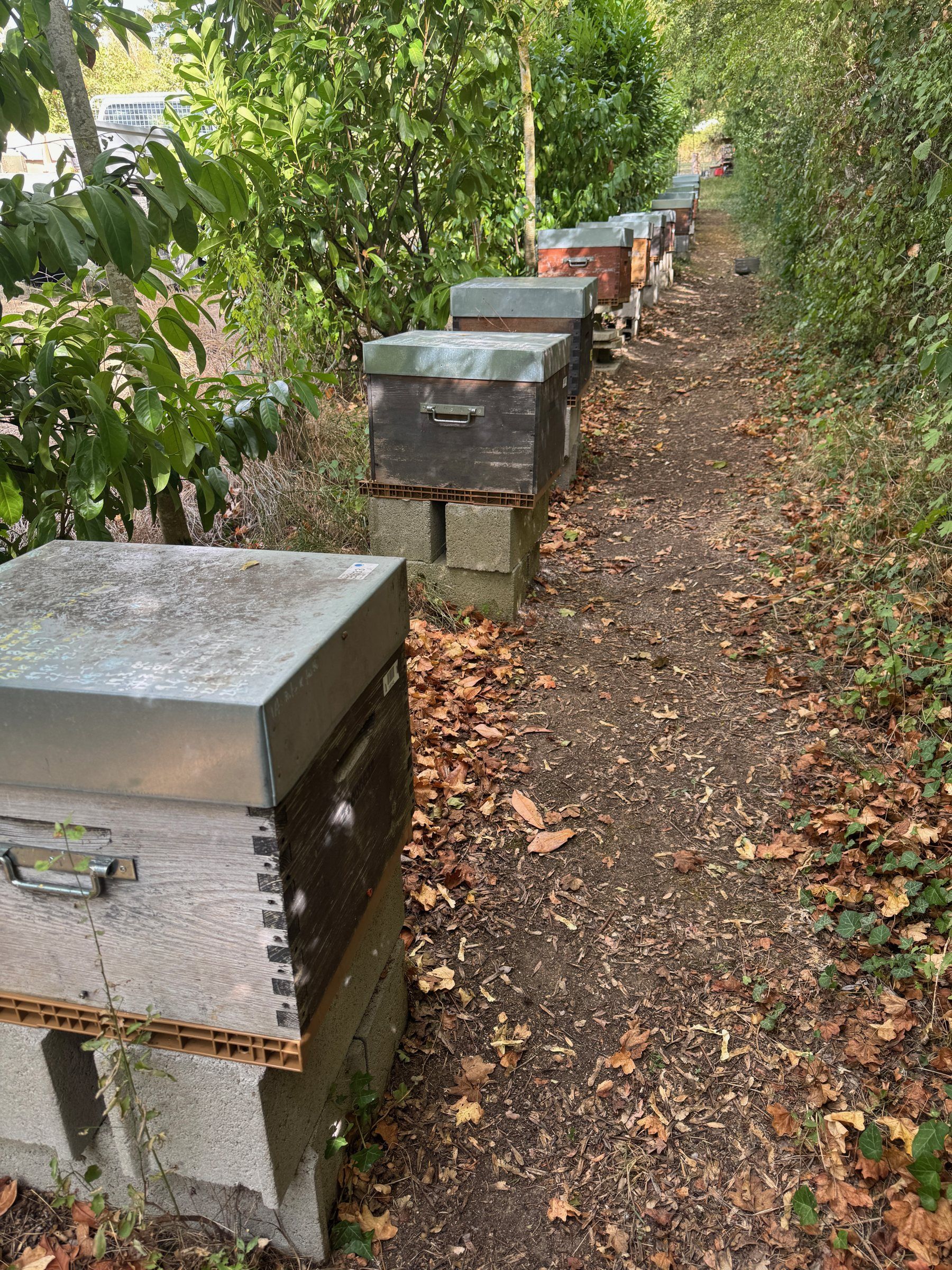
- Avoid long, straight rows of identical hives. Use pairs, small groups, a curve or a U shape.
- Alternate entrance directions. Mississippi State recommends leaving space between hives in rows and alternating entrance directions.
- Add landmarks: different colors, a painted shape above the entrance, a shrub or post between hives.
- Work from the back or side, never standing in the flight path.
| Situation | Practical spacing |
|---|---|
| Two hives on one stand | 1 to 1.5 ft (30 to 45 cm) apart |
| Hives on separate stands | at least 3 ft (1 m) |
| Comfortable yard | 5 to 10 ft (1.5 to 3 m) between hives |
| Working space behind each hive | about 3 ft (1 m) |
These are working figures, not legal rules.
Do bees need a water source near the hive?
Yes, and several local rules make it mandatory: Florida’s compliance agreement, Los Angeles, St. Paul and New York City all require a water source for the bees on the property. Texas A&M AgriLife says to provide water if there is no natural source within 100 yards (90 m), and that a colony may drink up to a gallon (3.8 L) a day.
Water dilutes honey for brood food and cools the nest by evaporation. Ostwald, Smith and Seeley (Journal of Experimental Biology, 2016) heated the brood nest of two colonies and removed their water: brood temperatures rose to 43.3 °C and 43.7 °C (about 110 °F). When water came back, collection jumped from 6.0 and 3.2 g to 21.5 and 22.8 g per 30 minutes, and the nest cooled by about 4 to 6 °C (7 to 11 °F) within hours. Colonies keep only a small water reserve, so they depend on a steady supply on hot days.
Setting it up
- Put water out before the bees arrive. Foragers stick with the first reliable source they find. If that is a neighbor’s pool, Mississippi State notes the conflict may only end by moving the hives.
- Give them a landing surface: Texas A&M suggests straw or pebbles in a bucket or bowl. A float in a stock tank, wood chips or a dripping faucet over gravel also work.
- Keep it filled through summer, especially in the South and the West, and clean it often.
- Place it in the sun and out of the flight path, so bees do not cross a walkway to reach it.
Texas A&M also warns that bees short of food and water will visit pools and hummingbird feeders, so keep colonies fed during a dearth.
How do you prepare the ground: stands, pests and protection?
Hive stands
Set hives on a stand, never on the ground. Cinder blocks with two 4x4 rails, a purpose-built stand or a pallet on blocks all work. A height of 16 to 18 inches (40 to 45 cm) keeps the bottom board out of wet grass and away from skunks scratching at the entrance at night, and puts the boxes at a workable height when supers stack up. Texas A&M advises a fairly level spot with a slight forward tilt so moisture drains out of the entrance; level the stand side to side so frames hang straight.
Livestock, ants and weeds
- Livestock: Mississippi State suggests an electric fence 20 feet (6 m) out from the hives to keep cattle and horses away, and warns never to keep bees near penned animals that cannot escape.
- Ants: in the Southeast, fire ants and Argentine ants raid weak colonies. Keep grass short around stands, and consider stand legs set in cans of oil or a sticky barrier.
- Weeds: keep vegetation clear of entrances without herbicide sprayed near the hives.
Bears
Black bears are the most destructive hive predator in the Northeast, the Appalachians, the Upper Midwest, the Rockies and the Pacific Northwest. A fence is the only reliable answer, and it has to be built correctly. The Maine Department of Inland Fisheries and Wildlife specifies:
- an energizer of at least 0.7 joules (a horse fence needs only about 0.1 joules);
- at least 5,000 volts on each hot wire;
- an all-hot design in poly wire or poly tape;
- galvanized steel ground rods driven 6 feet (1.8 m) deep, one per joule of output, ideally in moist soil;
- weekly checks with a voltage meter on every wire, and vegetation kept off the wires.
Maine suggests running the fence seasonally from May 1 to November 1, while bears are active. Put it up the day the bees arrive: a bear that has eaten brood once will come back.
Theft and vandalism
Out-yards hidden from roads suffer less from theft. Brand or mark your boxes with your name or registration number so stolen equipment can be identified.
What extra precautions do backyards, cities and the South need?
In a backyard
- Tell the neighbors. A University of Florida beekeeping field guide article’s advice for beekeepers is to tell neighbors you keep bees and where, give them your contact details, and be willing to accommodate their concerns or move the hives if relations sour.
- Fence the hives and use a 6-foot barrier along close boundaries.
- Control swarms. A swarm on a neighbor’s swing set is the fastest way to lose goodwill. See our guide to swarming.
- Check your insurance. UF recommends confirming that your homeowner’s policy covers injuries caused by your bees, and disclosing that you keep them.
- Keep gentle stock. UF names Italian, Carniolan and Caucasian bees as gentler stocks, and advises requeening any colony that turns defensive. Our Langstroth hive guide covers the standard equipment.
On a roof
Rooftop hives are legal in many cities with the owner’s consent, and UF suggests rooftops as a way to keep people away from hives. St. Paul shows what a careful city asks for: flat roofs only, a permanent stair rather than a ladder, a guard if hives sit within 10 feet (3 m) of the roof edge, and historic-district approval where needed. Wind and summer heat are harsher on a roof, so strap hives down and provide shade and water.
In Africanized bee areas
Africanized honey bees are established in parts of the southern US, including Texas, Arizona, Southern California and South Florida. Colonies that swarm or replace their own queen there can pick up Africanized genetics and become far more defensive. Texas A&M recommends preventing swarms and requeening every one to two years. Florida, where Africanized bees are established, requires apiaries on non-agricultural land to sit at least 150 feet (46 m) from public gathering places and from tethered or penned animals, and to be requeened with queens from European honey bee producers. Even where no rule says so, those distances are sensible anywhere Africanized bees occur.
How do you protect hives on farmland from pesticides?
Talk to the grower before you place hives on someone else’s land. Mississippi State advises discussing pesticide exposure with the farmer first, to avoid contaminated comb or bee kills.
Then register your hives on BeeCheck, part of the free FieldWatch system run by the nonprofit FieldWatch, Inc. Beekeepers mark their hive locations on a map that registered pesticide applicators check before spraying. Participation is voluntary, and you must re-register each year to stay on the map. According to the Minnesota Department of Agriculture, FieldCheck is used in 22 states plus Saskatchewan, and in Minnesota registration with BeeCheck is required for a beekeeper to be eligible for compensation after a bee kill, which is considered only once an investigation has found acute pesticide poisoning. Ask your state department of agriculture whether it uses FieldWatch or another system.
How do you move a beehive to a new spot?
Under 3 feet or over 3 miles
Foragers fly back to the exact spot they know. Move a hive 30 feet across the yard and many will cluster where it used to be. The beekeepers’ rule:
- Short moves: about 3 feet (1 m) per flying day, in steps.
- Long moves: more than 3 miles (5 km), so the bees reorient. To move a hive a few hundred yards, take it more than 3 miles away for about three weeks, then bring it to the final spot.
Nelson and Jay’s data show that relocated colonies lose the most bees to drift, so give the new site clear landmarks.
On moving day
- Close the entrance at dusk once foragers are home, with screen so air still flows.
- Strap the hive with a ratchet strap or hive staples.
- Keep it cool: move early in the morning or at night in summer, and never leave a closed hive in a hot truck bed.
- Open the entrance once the hive is on its stand, and lean a branch across the entrance so the bees notice the change.
- Update your state registration if your state records apiary locations, and check the rules before moving bees across state lines: many states require a certificate of inspection.
When should you set up your apiary?
A typical first-year timeline, adjusted by region:
- Fall and winter before: take a class through your local club or extension office, and check state, city and HOA rules.
- January and February: order package bees or nucs, which sell out early. In Florida and along the Gulf Coast, colonies build up early, so order sooner.
- February and March: prepare the site: stands, fence or flyway barrier, water, bear fence where needed. Register with your state if required.
- March to May: install bees. Suppliers usually ship packages in spring, earlier in the South than in the North and Midwest; nucs are often ready a few weeks after packages.
- Summer: watch water, space and swarming, and feed during a dearth.
- Fall: check stores, treat for mites, reduce entrances and, in the North, add a windbreak before the first hard freeze.
For more on hives and equipment, see the hives and apiary section.
Frequently asked questions
How far should a beehive be from my house or property line?
There is no federal rule; it depends on your state and city. Los Angeles requires 5 feet (1.5 m) from lot lines and 20 feet (6 m) from streets. St. Paul, Minnesota, requires 10 feet (3 m) from property lines and 25 feet (7.6 m) from a neighbor's occupied building. On non-agricultural land, Florida requires a 6-foot flyway barrier when a colony is within 15 feet of a property line. Ask your city and state department of agriculture.
Can I keep bees in my backyard?
In most of the US, yes, but check three layers of rules first: your state apiary law, which may require registration; your city or county code, which may set hive limits, setbacks or permits; and any HOA covenants or deed restrictions, which can ban bees even where the state allows them. Florida's compliance agreement says deed restrictions take precedence over the state rule.
Should beehives be in full sun or shade?
It depends on your region. In the North and Midwest, full sun with a windbreak on the north side is usually best. In the hot, humid South, Texas A&M AgriLife recommends morning sun and afternoon shade, but avoid deep shade, which encourages small hive beetles. Mississippi State Extension notes that full sun suppresses beetles but adds heat stress in humid summers.
Which direction should a beehive entrance face?
Face it east or southeast if you can. Texas A&M AgriLife advises avoiding a due-north entrance so winter north winds do not blow into the hive, and pointing entrances away from foot traffic. Morning sun on the entrance gets foragers flying earlier. Where space is tight, the direction of the flight path matters more than the compass: keep it off sidewalks, driveways and the neighbor's patio.
How many beehives can I have on my property?
That is set locally. Los Angeles allows one hive per 2,500 square feet of lot. St. Paul allows two colonies per 2,000 square feet, up to four. Florida's rule for non-agricultural land allows 3 colonies on a quarter acre or less, rising to 100 on 10 acres or more. Many beginners keep two hives, which is enough to compare colonies and share frames.
Do I need to tell my neighbors I keep bees?
Some cities require it. St. Paul makes applicants collect consent from 75% of neighbors on a petition. Elsewhere it is not a legal duty, but extension specialists advise telling neighbors where your hives are and giving them your phone number. A tall fence, your own water source and good swarm control prevent most complaints before they start.
How do I protect my beehives from bears?
Use an electric fence before the first bear finds the hives. Maine's wildlife agency says bears need an energizer of at least 0.7 joules and at least 5,000 volts on every hot wire, with an all-hot design, solid grounding rods and weekly voltage checks. Once a bear has eaten brood and honey, it will come back, so fence from the day the bees arrive.
Can I put a beehive on my roof?
Many cities allow it with the building owner's consent. St. Paul permits rooftop hives only on flat roofs reached by a permanent stair, with a guard if hives are within 10 feet of the edge. New York City requires every hive, rooftop or not, to be registered with the Health Department within 30 days. Plan for wind, heat, water and carrying heavy supers down safely.
Sources
- Fla. Admin. Code R. 5B-54.0105: Location of Managed Honey Bee Colonies, Legal Information Institute, Cornell Law School
- Beekeeper Compliance Agreement, FDACS-08492 (rev. 12/17), Florida Department of Agriculture and Consumer Services
- Florida Statutes, Chapter 586: Honeybee Technical Council and apiary law (2025), The Florida Senate
- Beekeeping in Florida: important beekeeping regulations (August 2025), UF/IFAS Extension Polk County
- Backyard beekeeping ordinance No. 183920 (effective December 6, 2015), Los Angeles City Planning
- Beekeeping rules, City of Saint Paul, Department of Safety and Inspections
- Beekeeper registration, NYC Business, City of New York
- Choosing an apiary location (P2937, A. B. Sheridan and J. Harris), Mississippi State University Extension Service
- Setting up your apiary (ENTO-099, M. Keck, January 2021), Texas A&M AgriLife Extension
- Mitigating the threat your bees pose to others (American Bee Journal, May 2016), University of Florida, Department of Entomology and Nematology
- Electric fencing for black bears, Maine Department of Inland Fisheries and Wildlife
- FieldWatch: DriftWatch, BeeCheck and FieldCheck, Minnesota Department of Agriculture
- Crowding honeybee colonies in apiaries can increase their vulnerability to the deadly ectoparasite Varroa destructor (Seeley and Smith, Apidologie 46, 2015), Apidologie, Springer
- The effect of colony relocation on loss and disorientation of honeybees (Nelson and Jay, Apidologie 20, 1989), Apidologie
- The behavioral regulation of thirst, water collection and water storage in honey bee colonies (Ostwald, Smith and Seeley, Journal of Experimental Biology 219, 2016), The Company of Biologists
- The state of the world's urban ecosystems: what can we learn from trees, fungi, and bees? (Stevenson et al., Plants, People, Planet, 2020), University of Greenwich Research Repository