Langstroth hive: dimensions, deeps vs mediums, 8 vs 10 frames, and cost
The Langstroth hive explained: box and frame dimensions, bee space, deeps vs mediums, 8 or 10 frames, supering, wintering by region, state laws and 2026 prices.
The Langstroth hive is the standard beehive in the United States: a stack of interchangeable, open-ended wooden boxes, each holding 8 or 10 removable frames that hang from rabbets with a bee space of about 1/4 to 3/8 in (6 to 9.5 mm) around them. A 10-frame box measures about 16 1/4 by 19 7/8 in (41 by 50.5 cm) outside and comes in three main depths: deep (9 5/8 in, 24.4 cm), medium (6 5/8 in, 16.8 cm) and shallow (5 11/16 in, 14.4 cm). Nearly all US bees, nucs, frames and accessories are sold to these dimensions, which is why almost every new beekeeper starts with one.
What are the parts of a Langstroth hive?
From the ground up, a typical backyard Langstroth has these parts:
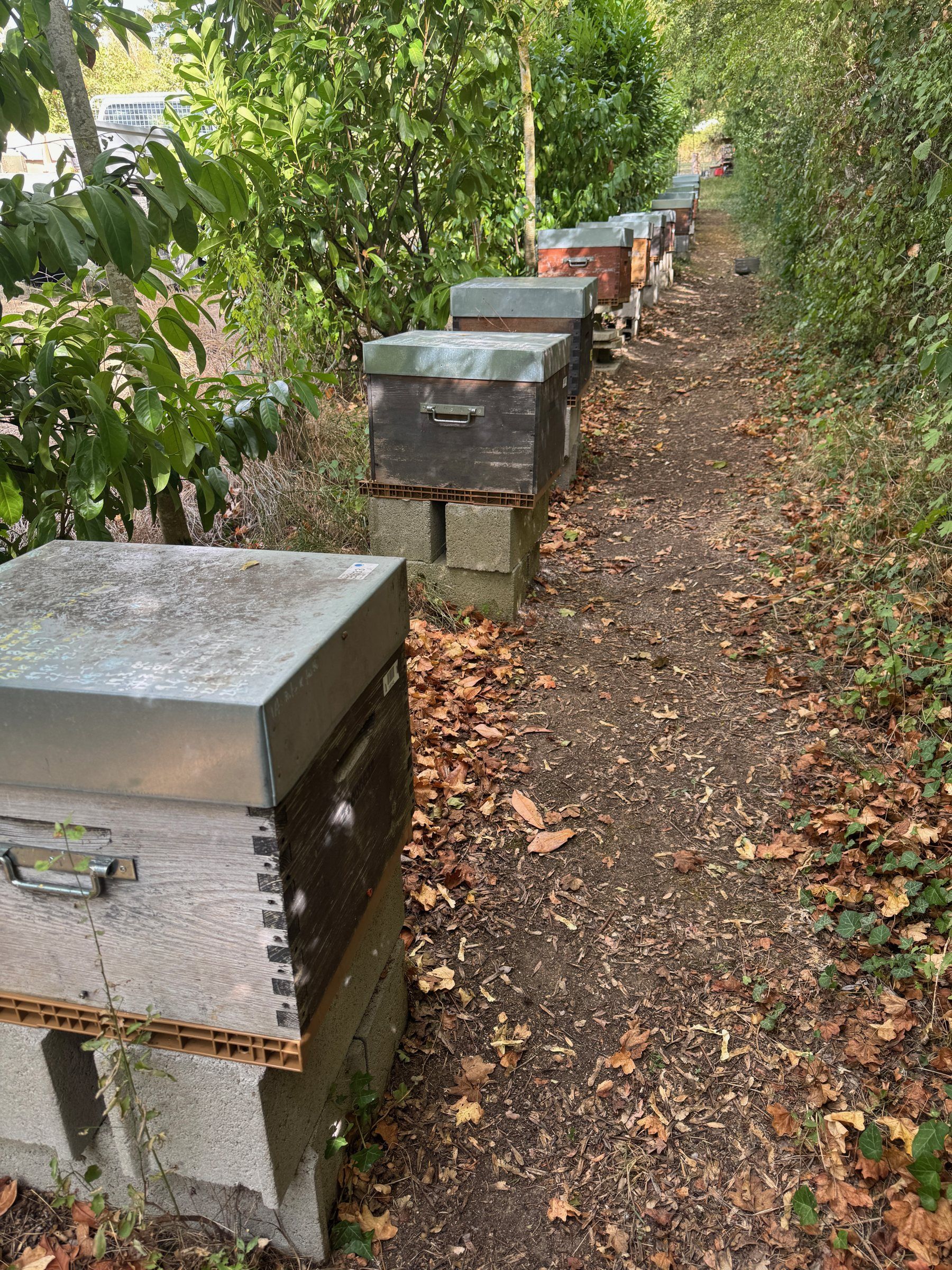
- Hive stand: raises the hive 12 to 18 in (30 to 45 cm) off the ground, away from damp, skunks and grass. Cinder blocks and a pair of 4x4s are the classic budget version.
- Bottom board: solid or screened. A reversible solid board gives either a 7/8 in or a 3/8 in entrance, depending on which side faces up. Screened bottom boards add ventilation and a slot for a sticky board.
- Entrance reducer: a notched wooden cleat that narrows the entrance for a new colony, in a robbing spell or for winter.
- Hive bodies (brood boxes): usually two deeps, or three mediums, where the queen lays and the colony stores its winter food.
- Queen excluder (optional): a metal or plastic grid that keeps the queen out of the honey supers. According to MAAREC, fewer than half of beekeepers use one.
- Honey supers: medium or shallow boxes stacked above the brood nest for surplus honey. Cooperative extension guidance says four to six supers are usually needed for honey production in a good season.
- Inner cover: a flat board with a central hole that keeps the bees from gluing the lid down, gives an insulating dead-air space and takes a Porter bee escape.
- Outer cover: a telescoping cover with a metal top that overlaps the box on all sides. Migratory beekeepers use a flush migratory lid instead, so that hives can be packed tightly on pallets and trucked.
What are the dimensions of a Langstroth hive?
Box sizes
| Box | Height | Frame height | Typical use | Weight full of honey (10-frame) |
|---|---|---|---|---|
| Deep (full-depth) | 9 5/8 in (24.4 cm) | 9 1/8 in (23.2 cm) | brood nest | over 60 lb (27 kg) |
| Intermediate (“Western”) | 7 5/8 in (19.4 cm) | 7 1/4 in (18.4 cm) | brood or honey, mostly homemade | between deep and medium |
| Medium (“Illinois” or Dadant depth) | 6 5/8 in (16.8 cm) | 6 1/4 in (15.9 cm) | honey, or brood in an all-medium hive | typically 45 to 55 lb (20 to 25 kg) |
| Shallow | 5 11/16 in (14.4 cm) | 5 3/8 in (13.7 cm) | honey, chunk comb | about 35 lb (16 kg) |
| Section comb super | 4 5/8 in (11.7 cm) | section boxes | comb honey sections | lighter |
The heights and the deep and shallow weights are those given by the Mid-Atlantic Apiculture Research and Extension Consortium (MAAREC); the medium weight range is an estimate between the two. A 10-frame box is about 16 1/4 by 19 7/8 in (41.3 by 50.5 cm) outside, as listed by Mann Lake for its assembled deep. Eight-frame boxes keep the same length and frames but are two frames narrower.
MAAREC also calls the medium the Dadant or Illinois depth, a reminder of the Dadant family of Hamilton, Illinois, whose influence on American hive design is covered in the history section below.
Frames
All Langstroth frames share the same length: about 17 5/8 in (44.8 cm) for the frame itself, with a top bar of about 19 in (48 cm) whose ends, the lugs or “ears”, rest on rabbets cut into the box ends. Only the height changes with the box.
You will meet several frame styles:
- Wooden frames with wax foundation: the traditional option, with a wedge top bar and a split or grooved bottom bar. Wired foundation or cross-wiring keeps combs straight in the extractor.
- Wooden frames with plastic foundation: a plastic sheet coated in beeswax. Easy to assemble and very common in kits; brood foundation is often black, which makes eggs easier to see.
- One-piece plastic frames: durable and fast, but some colonies are slow to draw them.
- Foundationless frames: a wooden frame with a starter strip or wedge, used by beekeepers who want natural cell size or cut-comb honey.
Standard frames are Hoffman self-spacing: the upper end bars widen so that frames pushed together sit at about 1 3/8 in (35 mm) centers.
Bee space and frame spacing
Bee space is the key to the whole design. Cooperative extension guidance gives a range of 1/4 to 3/8 in (6 to 9.5 mm), with 5/16 in (8 mm) the average most beekeepers aim for: bees fill smaller gaps with propolis and build comb in larger ones. The Langstroth leaves bee space between frames and every other part of the hive, including above the top bars. This is a top bee space hive, the opposite of the British National, which leaves it below the bottom bars.
Practical rules that follow:
- In brood boxes: always run the full count, 10 frames in a 10-frame box (or 9 plus a follower board), pushed together at 1 3/8 in centers. Gaps lead to burr comb and drone comb.
- In honey supers: once the comb is drawn, many beekeepers run 9 frames in a 10-frame super, or 8 with a spacing tool. The bees draw fatter combs that are faster to uncap. Do not space undrawn foundation wide, or the bees will build wild comb between frames.
- Never mix equipment with different bee space, and check that boxes from different suppliers stack without gaps before you put bees in them.
How big is a deep, compared with a wild nest?
With 3/4 in (19 mm) walls, the inside of a 10-frame deep is roughly 18 3/8 by 14 3/4 by 9 5/8 in, about 2,600 cubic inches or 42 liters. That is close to the cavity of about 40 liters that swarms prefer in Thomas Seeley’s classic nest-site studies. Two deeps, around 85 liters, give a colony twice the space it would choose in a tree, which is what makes large honey crops possible.
Deeps or mediums: how should you set up the brood nest?
There is no single right answer, and US extension services accept several configurations. Cooperative extension guidance recommends two deeps or three mediums for brood, accepts one deep plus one medium, and treats one deep plus one shallow as the minimum.
| Setup | Frames for brood | Advantages | Drawbacks |
|---|---|---|---|
| Two deeps | 20 deep frames | most common, cheapest per comb area, every nuc fits | a full deep weighs over 60 lb |
| Three mediums | 30 medium frames | one box and frame size throughout the hive, lighter lifts | more boxes, more frames to buy, queen harder to find |
| One deep plus one medium | 10 deep and 10 medium | a compromise, common in milder regions | two frame sizes in the brood nest |
| Single deep (temporary) | 10 deep frames | for a package, nuc, split or comb honey hive | too small for a full colony through a northern season |
MAAREC notes that an all-shallow brood nest is possible but is the most expensive and time-consuming setup, since it takes three boxes and 30 frames to match two deeps. Mediums are the usual compromise for beekeepers who do not want to lift full deeps.
Whatever you pick, standardize across your apiary. The whole point of the Langstroth system is that a frame of brood, eggs or honey can move from any hive to any other, for splits, uniting colonies or rescuing a queenless hive.
8-frame or 10-frame: which should you choose?
| Criterion | 10-frame | 8-frame |
|---|---|---|
| Availability | US standard, every supplier and nuc producer | widely available, but fewer nucs sold on it |
| Weight of a full deep | over 60 lb | about 20% less |
| Price per frame of comb | lowest | slightly higher |
| Stack height for the same colony | lower | taller, more boxes |
| Winter cluster fit | wide, the cluster may move up one side | narrow, closer to a natural tree cavity |
| Compatibility | frames fit 8-frame boxes | frames fit 10-frame boxes; boxes, covers and bottom boards do not mix |
- Choose 10-frame if you want the cheapest, most widely supported equipment, plan to buy nucs, or hope to scale up or rent hives for pollination.
- Choose 8-frame if lifting is your limit. Two fewer frames take a fifth off the weight of every box.
Frames are interchangeable between the two, so you can move frames of brood from a 10-frame nuc into an 8-frame hive, but buy all boxes, covers, feeders and excluders in one width.
When should you add honey supers to a Langstroth hive?
Adding the first super
Super when three things are true:
- The bees cover 7 or 8 of the 10 frames in the top brood box.
- You see fresh white wax on the top bars and between the frames.
- A nectar flow is on or imminent: in much of the country, fruit bloom, dandelion and black locust in spring, then clover in early summer.
Too early, a small colony struggles to heat the empty space on cold nights. Too late, the bees backfill the brood nest with nectar, the queen runs out of room and the colony swarms. If you have drawn comb, put two or three drawn frames in the middle of the first super to pull the bees up.
How many supers, and where?
Have at least two supers per hive ready before the main flow, and add the next one when the top super is about two-thirds full.
- Top supering: put the empty super on top. It is simple and means less lifting.
- Bottom supering (undersupering): put the empty super directly above the brood nest, under the partly full ones. The bees often fill it faster, but you have to lift the full supers off first.
Taking the crop off
Harvest frames that are at least about 80% capped. The FDA sets no moisture limit for honey, but the voluntary USDA grade standards require at least 81.4% soluble solids for Grades A and B, equivalent to about 18.6% moisture, as Texas A&M AgriLife Extension explains. Honey wetter than that is at risk of fermenting. Clear the bees with a fume board, a triangle escape board or a bee blower, and keep removed supers covered to prevent robbing.
How much does a Langstroth hive cost in 2026?
These are prices listed in October 2026 by Mann Lake, one of the largest US beekeeping suppliers, before shipping and sales tax.
| Equipment | Indicative price (2026) |
|---|---|
| Assembled 10-frame complete hive kit: screened bottom board, 1 deep, 1 medium, 10 deep and 10 medium frames with waxed plastic foundation, notched inner cover, telescoping cover | about $227 to $237 |
| Assembled 10-frame commercial-grade deep box, 9 5/8 in, no frames | about $40 |
A single deep plus a medium is a starter kit, not a full hive. Plan for a second deep (or two more mediums), at least one more super, an entrance reducer, a feeder, a hive tool, a smoker and a veil before the first summer. The bees come on top: either a package (usually 3 lb of bees and a queen) or a nuc (typically 5 deep frames with brood, stores and a laying queen). A nuc builds up faster, but you must order it on the frame depth you use. For a full shopping list, see our guide to beekeeping equipment for beginners.
Pine, cedar or polystyrene?
- Pine is the US standard. Paint the outside with exterior latex or dip in wax, never the inside.
- Cedar is lighter and more rot-resistant, but costs more.
- Polystyrene Langstroth-compatible boxes are popular in cold northern states for their insulation. Check that the frames and bee space match your wooden gear.
The University of Leeds reports that Derek Mitchell’s research, published in the Journal of the Royal Society Interface, found typical hives with 19 mm (3/4 in) wooden walls lose about seven times more heat than a natural nest in a tree with walls about 6 in (150 mm) thick. In cold regions, a wrap or an insulated top cover helps a Langstroth colony through winter.
What laws apply to a Langstroth hive in the US?
There is no single national beekeeping law. Federal agencies regulate honey labeling and varroa products, while hive registration and inspection are set by each state. City and county ordinances may add setbacks, flyway barriers or limits on colony numbers.
State registration and inspection
Rules vary widely, so here are three examples, not a national rule:
- Florida: Chapter 586 of the Florida Statutes requires each beekeeper with colonies in the state to register with the Florida Department of Agriculture and Consumer Services. UF/IFAS Extension explains that registered beekeepers receive a firm number they must mark on each hive body, and that registration is renewed annually.
- Illinois: under the Bees and Apiaries Act (510 ILCS 20/2), every person keeping one or more colonies must register with the state Department of Agriculture each year. Section 2-1 declares “hives that cannot be readily inspected” to be nuisances, which is why fixed-comb hives are a problem.
- Pennsylvania: the state’s Bee Law of 1994 mandates apiary registration, at $10 for about two years, according to the Pennsylvania Department of Agriculture, and seasonal inspectors check hives from May to mid-October.
The Smithsonian Magazine notes that removable frames are now required by law in most states, because inspectors must be able to lift each comb to check for American foulbrood. A Langstroth satisfies that automatically. To find your own state’s rules, contact your state department of agriculture or state apiarist, and see our overview of beekeeping laws by state.
Varroa products
Only EPA-registered pesticides may be used against varroa mites, following the label. EPA’s list (updated September 17, 2026) includes, among others:
- Amitraz: Apivar strips and Amiflex;
- Oxalic acid dihydrate: Api-Bioxal, Api-Bioxal RTU solution, Ez-Ox tablets and the slow-release Varroxsan strips;
- Formic acid: Formic Pro and Mite Away Quick Strips;
- Thymol: Apiguard and Api Life Var;
- Hop beta acids: HopGuard 3;
- Others: Apistan (tau-fluvalinate), CheckMite+ (coumaphos), sucrose octanoate, and new products based on l-glutamic acid and on vadescana, a double-stranded RNA.
Labels set when supers must be removed, temperature ranges and withdrawal periods. Resistance to tau-fluvalinate and coumaphos is widespread, so do not rely on them.
Selling honey
The FDA’s 2018 guidance says a product that is only honey should be labeled “honey”, and may carry a floral source such as “Clover Honey” or “Orange Blossom Honey” only if the producer has information showing that plant is the chief floral source. A blend with another sweetener must say so, for example “Blend of honey and corn syrup”. Many states also have cottage food laws covering small-scale honey sales; check yours.
Running a Langstroth hive through the year, by region
The US spans climates from Minnesota to south Florida, so there is no single calendar. For month-by-month detail, see our beekeeping calendar.
| Region | Spring buildup and first supers | Main flows and honey | Winter |
|---|---|---|---|
| Northeast and Upper Midwest | April to May: fruit bloom, dandelion, black locust | June to July: clover, basswood, alfalfa; buckwheat and goldenrod in late summer and fall | long cluster from November to March; two deeps, 80 lb or more of honey, wrapping and an upper entrance |
| Southeast and Gulf states | February to March | spring citrus (orange blossom), tupelo in the Florida Panhandle in April and May, sourwood in the Appalachians in midsummer, gallberry and saw palmetto in Florida | short; colonies fly most days, risk of starvation in dry spells and fall dearth |
| California | almond pollination in February, then citrus | orange blossom, sage, wildflowers | mild, but many colonies are moved for pollination |
| Pacific Northwest | March to April, often wet | blackberry, fireweed, clover | mild, damp; moisture management matters more than cold |
Pollination and migratory beekeeping
A large share of US colonies live on trucks. The farmdoc daily analysis by University of Illinois economists estimates that the 2024 California almond bloom required about 2.7 million colonies, at two colonies per acre for traditional varieties and one for self-fertile ones, on about 1.4 million acres. On January 1, 2024, 37% of all US honey bee colonies were in California. Migratory beekeepers favor 10-frame deeps on pallets of four, with migratory lids, so that hives can be loaded by forklift.
Wintering a Langstroth in the North
Cornell University’s guidance for upstate New York is a good model for cold regions:
- leave a minimum of 80 lb (36 kg) of honey for a full-size colony in two deeps (or a deep and two mediums), and at least 50 lb (23 kg) for a nuc; the whole hive should weigh about 160 lb (73 kg);
- if the colony is light, feed 2:1 sugar syrup (two parts cane sugar to one part water) in early fall, while bees are still flying; once clustering starts, it is too late for liquid feed, so switch to fondant or dry sugar;
- wrap hives with roofing felt, provide a small upper entrance under the inner cover for moisture and cleansing flights, and fit mouse guards before the cluster forms.
In the South, colonies need much less, but check them in late fall and in early spring before the first flow. UF/IFAS Extension notes that a super full of honey can be left on a Florida hive as extra winter food.
Varroa monitoring
The Honey Bee Health Coalition’s Tools for Varroa Management, ninth edition (June 2026), recommends an alcohol or soap wash of about 300 adult bees (about 1/2 cup) taken from the brood nest, away from the queen. Its thresholds are:
| Colony phase | Treat promptly at |
|---|---|
| Dormant (sample before clustering) | 1 or more mites per 100 bees |
| Population increase (spring) | 1 or more mites per 100 bees |
| Peak population (summer) | 2 or more mites per 100 bees |
| Population decrease (late summer, fall) | 2 or more mites per 100 bees |
The guide advises sampling monthly from spring, re-sampling after each treatment and rotating active ingredients. Your state apiarist may set different regional thresholds. For details, see our page on varroa mites.
Bees for your Langstroth
Most US packages and nucs are Italian or Carniolan stock, or hybrids. Russian bees, descended from 100 queens imported in 1997 by USDA-ARS from the Primorsky territory in Russia’s Far East, were selected at Baton Rouge for varroa resistance. In the South, Africanized bees are part of the picture: UF/IFAS Extension reports that African honey bees have been in Florida since at least the early 2000s and nest in high densities in south Florida, so beekeepers there buy queens from reputable breeders and requeen colonies that turn defensive.
What yield to expect
USDA NASS reports that US honey-producing colonies averaged 48.0 lb (21.8 kg) of honey in 2025, with 116 million lb from 2.41 million colonies and an average price of $3.05 per pound. Yields ranged from 67 lb per colony in North Dakota to 35 lb in California and 32 lb in Florida. A backyard colony started from a package or nuc often produces little or no surplus in its first year, because it spends the season drawing comb.
Where did the Langstroth hive come from?
Lorenzo Lorraine Langstroth, a Congregational minister and Yale graduate, worked out the hive in 1851 and patented it on October 5, 1852, according to the Smithsonian. His insight was bee space: a gap of the right size around the frames that bees leave open, so that each frame can be lifted out without cutting comb. His book, Langstroth on the Hive and the Honey-Bee, appeared in 1853, and the American Bee Journal, founded in 1861, published him from its first years.
The Dadant family carried the design forward. Charles Dadant, a French immigrant who settled in Hamilton, Illinois, wrote for the American Bee Journal from 1867 until his death in 1902, and his son C. P. Dadant bought the journal in 1912. Charles Dadant championed a larger hive with a deep brood box and shallower supers; in Europe, that design became the Dadant-Blatt, still the standard hive in France. In the US, the smaller, cheaper Langstroth won, and the Dadant company in Hamilton still sells Langstroth equipment. For the wider story, read our history of beekeeping.
Is the Langstroth hive right for you?
For most US beekeepers, yes. Its strengths are availability, interchangeability and resale value: every supplier, nuc producer, mentor and club uses it, and any frame fits any hive of the same depth. Its weaknesses are weight, especially full deeps, and the fact that a full hive is a tall stack to take apart at each inspection. If you want something different, compare it with top-bar hives and other designs in our guide to types of beehives.
Before you buy:
- choose 10-frame or 8-frame once, and buy all boxes, covers and bottom boards in that width;
- choose deeps or mediums for brood, then order your nuc on the same frame depth;
- keep 1 3/8 in frame spacing in the brood nest and do not mix suppliers until you have checked bee space;
- budget for two brood boxes and at least two supers per colony;
- check your state’s registration rules and plan your varroa monitoring before the bees arrive.
Frequently asked questions
What are the dimensions of a 10-frame Langstroth hive?
A standard 10-frame box measures about 16 1/4 by 19 7/8 in (41 by 50.5 cm) on the outside. A deep is 9 5/8 in (24.4 cm) tall, a medium 6 5/8 in (16.8 cm) and a shallow 5 11/16 in (14.4 cm). Frames are 17 5/8 in (44.8 cm) long, and 9 1/8, 6 1/4 or 5 3/8 in tall for deeps, mediums and shallows. Dimensions vary slightly between manufacturers.
Should I use deeps or mediums for brood?
Both work. The classic setup is two deeps for brood, which gives 20 large frames. Many hobbyists now run three mediums instead, so every box and frame in the hive is the same size and no box weighs much over 50 lb. Mediums cost more, since you need 30 frames instead of 20, and the queen has more boxes to hide in during inspections.
Is an 8-frame or a 10-frame Langstroth hive better?
Ten-frame equipment is the US standard and the cheapest per frame, and nearly every nuc is sold on it. Eight-frame boxes are about 20% lighter when full, which matters if you have a bad back or lift alone. They are taller for the same volume, so you will stack more boxes. Frames are identical, but the boxes, covers and bottom boards do not mix.
How heavy is a full Langstroth deep?
Mid-Atlantic extension specialists put a full-depth 10-frame body full of honey at over 60 lb (27 kg), and a full shallow at about 35 lb (16 kg). A full medium falls between the two, typically 45 to 55 lb. This is why many beekeepers keep deeps for the brood nest, where they are lifted less often, and use mediums or shallows for honey.
How much honey does a Langstroth hive need for winter?
It depends on where you live. Cornell recommends at least 80 lb (36 kg) of honey for a full-size colony in two deeps in upstate New York, and about 160 lb (73 kg) for the whole hive. In the Deep South, colonies fly most of the winter and need far less, but they can starve in a dry spell. Ask your state apiarist or extension office for local figures.
Do I have to register my beehives?
It depends on your state. Florida, Illinois and Pennsylvania, for example, require every beekeeper to register, even with one hive; Pennsylvania charges $10 for about two years. Other states have voluntary or no registration, and city or county ordinances can add rules on setbacks and colony numbers. Check with your state department of agriculture before your bees arrive.
Can I put Langstroth frames in a Dadant or British National hive?
No. A Langstroth frame is about 19 in long over the top bar, the French Dadant-Blatt frame about 18 1/2 in and the British National 17 in, and their depths all differ. The boxes have different footprints, and the National uses bottom bee space where the Langstroth uses top bee space. In the US, almost all equipment and nucs are Langstroth, so stick with it.
How much does a complete Langstroth hive cost?
In October 2026 an assembled 10-frame kit with a screened bottom board, one deep, one medium, 20 frames with plastic foundation, an inner cover and a telescoping cover costs about $227 to $237 from a major US supplier. A single assembled commercial-grade deep box runs about $40. Bees, a second deep or more supers, a feeder and protective gear are extra.
Sources
- Beekeeping equipment, Mid-Atlantic Apiculture Research and Extension Consortium (MAAREC)
- Wooden components of a modern bee hive, Bee Health, Cooperative Extension (eXtension)
- The secret to the modern beehive is a one-centimeter air gap, Smithsonian Magazine
- History of the American Bee Journal, American Bee Journal
- 10 Frame Complete Hive Kit Combo (price and contents), Mann Lake
- 10 Frame Assembled 9 5/8" Commercial Grade Deep Hive Box (price and dimensions), Mann Lake
- Tools for Varroa Management, 9th edition (June 2026), Honey Bee Health Coalition
- EPA-registered pesticide products approved for use against varroa mites in bee hives (updated September 17, 2026), U.S. Environmental Protection Agency
- Overwintering, Cornell University, College of Agriculture and Life Sciences, Pollinator Network
- Honey (March 2026 report, 2025 data), USDA National Agricultural Statistics Service
- Where have all the honey bees gone? To California almond orchards (farmdoc daily 15:30, 2025), B. Goodrich and A. Altschuler, University of Illinois
- Guidance for industry: proper labeling of honey and honey products (March 2018), U.S. Food and Drug Administration
- Honey judging and standards, Texas A&M AgriLife Extension, Department of Entomology
- Keeping bees in Florida (ENY-134), UF/IFAS Extension
- Florida Statutes, Chapter 586: Honeybee Technical Council and apiary regulation (2025), The Florida Senate
- Bees and Apiaries Act, 510 ILCS 20/2 (registration), Illinois General Assembly
- Bees and Apiaries Act, 510 ILCS 20/2-1 (nuisances), Illinois General Assembly
- Apiary and pollinator services, Pennsylvania Department of Agriculture
- Evaluating the Russian bee, USDA Agricultural Research Service, Honey Bee Breeding, Genetics and Physiology Laboratory, Baton Rouge
- Research challenges beliefs on honeybee insulation (work of D. Mitchell), University of Leeds