How to harvest honey: timing by region, pulling supers, extracting, moisture and selling
How to harvest honey in the US: when supers are ready by region, escape and fume boards, small hive beetles, extracting, moisture, bottling and state rules.
To harvest honey, pull supers whose frames are at least 75% capped, clear the bees with an escape board left 24 to 48 hours or a fume board for a few minutes, extract within two or three days so small hive beetles cannot hatch in the combs, check that the honey is at or below 18.6% moisture (the USDA Grade A limit), then strain, settle and bottle it under a label that meets FDA guidance and your state’s rules. When that happens depends on where you live: June in much of the Southeast, July and August across the North, with California and Florida on calendars of their own. This guide walks through each step with US equipment, US pests and the state laws that decide whether you can sell from your kitchen.
When should you harvest honey?
Signs that a super is ready
Bees cap honey once they have evaporated the nectar down to a stable moisture content. NC State Extension’s rule of thumb is to harvest frames that are at least 75% capped, and to leave supers that are not sealed yet on the hive for a few more weeks before checking again. For partly capped frames, use the shake test: hold the frame flat over the hive and give it a sharp downward jerk. If nectar sprinkles out, it is not ripe.
Capping is a good indicator but not a guarantee. In the humid South, capped honey can still be wetter than you want, and in a dry Western summer bees sometimes leave ripe honey open. A refractometer gives a definite answer (see below).
A regional harvest calendar
There is no single US honey season. Use these as starting points and ask your local club or extension office for your county.
| Region | Main flows | Typical harvest |
|---|---|---|
| Southeast (Carolinas, Georgia, Tennessee) | Tulip poplar, blackberry, clover; sourwood in the mountains | Late May to June; sourwood in July and August |
| Florida and Gulf Coast | Citrus (orange blossom) in spring, tupelo in the Panhandle river swamps, saw palmetto, gallberry | April to July, flow by flow |
| Northeast and Midwest | Black locust, clover, basswood, alfalfa, then goldenrod and aster | July to early September |
| Northern Plains (North Dakota, Montana, South Dakota) | Sweet clover, alfalfa, canola, sunflower | August to early September |
| California | Orange blossom, sage, buckwheat, star thistle; almonds are for pollination, not honey | Spring and summer, by location |
| Pacific Northwest | Blackberry, fireweed, clover | July and August |
NC State notes that June usually marks the end of the honey flow across most of North Carolina, with the west of the state flowing a little longer, and that robbing starts soon after. Sourwood (Oxydendrum arboreum) blooms from June to August, and NC State Extension relays the old saying that an excellent sourwood crop comes only about once a decade. Tupelo blooms briefly, from late April through May, in Florida and Georgia, mainly in the Apalachicola River basin and around the Okefenokee, according to Bee Culture. Beekeepers who want a varietal honey pull or extract the supers just before the target bloom, so the new honey is not mixed with the previous flow.
How much honey a hive produces
USDA’s National Agricultural Statistics Service (NASS), which surveys operations with at least five colonies, reported 2025 US honey production of 116 million lb from 2.41 million colonies, an average of 48.0 lb (21.8 kg) per colony, down 7% on 2024. The average price was $3.05 per lb. State yields show how much region matters:
| State (2025) | Yield per colony |
|---|---|
| Mississippi | 89 lb |
| Montana | 85 lb |
| North Dakota | 67 lb |
| Pennsylvania | 57 lb |
| New York | 56 lb |
| Minnesota | 50 lb |
| Michigan | 42 lb |
| California | 35 lb |
| Florida | 32 lb |
| Georgia | 32 lb |
| Texas | 30 lb |
Commercial yields include migratory operations moving bees between crops. A backyard colony in its first year, drawing comb from foundation, often makes little or no surplus. To turn your own yield into jars and dollars, try our honey yield and price calculator.
How much to leave for winter
UF/IFAS Extension’s guide to overwintering in northern climates says a colony in the North needs about 90 lb (41 kg) of honey reserves, and recommends feeding 2:1 sugar syrup (by volume) in fall if stores fall short. In a two-deep Langstroth hive, that typically means leaving the top deep full of honey; in the South, a few frames of honey may be enough. Our guide to feeding bees has the details.
What equipment do you need to harvest honey?
Frame and box sizes
Oklahoma State University Extension gives these approximate weights of honey per Langstroth frame:
- Deep frame (9 5/8 in box): about 6 lb (2.7 kg)
- Medium frame (6 5/8 in box): about 4 lb (1.8 kg); a full 10-frame medium super holds about 40 lb (18 kg)
- Shallow frame (5 11/16 in box): about 3 lb (1.4 kg)
That is why most US hobbyists use medium supers: a full 10-frame deep holds about 60 lb (27 kg) of honey, and the box and frames add more on top: hard work for anyone lifting it off a hive. Eight-frame equipment weighs proportionally less.
Extraction kit and what it costs
The University of Florida’s field guide to extraction lists the basic tools and their purpose: a heated electric uncapping knife (with a thermostat so it does not scorch honey or wax), a capping scratcher, an uncapping tank with a mesh grate, an extractor, layered strainers, a settling tank with a honey gate and clean jars. It puts a basic setup at $500 to $1,000, and quality equipment for 20 or more colonies at $2,000 or more.
Oklahoma State’s 2022 cost example for a one-hive beekeeper priced an extractor at $254, an uncapping knife at $75, a scratcher at $7, a strainer at $34 and a bottling bucket at $25. Many local clubs rent extractors to members for a small fee, which NC State recommends for beekeepers with only a few colonies.
Crush and strain
If you have one or two hives, or foundationless frames, you can skip the extractor. Oklahoma State describes the crush and strain method: cut the comb into a food-grade bucket, mash it, and let the honey drain through a strainer overnight. It is cheap but destroys the comb, so the bees must rebuild it, which costs them honey and time.
How do you get the bees off the supers?
UF/IFAS Extension Orange County describes three ways, and most beekeepers combine them.
Escape boards
An escape board goes between the supers and the brood boxes. Bees can leave the supers but not easily return. Put it on in the afternoon, then come back after 24 to 48 hours and lift the supers off. UF/IFAS warns that leaving it longer exposes supers without bees to small hive beetles, ants and wax moth larvae. Before using one, make sure there is no brood in the supers (bees will not leave brood) and that the stack is tight, with no cracks for robbers.
Fume boards
A fume board is a cover lined with absorbent cloth. Apply a bee repellent, set it on top of the super with the dark side in the sun, and the bees move down into the hive within minutes. UF/IFAS names Honey Robber and Honey Bandit among the products sold for this and warns that fume boards smell terrible; butyric anhydride, the active ingredient in Honey Robber and Bee-Go, smells like vomit, so store the board well away from the house. Fume boards work best on warm, sunny days and poorly when it is cool or cloudy. Use the minimum amount and follow the product label for how long to leave the board on.
Brushing, shaking and blowers
For a few frames, shake each one sharply in front of the entrance and brush off the last bees with a soft bee brush, then put the frame in a covered empty box. UF/IFAS notes that commercial beekeepers often use a leaf blower from about 10 ft (3 m) away to blow bees out of whole supers. Stand the super on its end, blow between the frames, and keep the blower moving.
Whichever method you use, carry the supers away from the apiary at once. Late summer is robbing season, and an exposed stack of honey can trigger a robbing frenzy within minutes.
Why speed matters: small hive beetles and the honey house
The small hive beetle (Aethina tumida) is established across much of the US, especially the Southeast, and it is the main reason US beekeepers cannot let pulled supers sit. Beetle larvae tunnel through comb, and their feces make the honey ferment and run out of the cells as a slime; a stack of supers can be ruined in days.
The best management practices from the USDA-ARS honey bee laboratory in Baton Rouge and the LSU AgCenter (de Guzman and colleagues) are blunt:
- Extract within 2 to 3 days, before massive egg hatching.
- Return wet supers immediately. Supers extracted within 4 days, before any larvae reach the wandering stage, can be cleaned by the bees and then stored.
- Melt cappings as soon as possible.
- Keep the honey house clean, and freeze frames that hold pollen or brood, which are what beetles breed on.
Storing drawn comb
Once the bees have cleaned the wet supers, store the drawn comb so wax moths cannot destroy it. UF/IFAS Extension’s wax moth profile says all stages of the lesser wax moth die when held at 20°F (-7°C) for 24 to 48 hours, after which the frames should go into airtight bags. Cold storage around 39°F (4°C) does not kill the moths but keeps damage minimal, and stacking boxes at right angles in a bright, well-ventilated shed also helps, though that does not work for dark brood comb. UF/IFAS adds that chemical fumigants cannot be used on comb honey you plan to sell or eat.
Habits that keep beetles out
Do not stack supers on weak colonies that cannot patrol them, and do not leave honey supers in the garage over a weekend in July. Pennsylvania’s guidelines for honey processors add that honey must be extracted only from combs free of bee brood and wax moth larvae. Our guide to honey bee diseases covers the beetle as a hive pest.
How do you check honey moisture?
What the US standards say
FDA’s honey labeling guidance sets no moisture figure. The reference buyers use is the USDA Agricultural Marketing Service’s voluntary grade standards. To qualify for Grade A or Grade B, extracted honey needs at least 81.4% soluble solids, which is a maximum of 18.6% moisture; Grade C allows 20.0%. The same standards classify color on the Pfund scale from Water White (8 mm or less) through Extra Light Amber and Light Amber to Dark Amber (over 114 mm), and state that color is not a factor of quality.
Why 18.6% and not 20%
Honey always contains wild yeasts. An article on refractometers by Hanna Bäckmo, published in Bee Culture, gives the usual thresholds: below 17% honey does not ferment; at 18% it does not ferment unless yeasts are numerous; above 19% there is a definite risk; and from 20% up yeasts multiply freely. The UF field guide puts the bees’ own target at 15.5% to 18.5%. Aim for 18% or less if the honey will be stored warm or if you plan to cream it.
Using a refractometer
- Calibrate each season. Bäckmo’s method uses extra virgin olive oil, which reads 71 to 72 Brix: set the instrument to 71.5 Brix, or 27% water.
- Bring honey and instrument to room temperature. Most honey refractometers have automatic temperature compensation, but readings are most reliable at room temperature.
- Sample several frames, including the least capped ones, before you extract. After extraction, stir the bucket first and take several readings.
- Clean the prism with warm water and dry it between readings.
Enter your reading in our honey moisture calculator to compare it with USDA Grade A and state standards, or to check a blend of two batches.
Drying wet supers
If supers read high, the UF field guide suggests stacking them crisscross in a small, warm room with a dehumidifier and at least one circulating fan for a day or two before extracting. In beetle country, keep this short, and seal the room against bees and beetles.
How do you uncap and extract honey?
Setting up
Extract in a clean kitchen, garage or honey house with screened windows, hot water and washable surfaces. Pennsylvania’s guidelines describe what a state inspector looks for in a commercial honey house: food-safe, non-porous equipment, covered tanks, screened ventilation, potable water with hot water for cleaning and nearby toilet facilities. Even if your state does not inspect hobbyists, those are good standards to copy. Warm supers spin out far faster than cold ones, so work on the day you pull them.
Uncapping
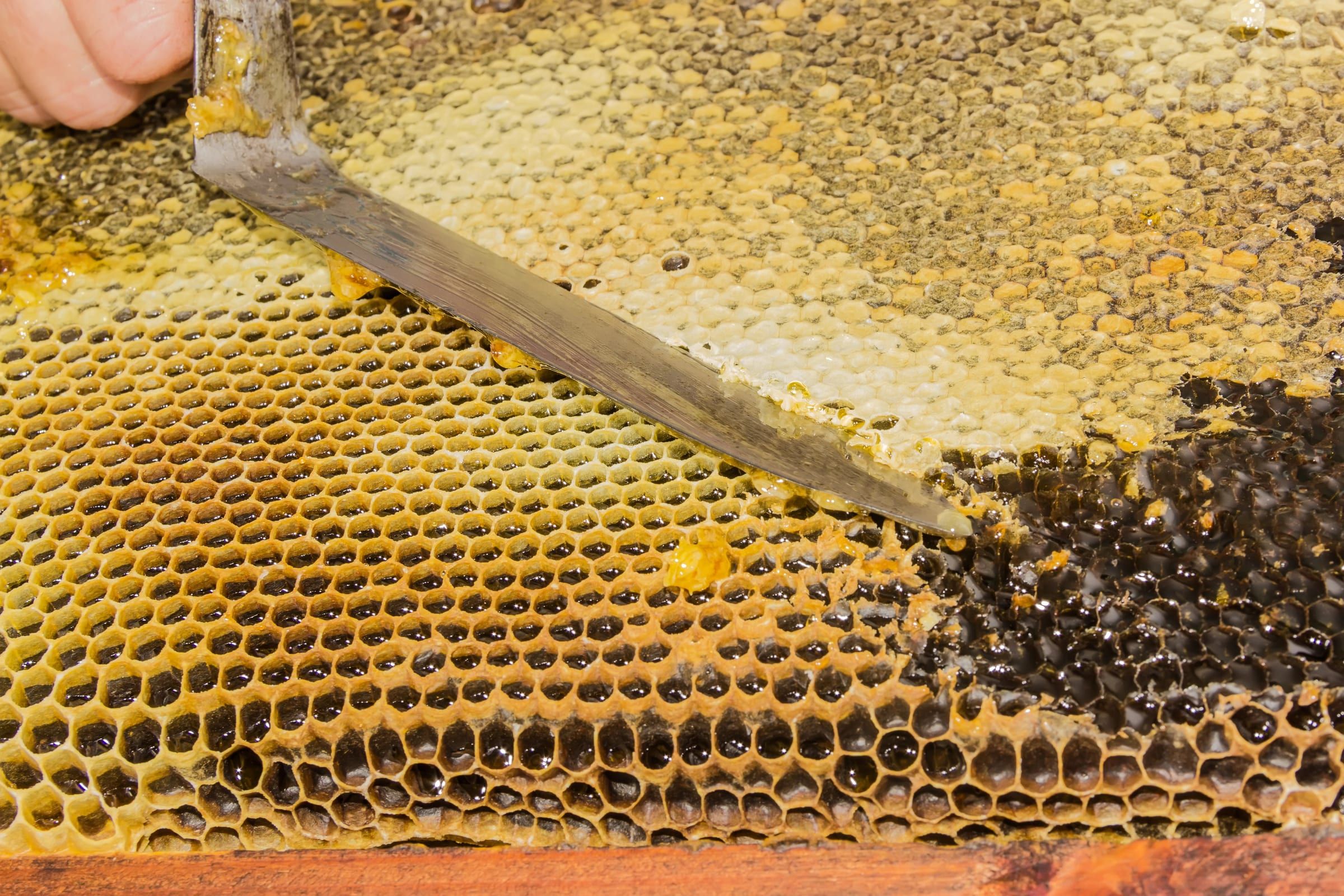
Hold the frame upright over the uncapping tank, tilt it slightly so cappings fall away from the comb, and slice the cappings off with a heated knife from the bottom up, guided by the end bars. Use a capping scratcher on low spots. Frames drawn on nine-to-a-ten-frame-box spacing bulge past the wood and are much easier to uncap. Let the cappings drain over the mesh for a day or two (in a beetle-proof room), then melt them: cappings wax is the cleanest wax you will produce.
Spinning
The UF field guide distinguishes extractors that spin one face at a time, with frames facing the wall (tangential), from those that extract both faces at once (radial). It recommends a both-sides model for beginners. With a tangential extractor:
- Balance the drum with frames of similar weight opposite each other.
- Spin slowly first and only partly empty the first face; full combs can blow out if spun hard.
- Flip the frames, empty the second face, flip again and finish the first.
- Open the gate as honey builds up so it does not drag on the basket.
Oklahoma State puts a typical spin at 10 to 12 minutes.
How do you strain, settle and bottle honey?
Straining
Run the honey through layered strainers, coarse above fine, into the settling tank. This removes wax, bee parts and debris but leaves pollen, which is what most customers buying local honey expect. Commercial packers warm honey to push it through fine filters; at hobby scale, simple straining is enough.
Settling
Let the honey stand in a closed bucket or tank in a warm, dry place for a day or two so air bubbles and wax rise as a foam you can skim off. The UF field guide’s author used a 30-gallon (about 110 L) can fitted with a honey gate; whatever you use should be food-grade. Keep it covered: honey absorbs moisture from humid air, and an open tank in a Southern summer can pick up water.
Warming and crystallization
Most US honeys crystallize sooner or later. Clover, alfalfa, canola and goldenrod honeys set fairly fast; tupelo, with its high fructose-to-glucose ratio, crystallizes very slowly, according to Bee Culture. If honey has started to granulate before bottling, warm the bucket gently in a water bath or warming cabinet, keeping the temperature low and the time short: heat darkens honey, drives off aroma and breaks down enzymes. Our page on crystallized honey explains why some honeys set and how to make creamed honey on purpose.
Bottling
Fill clean, dry jars from the gate. The standard US retail sizes are 12 oz bears, 1 lb (16 oz, 454 g) jars and 2 lb and 5 lb containers. Remember that net weight means honey only. Note the date, the apiary and the flow on each batch: that is your lot record. Our free honey extraction log keeps those batch records, with moisture and jar counts, in your browser.
Cut comb and chunk honey
Not every super has to be extracted. Cut comb honey, sold as squares of capped comb in a clear box, needs no extractor at all, and chunk honey is a piece of comb packed in a jar of liquid honey. Both fetch a higher price per pound than extracted honey, but they need thin, wax-only foundation or none, full and evenly capped frames and a strong flow, so they suit a good clover, basswood or sourwood year rather than a patchy one. Cut the comb on a clean board, let it drain on a rack for a few hours, then box it. Many beekeepers freeze the boxed comb before sale, using the same 20°F (-7°C) for 24 to 48 hours that UF/IFAS gives for killing wax moths (see above), and keep it cool until it goes on the table. Label each box as you would a jar, with the product name (for example “Comb Honey”), the net weight in both units and your name and address.
What about varroa treatments and honey supers?
In the US, varroa products are pesticides registered by EPA, and the label decides whether supers can be on. The Honey Bee Health Coalition’s Tools for Varroa Management (ninth edition, June 2026) lists:
| Can be used with honey supers on | Cannot be used with honey supers on |
|---|---|
| Formic Pro | Apivar (remove 2 weeks before supering) |
| HopGuard 3 (harvest honey only from supers, not treated brood boxes) | Apiguard |
| VarroxSan | ApiLife Var (remove at least 1 month before harvest) |
| Api-Bioxal (powder and ready-to-use) | Amiflex |
| EZ-OX | Apistan; CheckMite+ (wait 2 weeks before supering) |
That flexibility is a genuine difference from the UK, where the authorized Formic Pro instructions require honey supers to be removed first. In most US regions, though, the main late-summer treatment still follows the last harvest, because it protects the colony’s winter bees. See our guide to varroa mites for thresholds and timing by region.
What are the rules for selling honey?
Federal rules
FDA treats honey as a food. Its 2018 guidance on the proper labeling of honey and honey products describes honey as a thick, sweet, syrupy substance that bees make as food from the nectar of plants or secretions of living parts of plants. Key points:
- A product containing only honey is labeled “honey”, with no ingredient statement needed.
- A floral source (clover honey, orange blossom honey) may be named if you can support that it is the chief floral source.
- A blend of honey and another sweetener cannot be called honey: it must be named, for example, “blend of honey and corn syrup”, with an ingredient statement. Adding sugar or corn syrup and still calling it honey can be treated as adulteration and misbranding.
Nutrition labeling usually does not apply to small producers. FDA exempts retailers with annual gross sales of no more than $500,000, or food sales to consumers of no more than $50,000, with no notice required. A separate low-volume exemption covers firms with fewer than 100 full-time equivalent employees selling fewer than 100,000 units of a product a year, but it requires an annual notice to FDA and does not apply if the label makes a nutrition claim.
State rules: three examples
Whether you need a permit, an inspected kitchen or a special label is decided by your state, and the rules differ sharply. Three examples:
- Pennsylvania: the Department of Agriculture says all honey producers must register as a food establishment ($35 a year), but operations whose honey is 100% produced or processed on the farm, in line with the Honey Sale and Labeling Act, are exempt from registration fees and routine inspections. Honey made for personal use and given to close family and friends does not need registration.
- Florida: under the cottage food law (section 500.80, Florida Statutes), UF/IFAS explains that beekeepers can bottle honey in a home kitchen without a state food permit, provided annual gross sales of all cottage foods do not exceed $250,000, there is no wholesale or consignment selling and the label carries the statement “Made in a cottage food operation that is not subject to Florida’s food safety regulations.” in at least 10-point type.
- Texas: H.B. 519, signed on June 20, 2025 and in effect since September 1, 2025, replaced the old “small honey production operation”, capped at 2,500 lb a year, with a “honey production operation”: any beekeeper who sells or distributes honey or honeycomb they produce, with no volume cap. Such an operation is not a food service establishment; extracting honey counts as harvesting a raw agricultural commodity, and bottling it or packaging cut comb counts as packaging one, with no further manufacturing permit needed. Labels must follow Subchapter E, Chapter 131 of the Texas Agriculture Code.
Do not assume your state works like any of these. Check with your state department of agriculture or your state apiarist; our page on beekeeping laws by state links to each state’s apiary program.
How do you label honey in the US?
What the label needs
Combining FDA guidance with the UF/IFAS checklist, a jar of honey sold at retail generally needs:
- Statement of identity: “Honey”, or a supported floral name such as “Clover Honey”.
- Net quantity in both US customary and metric units, for example “Net Wt 16 oz (1 lb) 454 g”, placed in the bottom 30% of the main panel. UF/IFAS lists a misplaced net weight as one of the most common labeling mistakes, and notes that Florida cottage food producers are not held to the dual-unit rule.
- Name and address of the producer, packer or distributor. Florida cottage food labels need the full street address with ZIP code; no P.O. boxes.
- Ingredients only if anything other than honey is present, which turns the product into a flavored honey or a blend.
- State-specific statements where required, such as Florida’s cottage food line.
UF/IFAS also recommends the infant warning “Do not feed to infants less than one year old”, in line with the CDC’s advice that honey should not be given to children younger than 12 months because of the risk of infant botulism.
Words to be careful with
UF/IFAS advises avoiding nutrition or health claims (a claim such as “healthy” can trigger a Nutrition Facts panel), avoiding “pure” in front of a floral source, using “raw” only if it matches what buyers expect, since it has no official standard, avoiding “certified”, “registered” or “inspected” unless true, and using “organic” only with USDA organic certification. It also warns against labeling a blended honey as a single floral source, a common mistake when spring and summer flows mix in the same super. USDA grade marks such as “Grade A” are voluntary, but if you use one, the honey must meet the standard, including the 18.6% moisture limit.
Example label
Wildflower Honey Strained, from our hives in Lancaster County, PA Net Wt 16 oz (1 lb) 454 g Bottled July 2026, Lot 2607 Smith Family Apiary, 120 Orchard Road, Lititz, PA 17543 Do not feed to infants less than one year old.
Plan your harvests around the rest of the season with our beekeeping calendar.
Frequently asked questions
When is honey ready to harvest?
NC State Extension's rule of thumb is to harvest frames that are at least 75% capped. Uncapped nectar that shakes out of the cells when you jerk the frame downward is not ripe. A refractometer reading of 18.6% moisture or less is the USDA Grade A benchmark. Timing depends on your region: June in much of the Southeast, July and August in the North.
How long do you leave an escape board on?
UF/IFAS Extension suggests checking back after 24 to 48 hours, then removing the supers and the board. Put it on in the afternoon or evening and pull the supers the next day. Leaving it longer gives small hive beetles, wax moths and ants a chance to move into supers that no longer have bees defending them, and the honey cools and gets harder to extract.
How much honey does one hive produce?
USDA NASS reported an average of 48.0 lb (21.8 kg) per colony in 2025 for operations with five or more colonies. Yields ranged from 89 lb in Mississippi and 85 lb in Montana to 29 lb in Idaho and 27 lb in Oregon. A first-year colony building comb from foundation often produces little or no surplus, so do not count on a crop in year one.
How much honey should I leave for the bees?
It depends on your winter. UF/IFAS Extension says a colony in the North needs about 90 lb (41 kg) of honey reserves; in a two-deep hive that means a top deep close to full of honey plus the stores around the brood. Southern colonies need much less because they fly most of the winter. If stores are short after your last harvest, feed 2:1 sugar syrup in early fall.
What is the best moisture content for honey?
Aim for 18.6% or less, the maximum for USDA Grade A and Grade B extracted honey. Grade C allows 20%. Above about 19%, wild yeasts in the honey can start fermentation, especially in warm storage. Measure with a calibrated honey refractometer, and if supers read high, dry them in a closed room with a dehumidifier before you extract.
Do I need a license to sell honey?
It depends on your state. Pennsylvania requires honey producers to register as a food establishment, but beekeepers who produce all their honey on the farm are exempt from fees and routine inspection. Florida's cottage food law covers honey bottled at home up to $250,000 in annual sales. Texas exempts honey production operations from food service establishment rules. Ask your state department of agriculture.
Can you use varroa treatments with honey supers on?
Only products whose EPA label allows it. The Honey Bee Health Coalition guide lists Formic Pro, HopGuard 3, VarroxSan, Api-Bioxal and EZ-OX as usable with supers on. Apivar, Apiguard, ApiLife Var, Apistan, CheckMite+ and Amiflex are not. With HopGuard 3, honey may only be harvested from the supers, not the treated brood chambers. The label is the law.
Can babies eat local raw honey?
No. The CDC says not to give honey to children younger than 12 months, because it can cause infant botulism, a severe form of food poisoning. That includes raw and local honey, and honey added to food, water, formula or a pacifier. Florida's extension guide recommends that beekeepers print the warning Do not feed to infants less than one year old on their labels.
Sources
- Honey: released March 13, 2026 (2025 production), USDA National Agricultural Statistics Service
- United States Standards for Grades of Extracted Honey, USDA Agricultural Marketing Service
- Guidance for Industry: Proper Labeling of Honey and Honey Products (February 2018), US Food and Drug Administration
- Small Business Nutrition Labeling Exemption, US Food and Drug Administration
- Tools for Varroa Management, ninth edition (June 2026), Honey Bee Health Coalition
- Guidelines for Honey Processors in PA (rev. February 2023), Pennsylvania Department of Agriculture, Bureau of Food Safety and Laboratory Services
- Bottling, Labeling, and Selling Honey in Florida (ENY-159/IN918), UF/IFAS Extension
- H.B. 519 (89th Legislature), enrolled text: honey production operations and the harvesting and packaging of honey and honeycomb, Texas Legislature
- TX HB519, 2025-2026, 89th Legislature: status and history, LegiScan
- Basic equipment needed to extract and bottle honey (Field Guide to Beekeeping, American Bee Journal, November 2016), University of Florida Honey Bee Research and Extension Laboratory
- Beekeeping: honey harvest methods, costs and breakeven calculations (AGEC-272, August 2022), Oklahoma Cooperative Extension Service, Oklahoma State University
- What should I be doing in my apiary this month? June, NC State Extension
- Honey harvesting: honey out of the hive, UF/IFAS Extension Orange County
- Small hive beetles (SHB), Aethina tumida Murray: ten best management practices, USDA ARS Honey Bee Breeding, Genetics and Physiology Laboratory and LSU AgCenter
- Lesser wax moth (EENY637), UF/IFAS Extension
- Overwintering honey bee colonies in northern climates (ENY-161), UF/IFAS Extension
- Sourwood: a honey of a tree, NC State Extension, Lee County Center
- What is tupelo honey and why is it so special?, Bee Culture
- Refractometer: all you need to know (Hanna Bäckmo), Bee Culture
- Foods and drinks to avoid or limit (infant and toddler nutrition), Centers for Disease Control and Prevention